LADC Row: Why Punjab, Haryana Lawyers Are Striking, ₹15,000 Fine Explained
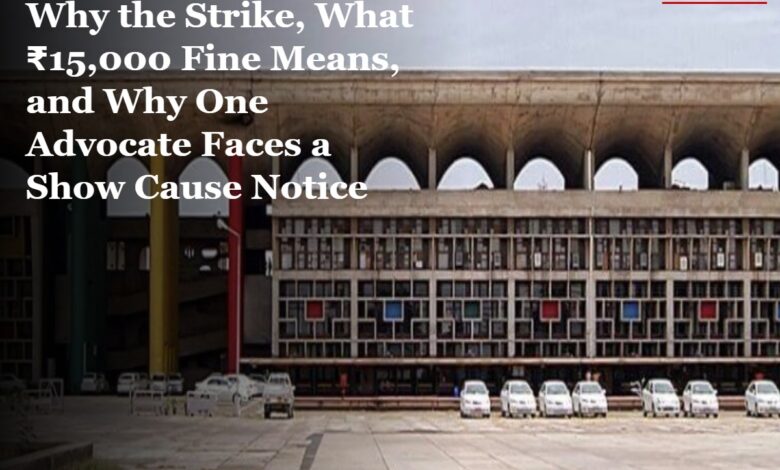
Punjab, Haryana Lawyers Strike: What is the Legal Aid Defence Counsel System, why are Punjab and Haryana lawyers boycotting court work over it, and why does a ₹15,000 fine and a Show Cause Notice against advocate Arvind Seth matter? A Q&A explainer.
North Desk Correspondent
Chandigarh, July 29
Q: What did the Punjab & Haryana High Court Bar Association decide on July 28?
Punjab, Haryana Lawyers Strike: At a General House meeting held that afternoon, the PHHCBA resolved to extend the suspension of work at the High Court, in support of the ongoing agitation by district bar associations against the Legal Aid Defence Counsel (LADC) System. The resolution said that from 2 PM on July 28 onward, no advocate — or anyone from their office — would appear before the Court during the suspension period. Any member found appearing, in person or via video conferencing, would face a fine of ₹15,000 and be debarred from HCBA membership. The General House also decided to press the Bar Council of Punjab and Haryana to suspend the licences of LADC lawyers, with that suspension order to be placed before the House again on July 30 at noon.
Q: What exactly is the LADC System, and why has it become a flashpoint?
Punjab, Haryana Lawyers Strike: The Legal Aid Defence Counsel System is a NALSA-run mechanism for providing legal representation to undertrials and the poor. It began as a pilot in 17 states and Union Territories and has since expanded nationwide; it’s now operational through roughly 680 district LADC offices across 37 states and UTs. Under this system, the District Legal Services Authority (DLSA) appoints salaried defence counsel, replacing the older “panel advocate” system, in which private lawyers were empanelled and paid case-by-case.
Bar bodies in Punjab say the shift has hit their livelihoods directly. A Bar Council of Punjab and Haryana sub-committee member, Karanjit Singh, said the LADC system currently handles an estimated 10-18% of criminal cases filed annually in several Punjab districts, with thousands of matters going to salaried LADC lawyers each year.
He said younger advocates, who get no stipend during their early years of practice, have been hit hardest, particularly in smaller district bars where work opportunities are already limited. The Bar Council has separately argued that the present LADC structure has created a parallel, state-funded criminal defence mechanism that has pulled substantial criminal work away from independent practitioners.
Q: How long has this agitation been running?
Punjab, Haryana Lawyers Strike: Well over three weeks by July 28. District bar associations across Punjab began a “No Work” protest that had crossed 22 consecutive days by July 28, with relay hunger strikes at the district level and demonstrations outside court complexes. The PHHCBA itself first suspended High Court work for a day on July 24 “in solidarity” with the protest, before Tuesday’s General House meeting extended it indefinitely. Lawyers have also announced plans to escalate to a sit-in at Jantar Mantar in Delhi, and to send individual representations to the Chief Justice of India.
Q: Is this the first time a fine has been attached to defying the strike?
No…and the numbers show an escalation. The District Bar Association, Chandigarh, had already passed a similar resolution on July 27, abstaining from work with effect from that date and fixing a fine of ₹2,500 (plus disciplinary action and debarment) for any member who appeared in court despite the boycott.
The HCBA’s own figure, set the very next day, is six times higher at ₹15,000.
Comparable disputes elsewhere have seen similar mechanisms — in Haryana’s Rohtak, a ₹11,000 penalty imposed by a bar body on an advocate who appeared in court during an earlier strike ultimately led to a High Court challenge and disciplinary proceedings against the bar’s own president under the Advocates Act.
Q: What is the High Court doing about the disruption to litigants?
Punjab, Haryana Lawyers Strike: The Court has been actively engaged since July 20, when it first heard a petition — CWP-PIL-181-2026 — filed by advocate Arvind Seth, appearing in person, seeking directions to restore normal judicial functioning. A Division Bench of Acting Chief Justice Ashwani Kumar Mishra and Justice Rohit Kapoor initially expressed hope that “wiser heads” within the Bar would resolve the matter without judicial intervention, and adjourned repeatedly — first to July 23, then July 27 — as the Bar and the Court’s administrative side worked through the concerns.
On July 27, the Registrar General circulated a detailed set of directions to judicial officers and DLSA secretaries meant to address the Bar’s grievances about LADC implementation. These include: DLSA secretaries alone will assign LADC counsel; no LADC lawyer may take a power of attorney directly from a jailed accused; if a private lawyer is willfully absent, the presiding officer must first record that absence and give the accused or their counsel a further chance before an LADC is appointed; and LADC counsel must strictly follow professional ethics and not solicit work.
Despite this, when the matter came up again on July 28, the Court noted that its oral observations from the previous hearing — where it had voiced “pain and anguish” over 27 days of blocked access to justice — had been “misquoted at certain forums.” The Bench reiterated that denial of access to justice to the common litigant “would be a failure on the part of the entire justice delivery system, which cannot be permitted,” and adjourned the matter to July 30 at the request of both sides, who sought one more opportunity for talks.
Q: What is the Show Cause Notice against Arvind Seth about?
Punjab, Haryana Lawyers Strike: At the same July 28 General House meeting where it extended the work suspension, the HCBA also resolved to issue a Show Cause Notice to Seth over his filing of PIL 181/2026 — the very petition the High Court has been hearing on the strike’s impact on litigants. The HCBA’s internal notice describes the filing as “contrary to the legal fraternity.” It is a notable moment: a practicing member of the Bar approached the Court on behalf of affected litigants, and is now facing an internal disciplinary query from his own professional association over that filing.
Q: Punjab, Haryana Lawyers Strike: What happens next?
Two dates matter. On July 29, advocates across Punjab, Haryana and Chandigarh are set to observe a separate “no-work day,” called by the Bar Council sub-committee, reinforcing the demand for a rollback of the LADC system. On July 30, both the High Court (in CWP-PIL-181-2026, at the parties’ request) and the HCBA’s General House (to review the Bar Council’s licence-suspension order for LADC counsel) reconvene — making it the likely inflection point for whether the standoff eases or hardens further.
READ ALSO: HC To Visa Fraud Accused: Publish Your Own Criminal Record in 5 Newspapers
READ ALSO: Dera Sacha Sauda Violence Case: How Forensics Sank Haryana’s Kaithal Dera Violence Case
Follow North Desk on WhatsApp for the latest from Punjab, Haryana and Himachal Pradesh: https://whatsapp.com/channel/0029Vb7ccdxJENy2H87DBG3E