Can Police Re-Arrest You After Release? Supreme Court Draws the Line in Punjab Case
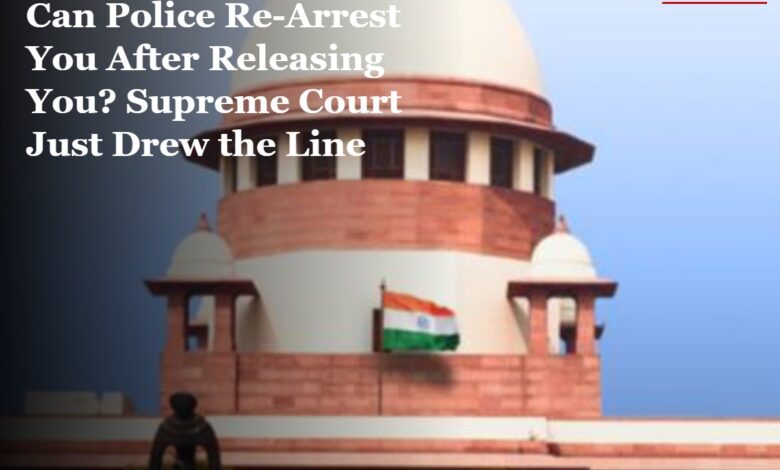
Can police re-arrest you after release? Supreme Court rules Punjab police need a magistrate’s approval, not just their own discretion; Mohali POCSO case explains why.
North Desk Correspondent
Chandigarh, September 24
If police arrest you and a magistrate later frees you because they broke the rules while arresting you, can the same police just show up and arrest you again?
Until last week, the honest answer in much of the country was: probably, and there wasn’t much you could do about it. The Supreme Court has now closed that gap.
In this week’s judgment, a bench of Justices Ujjal Bhuyan and Atul S. Chandurkar ruled that once police have violated a person’s constitutional rights during an arrest, the decision on whether to re-arrest that person cannot be left to the same police force that committed the violation. It now needs a magistrate’s approval — and, for the first time, a formal endorsement from a senior officer acknowledging the original violation before any fresh custody bid can even be filed.
The ruling applies nationwide, to every police force and every offence. But it grew out of a very local case: an FIR at Mataur police station in SAS Nagar, Mohali that shows exactly why the gap needed closing.
The case behind the ruling
Can Police Re-Arrest You: The case involves Jaskaran Jeet Singh Deol, who was arrested on May 17 in connection with an FIR registered at Mataur police station. The FIR was filed by the father of a minor girl, alleging that his wife had left him in October-November 2024 and moved in with Deol, taking their two daughters with her. The informant told police that his elder daughter returned to him on May 9 this year and disclosed physical and sexual abuse by Deol dating back to late 2024. The FIR invoked sections of the Bharatiya Nyaya Sanhita and Section 6 of the POCSO Act.
The Supreme Court has been explicit that it has expressed no view on the truth of these allegations — its ruling concerns only the constitutional procedure police followed, not Deol’s guilt or innocence.
Two rules police broke, and what happened because of it
Can Police Re-Arrest You: Deol was arrested at 7:54 am on May 17. He wasn’t produced before a magistrate until noon the next day — more than 24 hours later, in breach of Article 22(2) of the Constitution, which requires anyone arrested to be produced before a magistrate within 24 hours.
Worse, when he finally was produced, police still hadn’t given him written grounds for his arrest — a separate right under Article 22(1). The Magistrate, citing the Supreme Court’s recent ruling in Mihir Rajesh Shah v. State of Maharashtra, ordered Deol released immediately and flagged the officers for action, while clarifying that police could still seek custody later if they got the process right.
That same day, the same Station House Officer, Rupinder Singh, filed a fresh custody application but it went before a different magistrate, the Additional Chief Judicial Magistrate, who threw it out on May 22 because it had effectively been filed before Deol had been properly arrested and informed of the case against him at all.
Deol then went to the Punjab and Haryana High Court, asking it to permanently bar police from ever re-arresting him. On May 29, the High Court refused, ruling that as long as any future arrest followed proper procedure, police couldn’t be blanket-barred from seeking it, and that Deol’s only remedy for the illegal 24-hour detention was to separately sue the officers involved.
Can Police Re-Arrest You: Why the Supreme Court stepped in
Can Police Re-Arrest You: The Supreme Court agreed police shouldn’t get a free pass just because a case is serious, but disagreed that the fix was to leave re-arrest entirely to police discretion. Its concern: if the same force that broke the rules can freely re-arrest someone the moment a court sets them free, the constitutional protection is essentially meaningless: a person could be illegally held, released, and picked up again in the same afternoon.
So the Court laid down a new two-layer check. If police still want custody of someone released over an Article 22 violation, they must now:
- File a fresh application before the magistrate explaining why re-arrest is necessary
- Formally explain, in writing, why the grounds of arrest weren’t supplied the first time
- Get the application endorsed by a senior officer before filing it; so someone above the arresting officer is on record as aware a constitutional violation occurred
- Have the magistrate rule on it within a week
The Court said this applies whether the violation was of Article 22(1) (not being told why you were arrested) or Article 22(2) (not being produced before a magistrate within 24 hours) — and for 24-hour violations specifically, High Courts can also order compensation, separate from any private civil suit the person may choose to file.
The officers involved have already been disciplined
According to affidavits the Punjab government filed during the case, action has already been taken. ASI Gurtej Singh, who arrested Deol without giving him written grounds, has been suspended.
Inspector Rupinder Singh, the SHO who filed the flawed custody application, has been removed from that post and transferred to the Police Lines. A departmental inquiry into both officers is being led by SP (Investigation) Saurabh Jindal, and the FIR investigation has since been handed to a new SHO, Inspector Amandeep Singh.
Despite the setback, police did obtain fresh arrest warrants against Deol on May 23 and again on July 14, 2026, but the state says he could not be apprehended and was evading arrest.
ALSO: Chawla Rape Case: Harpreet Singh Alleges Woman Was Brought to Defame Him
Follow North Desk on WhatsApp for the latest from Punjab, Haryana and Himachal Pradesh: https://whatsapp.com/channel/0029Vb7ccdxJENy2H87DBG3E




One Comment