Delimitation Bill 2026: What it means for Punjab, Haryana
What is the Centre’s plan to redraw India’s electoral map, how will it affect Punjab and Haryana, and why has it become a political flashpoint?
North Desk Correspondent
Chandigarh, April 16
A special session of Parliament beginning April 16 is set to consider one of the most consequential reshapes of Indian democracy in decades. The government calls it about women’s empowerment. The opposition calls it a Trojan horse. Here is what is actually happening — in plain words.
What is delimitation?
Delimitation means redrawing the boundaries of Lok Sabha (parliamentary) and Vidhan Sabha (state assembly) constituencies, and deciding how many seats each state gets. It is done on the basis of population data from a census.
The current freeze on delimitation — meaning Lok Sabha seat allocation has remained unchanged since 1971 — is the result of two successive constitutional amendments: the 1976 amendment, which froze the definition of the “last preceding census” in Articles 81 and 82 to mean the 1971 Census; and the 2001 amendment, which extended that freeze until “the relevant figures for the first census taken after the year 2026 have been published.” In simple terms: India’s parliamentary seats have been frozen at 543 for over 50 years, and the rules said this could not change until after a post-2026 census.
What has the government proposed now?
The Union government has unveiled a three-bill legislative package that could fundamentally reshape political representation in India. Together, these bills aim to restart India’s stalled delimitation process, lift the decades-long freeze on seat readjustment, significantly expand the Lok Sabha to 850 seats, and then operationalise women’s reservation in legislatures.
The three bills are: the Constitution (131st Amendment) Bill, 2026; the Delimitation Bill, 2026; and the Union Territories Laws (Amendment) Bill, 2026.
The proposed legislation seeks to amend Article 81 of the Constitution and provides for a Lok Sabha comprising not more than 815 members elected from states and up to 35 members representing Union territories. To redraw constituencies, the bill proposes using population data from the 2011 Census, the latest available official figures.
Why now — and what does women’s reservation have to do with it?
The Women’s Reservation Bill (Nari Shakti Vandan Adhiniyam) was passed in September 2023. It guarantees one-third of Lok Sabha and assembly seats to women. But under the existing framework, implementation was linked to the completion of the next Census and delimitation exercise, potentially delaying it until 2034. The proposed amendments aim to advance its rollout, with the government targeting implementation ahead of the 2029 Lok Sabha elections.
The Centre’s argument: do the delimitation now, on the 2011 Census data, so women’s reservation can begin from 2029.
How will seats be calculated?
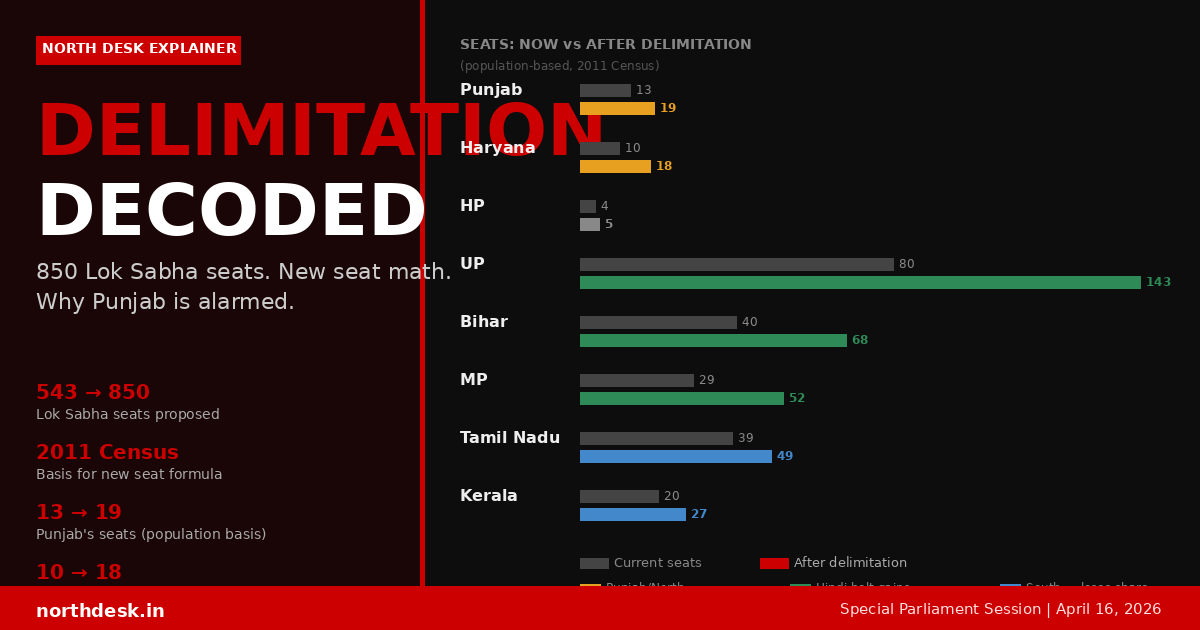
The rough formula is: divide India’s 2011 population of 1.2 billion by 850. The figure this yields is 14 lakh. Then divide the 2011 population of every state by 14 lakh to get the number of seats that state will have in an 850-member Lok Sabha. This calculation will hold if population-based delimitation is done.
What does it mean for Punjab, Haryana, and Himachal?
Punjab’s population in 2011 was 2.77 crore. Dividing by 14 lakh yields 19 seats — an increase of 6 from the current 13. Under a proportional system, Punjab’s share would remain unchanged, translating to around 20 seats.
Haryana currently has 10 Lok Sabha seats. Dividing its 2011 population of 2.53 crore by 14 lakh yields 18 seats — a gain of eight seats. Under proportional representation, Haryana would have 16 seats instead of 18.
Himachal Pradesh, with a 2011 population of 68.6 lakh, would have about 5 seats in an 850-member House — compared to 4 at present.
At first glance, these are gains. So what is the objection?
The catch: a bigger slice of a much bigger pie
The real concern is not about raw seat numbers but about proportional power — each state’s share of the total Lok Sabha. The opposition says the government has proposed to raise Lok Sabha strength up to 850 without promising proportional representation to states. South states currently have 24 per cent representation in the Lok Sabha. This, in the 850-MP Lok Sabha, would reduce to 20 per cent. Whereas, the five northern states which have 37 per cent representation in Lok Sabha now would have 43 per cent representation in the new Lok Sabha.
As an example, UP has 80 seats (14.7 per cent share) in the current 543-member Lok Sabha. This would increase to 143 seats in an 850-member Lok Sabha — a rise of 63 seats, with its share going up to 16.8 per cent. But Tamil Nadu, which has 39 seats and 7.2 per cent share in the current Lok Sabha, would add only 10 seats and have 49 seats in the new Lok Sabha, but its proportional share would fall.
Punjab faces the same arithmetic: more seats in absolute terms, but its voice diluted against a far-larger Hindi belt bloc.
Why is Punjab specifically upset?
The argument being made by Akali Dal and Congress — and echoed by Bhagwant Mann — is that Punjab followed national population control goals. It kept its birth rate in check, invested in education and health, and as a result has a smaller (and more stable) population than states that did not.
Under a population-based formula, this responsible record becomes a punishment: states with high population growth get more seats, while states with controlled growth stagnate or relatively decline.
Akali Dal president Sukhbir Singh Badal said Punjab would get only a nominal increase while Haryana would see its seats nearly double. He called it “brazenly discriminatory” and warned that the move would hand control of Parliament to four Hindi heartland states — UP, MP, Bihar, and Rajasthan — giving them a combined strength of over 40 per cent.
Punjab Congress president Amarinder Singh Raja Warring said the states at a disadvantage — Punjab, Tamil Nadu, Kerala — were precisely those that had rejected the BJP, while the states set to gain were BJP strongholds. He demanded that the AAP government call a special session of the Punjab assembly and pass a resolution against delimitation.
What does the government say?
The government has clarified that the seats in the new Lok Sabha would be proportional only. “We will see a 50 per cent increase in current seats for every state. No injustice would be done to any state. Misreading of the Bills must be avoided,” it said, adding that nuances would be clarified during parliamentary debate.
What happens next?
The new Delimitation Commission will determine the number of Lok Sabha seats allocated to each state and Union Territory, set the total strength of state assemblies, redraw parliamentary and assembly constituencies, and identify seats reserved for Scheduled Castes, Scheduled Tribes, and women. Once the Commission’s orders are published in the Gazette of India, they will have the force of law and cannot be challenged in court.
The constitutional amendment requires a special majority. The two other bills need only a simple majority. With the BJP issuing a three-line whip to its MPs, the bills are expected to pass — unless the government faces significant defections or agrees to amendments.
REACTIONS
Sukhbir Singh Badal (SAD):
Called delimitation “a death blow to the federal structure” and said it was a conspiracy to hand control of India to four Hindi heartland states. Announced an all-party initiative in Punjab to oppose the move.
Amarinder Singh Raja Warring (Congress):
Called it the “BJP’s hidden attack” on states like Punjab. Threatened mass mobilisation and challenged AAP to call a special assembly session.
Bhagwant Mann (AAP/Punjab CM):
Has previously accused the BJP of “dirty tricks” and attended the anti-delimitation meeting hosted by Tamil Nadu CM Stalin in Chennai in March 2025.