Drishyam The Conclusion Ending Explained: The Wiretap Trap, Church Grave Swap and Final Verdict
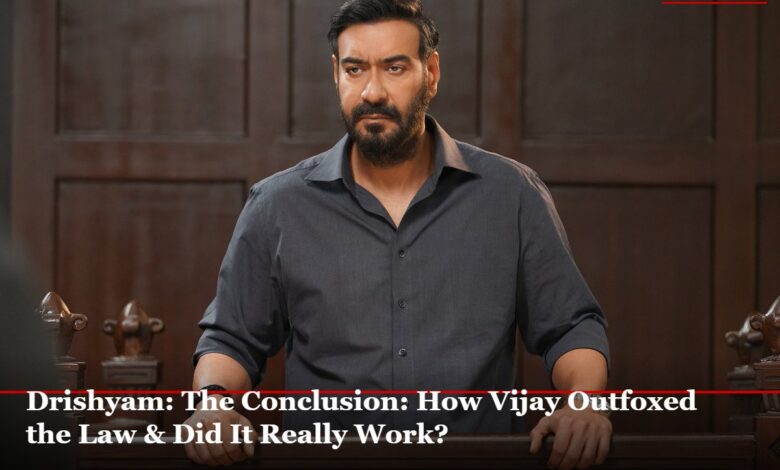
Drishyam The Conclusion ending explained: how Vijay manipulated the police wiretaps, the church grave swap twist, and whether he finally gets caught.
By North Desk Bureau
Drishyam The Conclusion Ending Explained: When Abhishek Pathak announced Drishyam: The Conclusion, the burning question wasn’t just whether Vijay Salgaonkar (Ajay Devgn) would survive another police dragnet. It was whether the franchise could pull off a third high-stakes masterstroke without collapsing under the weight of its own mythology.
With the film having hit cinemas and already crossing major box office milestones, viewers are rushing to break down the climactic twist. Unlike the Malayalam parallel written by Jeethu Joseph, the Hindi adaptation branches off in its own direction—introducing high-intensity legal duels, a formidable new investigator, and an alibi mechanism that flips electronic surveillance on its head.
Here is the complete, beat-by-beat breakdown of the climax of Drishyam: The Conclusion, how Vijay pulled it off, and the plot debates currently dividing the fanbase.
(Warning: Major spoilers ahead for Drishyam: The Conclusion)
The New Threat: Why the Old Playbook Wouldn’t Work
ALSO: Drishyam The Conclusion Story Explained: What Happens in The Film
Drishyam The Conclusion Ending Explained: In the first film, Vijay relied on human memory manipulation—the classic October 2 Panaji trip, Swami Chinmayananda’s satsang, and movie tickets. In Drishyam 2, he pre-empted physical forensics by swapping the skeletal remains inside the police morgue before DNA testing could nail him.
In Drishyam The Conclusion, Crime Branch officer Rajveer Singh Tomar (Jaideep Ahlawat) knows Vijay cannot be broken through standard interrogation or circumstantial alibis. Instead, the prosecution—led by seasoned legal counsel Indrajith Shetty (Prakash Raj)—takes aim at “electronic surveillance and internal family fissures”.
Wiretaps, covert audio monitoring, and intense psychological pressure on Nandini (Shriya Saran) and Anju (Ishita Dutta) become the state’s primary weapons. Vijay realizes early on that he can no longer just hide evidence; he has to feed the police synthetic evidence they believe they uncovered themselves.
The Climax Explained: The Audio Deception
Drishyam The Conclusion Ending Explained: The turning point of the investigation comes when the police intercept what they believe is an authentic, in-home confession. Believing they have caught Vijay off-guard in private conversation, the prosecution prepares to strike in court.
However, the final courtroom revelation turns the wiretap on its head:
1. Pre-recorded Dialogue: Vijay had realized the family home and phones were under advanced surveillance.
2. The Rehearsed Script: Rather than speaking naturally, the family was acting against a meticulously timed pre-recorded audio track.
3. Inadmissible Evidence: The police believed they were listening to a live, spontaneous confession. When Vijay’s defense proves that the audio captured was a pre-scripted rehearsal designed to expose unlawful electronic eavesdropping, the prosecution’s star evidence collapses under legal scrutiny.
Vijay’s legal doctrine remains unchanged: “A theory is not evidence, and suspicion is not proof.” He doesn’t need the judge to believe he is an innocent angel; he only needs the prosecution’s narrative to contain reasonable doubt.
The Church Grave Swap: Did Vijay Really Pull It Off?
Drishyam The Conclusion Ending Explained: The second critical pillar of Drishyam The Conclusion revolves around the exhumation of remains. With the police pushing for a fresh exhumation from a cemetery to locate the real body, Vijay anticipates the move.
Working alongside local confidants, Vijay ensures that when the authorities open the designated coffin under court supervision, what they find does not match the prosecution’s claim. By weaponizing bureaucratic overconfidence, the police are left red-faced in front of the local community and the judicial bench.
Because the prosecution boldly asserted the coffin would be empty or yield specific remains, the presence of the substitute skeleton completely discredits the state’s petition. No judge would sanction an open-ended, repeated desecration of graves without concrete probable cause—effectively sealing the case forever.
Drishyam The Conclusion Ending Explained: Is Vijay Salgaonkar Finally Caught?
No. Vijay Salgaonkar walks out of the courtroom a free man. The state’s charges against him and his family collapse due to lack of admissible, corroborating evidence.
Yet, Drishyam The Conclusion deliberately avoids framing this as an unadulterated triumph.
Drishyam The Conclusion Ending Explained:
The Lingering Cost: The trauma inflicted on Anju and Nandini over years of harassment cannot be undone by an acquittal.
Meera Deshmukh’s Resentment: The film ends with a piercing shot of Meera (Tabu). In Drishyam 2, there was a semblance of closure when the ashes were handed over. Here, Meera’s quest has hardened from seeking justice into lifelong, unresolved bitterness. Vijay has outplayed the Indian Penal Code, but he has not escaped the moral vacuum created by Sameer’s death.
Why the Ending Has Divided the Audience
While the film is raking in numbers, long-time franchise purists have pointed out several narrative friction points online:
1. The Exhumation Timeline: Critics argue that swapping a coffin’s contents beneath modern church ground without leaving obvious soil disruption or concrete tampering stretches procedural logic to its absolute limit.
2. The Underutilized Antagonist: Jaideep Ahlawat brings swagger, tension, and razor-sharp screen presence as Rajveer Singh Tomar. However, fans have noted that despite his menacing setup, the script ultimately forces him to make elementary procedural blunders to let Vijay triumph.
3. The Closure Conundrum: Many felt Drishyam 2 provided an emotionally satisfying thematic closure, whereas Drishyam The Conclusion elevates Vijay almost to mythical mastermind status at the cost of emotional realism.
Whether you view it as the ultimate triumph of a protective father or an over-engineered cinematic escape, one thing is certain: Vijay Salgaonkar remains the most cunning protagonist Hindi commercial cinema has ever seen.
Quick FAQ Schema
Does Vijay Salgaonkar get arrested in Drishyam: The Conclusion?
No. The prosecution fails to produce legally admissible evidence, and the court officially acquits the Salgaonkar family.
Is Drishyam: The Conclusion different from the Malayalam version?
Yes. Co-writer and director Abhishek Pathak developed a distinct screenplay featuring new characters like Jaideep Ahlawat’s investigator and Prakash Raj’s lawyer, leading to a different tactical resolution.
Will there be a Drishyam 4?
While the film is billed as Drishyam The Conclusion, Ajay Devgn has noted that while this marks the definitive end for now, franchise avenues in cinema are never 100% closed if an extraordinary concept emerges.
ALSO: Drishyam The Conclusion Story Explained: What Happens in The Film
ALSO: Drishyam The Conclusion Reviews: Critics Rate Ajay Devgn’s Finale
Follow North Desk on WhatsApp for the latest from Punjab, Haryana and Himachal Pradesh: https://whatsapp.com/channel/0029Vb7ccdxJENy2H87DBG3E





3 Comments