1984 Massacre: ‘200 Murders in One FIR’: Ex Judge Dhingra on How Trials Were Rigged
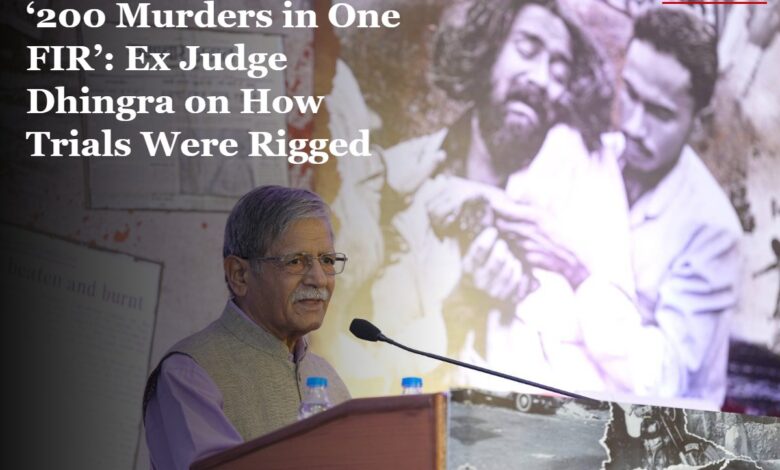
1984 Massacre: Speaking in Chandigarh, former judge Justice SN Dhingra exposed how the state sabotaged 1984 anti-Sikh massacre justice using omnibus FIRs, stalled trials, and vanished files.
North Desk Correspondent
Chandigarh, November 4
When sleuths from the Central Bureau of Investigation (CBI) arrived at senior Congress leader Sajjan Kumar’s residence at 7:00 AM to execute an arrest warrant in connection with the 1984 violence, they were asked to wait outside.
Within fifteen minutes, a coordinated mob had cordoned off the house, shouting down the agency’s officers. The local police brass refused to dispatch backup. Before the standoff could resolve, Kumar’s lawyers had already secured anticipatory bail before noon.
Later, the CBI placed a startling affidavit on record before a special court: the official police case file containing key evidence against Kumar was in the physical possession of his private defence attorney.
That was one of several damning behind-the-scenes revelations shared in Chandigarh on Monday by Justice Shiv Narain Dhingra (Retd.), former Delhi High Court judge who later chaired the Supreme Court-appointed Special Investigation Team (SIT) in 2018 to review closed cases from the violence.
Speaking at the ‘Zakhm 84 De’ conclave alongside senior human rights advocate H.S. Phoolka and former Nanavati Commission counsel Ashok Kashyap, Justice Dhingra pulled back the curtain on how successive political administrations, law enforcement agencies, and the judicial system engineered what he called a procedural “sham and a fraud” on the victims.
1984 Massacre: ‘Every Riot is Managed, Never Spontaneous’
1984 Massacre: Addressing a room filled with survivors and legal observers, Justice Dhingra dismissed the long-peddled official narrative that the November 1984 killings across Delhi were an organic eruption of communal anger following the assassination of Prime Minister Indira Gandhi.
“Every riot is managed; it never happens on its own,” Justice Dhingra stated bluntly. “Riots have unfortunately evolved into an instrument of Indian politics, carried out by people looking to curry favour with political masters. In 1984, mobs from resettlement colonies were mobilized, armed, and handed specific voter lists to target Sikh households.”
He recalled how ordinary citizens in several Delhi neighbourhoods organized their own civil defense committees to prevent outside mobs from entering, exposing the complete dereliction of duty by the Delhi Police, which stood by as targeted killings continued unchecked.
The 200-Murders Omnibus Trap
1984 Massacre: Drawing upon his tenure as an Additional Sessions Judge at Delhi’s Karkardooma Court—which held jurisdiction over East Delhi localities like Trilokpuri and Kalyanpuri where some of the worst atrocities took place—Justice Dhingra explained how investigators exploited legal technicalities to kill prosecutions before trials even began.
Under the Code of Criminal Procedure, a trial court cannot legally club more than three separate offences together in a single trial. Aware of this statutory restriction, the local police lumped over 200 distinct homicides from East Delhi into a single, omnibus FIR.
“Police had registered just one case for 200 murders. How can 200 murders be tried in one single charge?” Justice Dhingra asked.
When he summoned the public prosecutor to explain the legal absurdity, the prosecutor disclosed that an application to split the omnibus case into individual chargesheets had been pending without action for three full years.
“I pulled out that application from the files and ordered that separate chargesheets be framed for each individual murder. That single FIR was split into 200 separate criminal cases, and only then could the trials finally begin,” Dhingra said.
That single judicial intervention forced key political patrons, including former Union Minister H.K.L. Bhagat and local municipal councillors accused of inciting mobs, to formally face prosecution.
The Engineered 8-Year Delay
1984 Massacre: One of the most insidious methods used to scuttle cases, according to Justice Dhingra, was the successive deployment of inquiry commissions whose real objective was to run out the clock.
Between 1984 and 1992, multiple committees and commissions—including the Justice Ranganath Misra Commission, the Kapur-Mittal Committee, and the Poti-Ahuja Committee—were formed and subsequently dissolved. Formal FIRs in dozens of heinous cases were not registered until 1992, eight years after the carnage occurred.
When these delayed cases finally landed in trial courts, defence attorneys representing high-profile accused routinely argued that the “unexplained eight-year delay in lodging FIRs” warranted immediate discharge or acquittal.
“The courts remarked that the delay of eight years was unexplained,” Justice Dhingra noted. “It was shocking. Did they not know the history? That government-appointed committees kept sitting on evidence, and the FIRs were registered only when these panels finally ordered them? The delay was manufactured by the system itself.”
Phantom Accused and Deliberate Non-Appeals
1984 Massacre: The former judge also detailed how trial dockets were systematically compromised from within:
- Prosecuting the Wrong Men: In multiple cases, police chargesheets originally named five specific individuals, but during the actual court proceedings, entirely different persons were put on trial and subsequently acquitted due to lack of evidence.
- No Appeals on Acquittals: When lower courts handed down routine acquittals due to sabotaged investigations or hostile witnesses, state prosecutors deliberately refused to file appeals before higher judicial forums, cementing permanent legal immunity for the accused.
‘Is an Acquittal After 20 Years Called Justice?’
1984 Massacre: Justice Dhingra’s critique extended beyond individual political figures to the systemic flaws of India’s colonial-era criminal justice framework, noting that the national conviction rate hovers at an abysmal six percent.
“You often hear about someone being acquitted after 20 or 30 years in court. Is an acquittal justice?” Dhingra asked. “Someone committed the crime. Thousands were murdered. If the individual brought before the bench didn’t do it, then who did? Whose constitutional duty was it to track down the killer? Our criminal procedure today lacks an institutional mandate to deliver real justice.”
While acknowledging that landmark convictions—including the life sentence handed down to Sajjan Kumar—were finally secured following the constitution of a fresh SIT by the Centre, Justice Dhingra warned that without structural overhauls to police accountability and prosecution oversight, the institutional subversion seen in the 1984 cases remains a persistent threat across India’s justice machinery.
LPU Rape Case Truth: THE GHOST IN HOSTEL GH-3 — EXCLUSIVE
Follow North Desk on WhatsApp for the latest from Punjab, Haryana and Himachal Pradesh: https://whatsapp.com/channel/0029Vb7ccdxJENy2H87DBG3E