Diljit Dosanjh & Khalistan Row: Traitor to Separatists, Target of Trolls—Where Does He Really Stand?
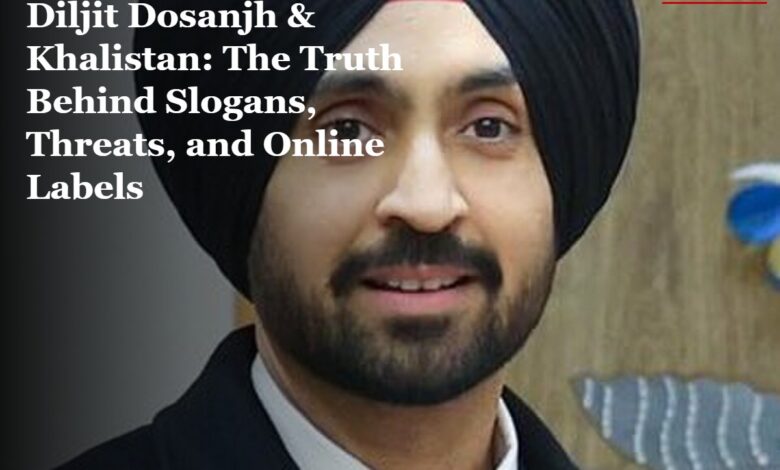
Diljit Dosanjh & Khalistan: Caught between separatist threats and online nationalist trolling, what is the real story behind Diljit Dosanjh and the Khalistan row? We break down the facts.
North Desk Correspondent
Chandigarh, November 2
Diljit Dosanjh & Khalistan: Whenever global Punjabi sensation Diljit Dosanjh hits a career peak or packs a stadium, an old, persistent headline resurfaces on search trends: “Diljit Dosanjh Khalistan link.”
The query spiked again after Delhi Police’s Special Cell arrested three individuals for scrawling pro-Khalistan graffiti at the Shastri Nagar and Jahangirpuri Metro stations in Delhi. But the reality behind the spray-painted walls flips internet rumours on their head: the graffiti—orchestrated by the banned separatist group Sikhs For Justice (SFJ)—did not praise the superstar; it branded him a “quam da gaddar” (traitor to the community) and threatened retribution.
This incident captures the tightrope Diljit walks: in India, online trolls frequently attack him as a separatist sympathizer; abroad, actual separatists threaten him for championing a united Indian identity on global stages.
Here is a fact-checked timeline of how Diljit Dosanjh became a target for both sides, what he has said on record, and why the crossfire refuses to die down.
Diljit Dosanjh & Khalistan–The Trigger: Why Did Khalistani Separatists Turn on Diljit?
For years, fringe separatist elements abroad sought to piggyback on Diljit’s monumental diaspora appeal. However, his refusal to endorse separatist politics has triggered overt hostility.
- The Kaun Banega Crorepati Controversy:
The primary friction with SFJ flared when Diljit appeared on Kaun Banega Crorepati alongside Amitabh Bachchan and touched the veteran actor’s feet in reverence. Hardline groups, citing disputed allegations regarding Bachchan’s remarks around the 1984 anti-Sikh violence, immediately issued video ultimatums against Diljit, accusing him of betraying the community’s sentiments.
- Flag Confrontations at Canadian Concerts:
During tour stops in Canada, fringe protestors attempted to raise Khalistani banners inside his concerts. Rather than entertaining the disruptions, Diljit had security intervene and addressed the audience directly: “The issue is not about a piece of cloth; it is about the intention to divide,” maintaining that his art exists to bring Punjabis and Indians together.
- Delhi Metro Graffiti and Native Village Threats:
The latest flare-up saw SFJ recruiters paying local recruits cash to vandalize Delhi Metro stations and walls in Diljit’s native village, Dosanjh Kalan in Punjab, threatening revenge because of his unapologetic mainstream Indian tour.
The Other Side: Why Do Online Critics Label Him a Sympathizer?
Diljit Dosanjh & Khalistan: The narrative claiming Diljit has “separatist leanings” does not originate from police dossiers or official intelligence; it stems almost entirely from polarized social media discourse:
- The 2020 Farmers’ Protest:
Diljit’s vocal backing of the year-long agitation against the three farm laws—including his high-profile social media spar with actor Kangana Ranaut and his physical appearance at the Singhu border to distribute warm clothes—drew the ire of hyper-nationalist social media accounts. During that politically charged window, critics began weaponizing the “Khalistani” slur against him and several other Punjabi artists who spoke in favor of farmers.
- The “Punjab First” Cultural Aesthetic:
Diljit unabashedly centers his Sikh identity, Punjabi dialect, and folk heritage. In an era where regional pride is sometimes mischaracterized on social media as anti-national dissent, critics have repeatedly conflated his assertion of Punjabi cultural identity with political separatism.
In His Own Words: “I Get Abused by Both Sides”
Diljit Dosanjh & Khalistan: Diljit has rarely entertained sensationalist political debates, but he addressed the double-edged sword during an emotional moment on stage while on his global tour:
“When I go to India, some say, ‘Look, the Khalistani has arrived.’ When I come here [abroad], separatists attack me and call me a traitor. I get abused from both political sides. I don’t know where to go. There is only one path I know—the middle path of humanity, unity, and love.”
He has reiterated his commitment to unity:
“For me, this earth is one. My Guru says, ‘Ik Onkar.’ I was born of this soil, I am of this land, and I will return to it. My only message is love, regardless of who trolls or envies me.”
From waving the Indian tricolor on international festival stages like Coachella to starring as an Indian Air Force officer in mainstream patriotic cinema, Diljit’s career contradicts the separatist tag.
The Cultural Squeeze on Punjabi Artists
Diljit Dosanjh & Khalistan: The attacks on Diljit Dosanjh highlight a broader cultural vulnerability. Modern Punjabi global artists command massive diaspora followings across Canada, the UK, and the US, where separatist elements actively seek cultural validation. When these artists perform across India, collaborate with Bollywood, and hoist the tricolor, fringe outfits brand them “traitors”.
Simultaneously, domestic internet echo chambers remain quick to cast suspicion whenever an artist champions minority or regional pride.
The police investigation in Delhi proves what the music industry has observed for months: Diljit Dosanjh is not an ally of the separatist movement—he is in its direct crosshairs precisely because he refuses to give it room.
ALSO: Diljit Dosanjh Delhi Concert: Defiant Star Blasts Critics After Police Hurdle
ALSO: Diljit Dosanjh’s Satluj: Here’s what Jaswant Singh Khalra Film Shows — in 10 points
Follow North Desk on WhatsApp for the latest from Punjab, Haryana and Himachal Pradesh: https://whatsapp.com/channel/0029Vb7ccdxJENy2H87DBG3E