Madhu Kishwar FIR 44: Chandigarh Police's Missing Case
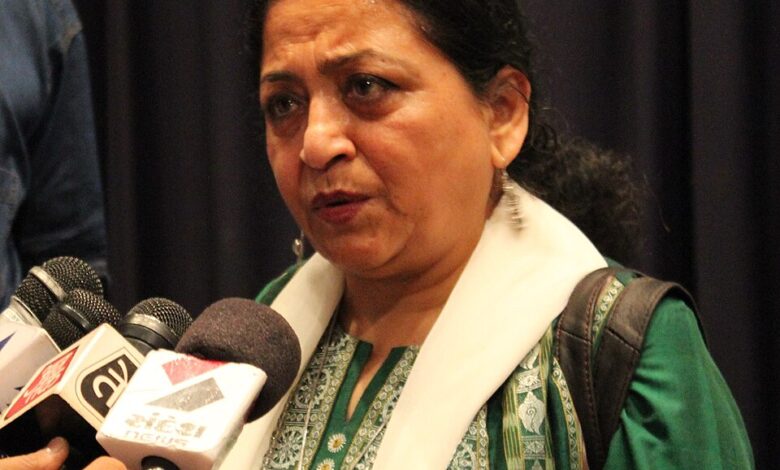
Chandigarh Police registered FIR No. 44 against scholar Madhu Kishwar — then seemingly ‘lost’ it. North Desk investigates where the case actually lives.
Arvind Chhabra
Chandigarh, April 26, 2026
Whether it’s the case of Madhu Kishwar or anyone else, it is a straightforward question: if a police station registers an FIR, where does the FIR go?
In the case of Chandigarh’s Police Station Sector-26 and FIR No. 44, the answer, it turns out, is: nobody quite knows.
Over the past three days, North Desk made two separate calls to the DSP (East), Chandigarh — the officer who oversees PS-26. Both times, the reply was identical. “We just have the DDR (Daily Diary Register) entry. Maybe cyber cell has registered the FIR.” In other words, the DSP whose jurisdiction covers PS-26 was directing a journalist to look elsewhere for an FIR that his own station is supposed to have registered.
To independently verify the gap, this reporter downloaded FIR No. 43 from the Chandigarh Police website — it pertains to a routine road accident involving an Activa scooter and an e-rickshaw. FIR No. 45 pertains to an Arms Act case. Between those two, FIR No. 44 — the case against scholar and academician Madhu Purnima Kishwar — does not appear. It has not been uploaded. And when you try to download it, this message pops up: “No record exists in the system for the selected condition.”
The accused has not received a copy. And the station that supposedly registered it cannot confirm with certainty that it, rather than cyber cell, actually owns the case.
This is the curious case of FIR No. 44.
HOW IT STARTED
On April 19, 2026, a Chandigarh resident filed a complaint at PS-26 alleging that multiple social media users had circulated video clips with obscene text and misleading content, misidentifying the person shown in the footage. According to police, the complainant alleged that a travel vlogger’s video — originally posted by his wife on social media — had been circulated out of context by several accounts with doctored descriptions. Statements of the vlogger, his wife, and another individual in the video were recorded during the preliminary inquiry stage.
On the same day, police registered FIR No. 44 at PS-26, booking Madhu Kishwar and several other social media users under Sections 196 (promoting enmity between groups on grounds of religion, race, or language), 336(1) (forgery), and 356 (criminal defamation) of the Bharatiya Nyaya Sanhita, 2023, along with relevant provisions of the Information Technology Act.
Madhu Purnima Kishwar, 73, is no ordinary social media user. A founder of the feminist journal Manushi, a former professor at the Centre for the Study of Developing Societies (CSDS) in Delhi, and a prolific commentator on politics and culture, Kishwar has been a prominent public voice — and a vocal supporter of the Modi government through much of the past decade. Her current falling out with the BJP establishment, reflected in pointed remarks she has been making on X (formerly Twitter), adds a layer of political complexity to the case.
FOUR VIOLATIONS BEFORE THE INVESTIGATION EVEN BEGAN
What happened after the FIR was registered is, in some ways, more troubling than the FIR itself. A sequence of procedural failures — each one individually significant, together forming a pattern — has given Kishwar grounds to resist all cooperation with the investigation.
First: the late-night visit. The same night the FIR was registered — April 19 — a team of Chandigarh Police officers arrived at Kishwar’s Delhi office past 10 pm to serve her a notice. Kishwar invoked the clear legal bar: under Section 46(4) of the Bharatiya Nagarik Suraksha Sanhita (BNSS), which replaced the CrPC, a woman cannot be arrested between sunset and sunrise, and police cannot visit a woman at her residence after dark except in exceptional circumstances with a woman officer present. She refused to receive them at that hour and asked the team to return in the morning. The team came back the next day.
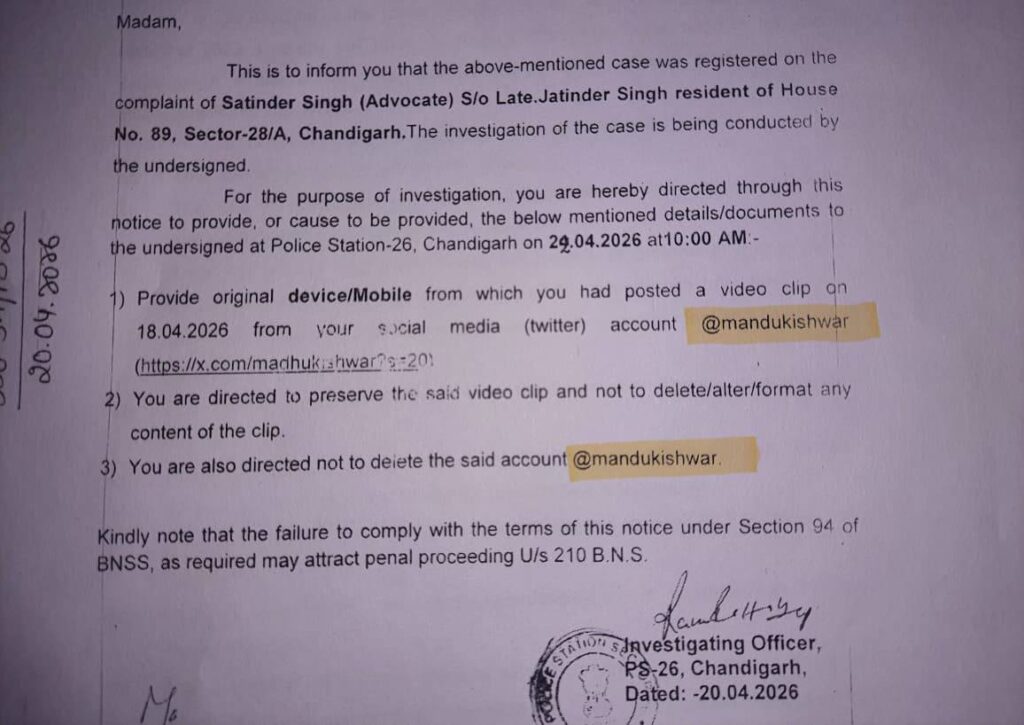
Second: the wrong identity. The notice served on Kishwar carried an incorrect X (Twitter) handle — @mandukishwar, not her actual handle @madhukishwar. This is not a trivial typographical error; in a case premised on social media posts, misidentifying the accused’s online identity strikes at the core of the accusation. Kishwar cited this discrepancy in her refusal to appear on April 22.
Third: no FIR copy. Every team that visited Kishwar in Delhi — and there were two separate teams on April 21 and April 22 — declined or was unable to give her a copy of the FIR. Kishwar formally recorded her protest in writing when accepting the second notice on April 22. She also emailed the Investigating Officer at PS-26 on April 21, assuring full cooperation provided she received a copy of the FIR. There has been no response to that email.
Fourth: not uploaded online. When Kishwar went to the Chandigarh Police website to download the FIR herself — which she had every right to do — she found that FIR No. 44 had not been uploaded, days after its registration. North Desk has independently verified this gap: FIRs No. 43 and No. 45 are available; No. 44 is not.
WHAT THE LAW SAYS — AND WHERE EXCEPTIONS APPLY
The Supreme Court’s position on FIR disclosure is unambiguous. In Youth Bar Association of India vs. Union of India (2016), the court held that a copy of the FIR must be provided to the accused person without delay, and that police are obligated to upload each FIR on their website within 24 hours of registration. Chandigarh Police has complied with neither requirement.
However, the Supreme Court’s ruling does recognise specific categories where the 24-hour online upload rule may not apply — and these are worth stating clearly, because the Kishwar case falls entirely outside them. The court carved out exceptions for FIRs involving: rape and sexual assault cases (to protect the survivor’s identity), cases under the Protection of Children from Sexual Offences (POCSO) Act, matters involving national security, and cases where upload could compromise an ongoing covert investigation or endanger a witness. These exceptions are grounded in victim protection and national security — not in administrative convenience, inter-departmental confusion, or the political sensitivity of the accused.
The FIR against Madhu Kishwar — registered under criminal defamation, forgery, and enmity-promotion provisions — falls into none of these exception categories. There is no victim whose identity needs shielding. There is no national security dimension. By any reading of the Supreme Court’s directions, Chandigarh Police has no legal cover for keeping FIR No. 44 off its website and away from the accused.
THE DSP WHO DOESN’T KNOW WHERE HIS OWN FIR IS
This brings us back to North Desk’s calls to the DSP (East). In two conversations over three days, the officer did not confirm that PS-26 definitively owns and holds FIR No. 44. His consistent position: “We have the DDR. Maybe cyber cell has registered the FIR.”
This raises a procedural puzzle that Chandigarh Police has not addressed publicly. If the FIR was registered at PS-26 — as stated in all police communications, as stated in the notice served on Kishwar, and as stated in Kishwar’s own letter to DGP Dr Sagar Preet Hooda — then PS-26 owns it. If cyber cell registered it, then the notices served citing PS-26 as the relevant station are themselves irregular. It cannot be both.
Either PS-26 has an FIR it has not shared with the accused, not uploaded online, and about which its own senior supervisory officer is uncertain — or there has been a registration anomaly that someone in Chandigarh Police needs to explain.
Also Read: HC tells Punjab you can’t plead poverty while paying full DA to IAS
THE STANDOFF CONTINUES
Kishwar skipped both summonses — April 22 and April 25 — citing the absence of the FIR copy as her primary reason. “Without a copy of the FIR, and without knowing the facts on which it was registered, how can I join the investigation?” she asked in her open letter to DGP Hooda. She has made clear she is willing to cooperate the moment she receives the document she is legally entitled to.
Kishwar, for her part, has not kept her political views to herself. “Modi Hai to Kucch Bhi Mumkin Hai,” she wrote on X, alleging that the withholding of the FIR is deliberate groundwork for her arrest. “Lawyer friends tell me this is being deliberately done to prepare the ground for my arrest.” She said she would “plead for a death sentence rather than stay in Modi sarkar’s jail.”
Whether that political framing is accurate or overwrought is a matter of interpretation. But the procedural facts are not a matter of interpretation — they are documented and, in the case of the missing FIR, independently verifiable.

2 Comments