Punjab High Court Rejects its 'No Money' Plea, Orders Full DA Payment by June 30
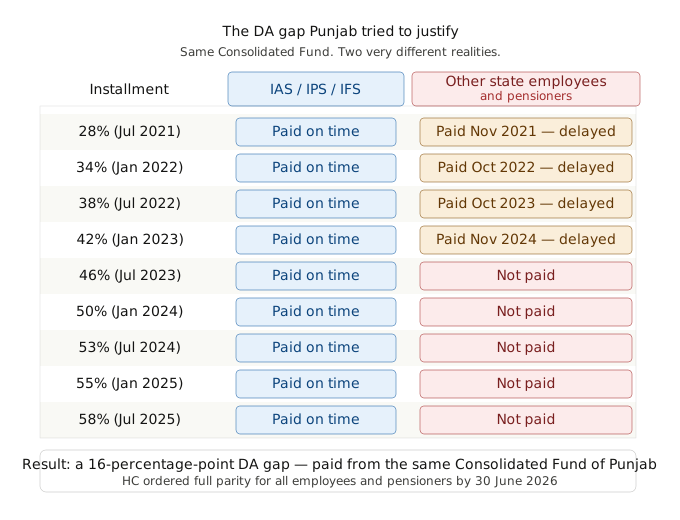
The state said it had no money to pay Dearness Allowance to its employees and pensioners. The High Court pointed out it had been paying IAS, IPS and IFS officers every rupee, from the same fund.
North Desk Correspondent
Chandigarh, April 20
For years, the Government of Punjab has had a ready answer whenever its employees and pensioners asked why their Dearness Allowance was not being revised: the state’s finances were under strain. It was not a trivial claim. Punjab’s fiscal health is genuinely stretched, and courts have generally been reluctant to second-guess governments on matters of financial management.
The Punjab and Haryana High Court, in a judgment delivered on April 8 and released on Sunday, was not persuaded.
In a ruling that cuts through four years of official delay, the court held that financial difficulty cannot be used to deny employees and pensioners a benefit they are legally entitled to — and that the state’s own conduct had already undermined its case. While Punjab told the court it lacked the resources to pay Dearness Allowance to its workforce, it had, all along, been paying DA in full to All India Service officers — IAS, IPS and IFS — serving within the state. The money for both comes from the same source: the Consolidated Fund of Punjab.
The court called this out directly. If austerity was genuine, it asked, why did it fall only on those at the bottom of the pyramid and not on the most privileged officers at the top?
What is Dearness Allowance and why does it matter
DA is not a bonus or a concession. It is a built-in correction mechanism — revised twice a year, in January and July — that adjusts salaries and pensions to keep pace with inflation as measured by the All India Consumer Price Index. When prices rise, DA rises with them. The idea is that a government employee’s real purchasing power should not be eroded simply because the cost of living has gone up.
For retired employees living on fixed pensions, Dearness Relief — the pensioners’ equivalent of DA — is often the only buffer they have against inflation. Without timely revision, their pension quietly loses value every six months while prices keep climbing.
The Sixth Punjab Pay Commission, whose recommendations were accepted by the Punjab Cabinet in June 2021, was unambiguous on this point. It said DA must continue to be paid on the Central Government pattern, and that there should be “no time lag” in its release. Every delay, the commission warned, “erodes the efficacy of DA as a hedge against inflation.”
What Punjab agreed to, and then didn’t do
In June 2021, the Council of Ministers formally approved the Sixth Pay Commission’s recommendations, including the commitment to follow the Central Government pattern for DA. Revised pay rules were notified. Some early installments were paid. Then the releases stopped.
By the time these cases came before the court, Punjab employees and pensioners had not received DA installments covering the period from July 2021 onwards at the rates applicable to Central Government employees. The gap — between what IAS officers were receiving and what other government employees were getting — had grown to 16 percentage points.
The government’s defence was that the Cabinet had only agreed to “endeavour” to eliminate the time lag, not to guarantee parity. It argued that the decision to revise DA, its frequency and its rate, remained an executive prerogative dependent on the state’s financial position.
The court rejected this. It held that once the recommendations of a Pay Commission are formally accepted by the government, they cease to be recommendations. They become a binding decision. The state cannot selectively implement what is convenient and defer what is expensive. As the court put it, the government “cannot be allowed to take a sudden U-turn and deny the petitioners their legitimate claim.”
You may like to read: Massive respite to thousands of Haryana contractual employees
The ‘no money’ argument, and why it failed
The state’s financial constraints argument had a specific problem: it was contradicted by the state’s own actions.
The court had, at an earlier hearing, asked the government a pointed question — were All India Service officers serving in Punjab being paid DA at Central Government rates, and was that money coming from the Consolidated Fund of the State? The government’s affidavit confirmed both. IAS, IPS and IFS officers had received every installment of DA on time. Everyone else had not.
The court found this impossible to reconcile with a plea of financial hardship. A classification founded solely on different service rules — the argument that IAS officers are governed by All India Services rules while state employees have their own rules — cannot justify unequal treatment in something as fundamental as inflation protection, the court held. Inflation does not apply differently to a retired school teacher than to a serving IAS officer. The burden of rising prices falls on both equally.
The court also noted that Punjab’s own history cuts against its current position. As recently as 2014, the state had a policy of releasing DA to all its employees before releasing it to All India Service officers — a deliberate choice to prioritise its own workforce. That policy was reversed in 2019. Since then, the position has flipped entirely.
The instalment plan that the court struck down
Alongside the DA dispute, the court also examined a payment plan the government had devised in February 2025 for clearing pension arrears owed since the Sixth Pay Commission’s implementation date of January 2016.
The plan divided pensioners into three categories based on age. Those aged 85 and above were to receive their arrears in two instalments. Those between 75 and 85 were to get theirs in 12 instalments. Those below 75 — the largest group — were placed in a schedule of 42 monthly instalments, with some payments not beginning until January 2028.
The court struck this down as unconstitutional. All pensioners, it held, form one homogeneous class. The purpose of pension revision and dearness relief is to address inflation — and inflation strikes every pensioner with equal force, regardless of whether they are 65 or 82. Sorting them into tiers, making younger retirees wait nearly four years for money they were owed from 2016, had no rational basis. It was, the court found, a violation of the constitutional guarantee of equality.
What the court has ordered
The judgment directs the Government of Punjab and all state corporations to pay all pending DA and DR instalments to employees and pensioners at the same rates that have been paid to IAS and IPS officers — on or before June 30, 2026.
It separately directs that pension arrears owed to all pensioners be cleared within the same deadline, at the same pace as was given to those aged 85 and above under the now-struck-down plan — in other words, promptly and without the tiered delay.
The Chief Secretary has been directed to file a compliance affidavit with the court by July 2, 2026. If the deadlines are not met, the court has left open the question of interest on delayed payments.
Crucially, the court held that its directions apply not just to the petitioners who filed these cases, but to all similarly situated employees and pensioners of the Government of Punjab. It rejected the idea that every affected person should have to file their own case.
The government now has roughly ten weeks.

11 Comments