Haryana Contract Workers Regularisation: Supreme Court 2026 Verdict Explained
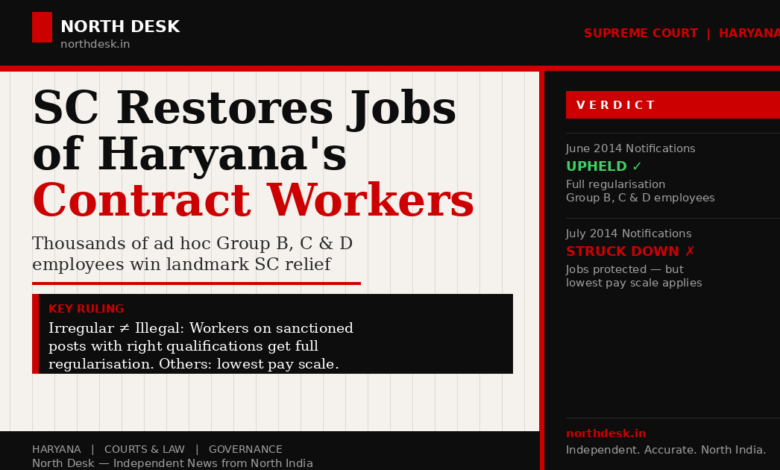
The Congress govt under Bhupinder Singh Hooda had regularised services of thousands of employees ahead of 2014 Assembly elections but the High Court struck it down. Now the SC order has come as a massive relief to these employees
Arvind Chhabra
Chandigarh, April 19
What was this case about?
Thousands of contractual, ad hoc, and daily-wage employees working with the Haryana government — in Groups B, C, and D — had been promised permanent jobs through a series of government notifications issued in June and July 2014. The Punjab and Haryana High Court had struck all of those notifications down in 2018, leaving these workers in limbo for years. They appealed to the Supreme Court. On April 16, 2026, the Supreme Court delivered its verdict — partly in their favour, partly not.
Who are these workers?
They fall into three categories under government classification — Group B (junior officers and assistant professors, among others), Group C (clerical and technical staff), and Group D (support and peon-level staff). Many had been working for the Haryana government for years — some over a decade — but on contractual or ad hoc terms, without the job security, pension, or pay scales of permanent government employees.
What did the Haryana government do in 2014?
Between June 16 and July 7, 2014, the state’s General Administration Department issued four notifications — two in June, two in July — promising to regularise, meaning make permanent, the services of eligible ad hoc workers. The government called it a “one time measure on humanitarian grounds.” Critics, including candidates who had appeared in competitive exams for the same posts, challenged the move in the High Court, calling it back-door recruitment timed to the October 2014 Haryana assembly elections.
What did the High Court say?
The Punjab and Haryana High Court in 2018 struck down all four notifications. It said the government had repeatedly misused the “one time measure” label — the Supreme Court had used that phrase in its landmark 2006 Umadevi judgment to allow a single, limited regularisation exercise for long-serving workers. The High Court found the 2014 notifications were politically motivated, extended the backdoor practice further, and violated the rights of candidates seeking regular appointments through proper competitive recruitment.
What has the Supreme Court now decided?
The Supreme Court has partly agreed with the workers and partly with the High Court. Here is the breakdown:
The June notifications (June 16 and June 18, 2014) — UPHELD ✅
These covered Group B, C, and D workers who had worked for at least three years as of May 28, 2014, were appointed against sanctioned vacant posts, held the required qualifications, and had originally been engaged through some process — an employment exchange, a selection committee, or a government-approved agency like HARTRON. The Supreme Court found these notifications were essentially completing unfinished business from a 1996 regularisation policy that the government had withdrawn in 1997, leaving some workers stranded. The court said these workers were irregular, not illegal — a crucial distinction — and their regularisation was valid.
You may also like to read Why and on what condition High Court gave bail to Godman Rampal
The July notifications (both dated July 7, 2014) — STRUCK DOWN ❌
These were a different matter. They sought to regularise workers who had not been appointed through any advertisement or interview at all — and they used a future cut-off date of December 31, 2018, meaning workers who would complete ten years of service at some point in the future were being promised permanent jobs even before that happened. The Supreme Court agreed with the High Court: no advertisement, no interview, no valid regularisation. The notifications were declared arbitrary and illegal.
But wait — if the July notifications were struck down, do those workers lose their jobs?
This is where the judgment takes an unexpected turn. The Supreme Court used its extraordinary powers under Article 142 of the Constitution — which allows it to pass any order necessary to do complete justice — to protect even those workers covered by the July notifications, provided they are currently in service.
The court’s reasoning: these workers have been in service for over twelve years since the notifications were issued. Various courts passed interim orders keeping them in their posts during the legal battle. They have gained experience, built lives, and the state itself has been utilising their services all along. Throwing them out now would cause grave hardship.
So they stay. But with one condition — they will be placed at the lowest pay scale applicable to the post they hold. They will not get the full benefit of seniority or higher pay that regularly recruited employees get.
In plain language, what does this mean for each category of worker?
Workers covered by the June 2014 notifications — full regularisation, valid service, entitled to all benefits. Their services stand protected completely.
Workers covered by the July 2014 notifications who are currently in service — they keep their jobs, but at the lowest pay scale of their post. The Supreme Court used Article 142 to ensure they are not disturbed, even though the notification under which they were regularised has been struck down.
Workers who were denied regularisation and had separately approached the High Court — they are free to take fresh steps in accordance with this judgment.
Was the political motivation argument accepted?
The High Court had found the notifications were timed to the October 2014 elections. The Supreme Court did not directly address this finding in its conclusions on the June notifications — it focused on the legal validity of the criteria prescribed, finding them sound. On the July notifications, it struck them down on legal grounds without needing to rule on political motivation.
What happens next?
The State of Haryana must now implement the order. Workers entitled to regularisation under the June notifications will need to be verified by competent authorities. Workers continuing under the July notifications will have their pay scales revised downward to the lowest applicable level. Those who had separate regularisation petitions pending are now free to pursue them in light of this judgment.

One Comment