Bank Strike September 11: Why Banks Are Closing — Full Explainer
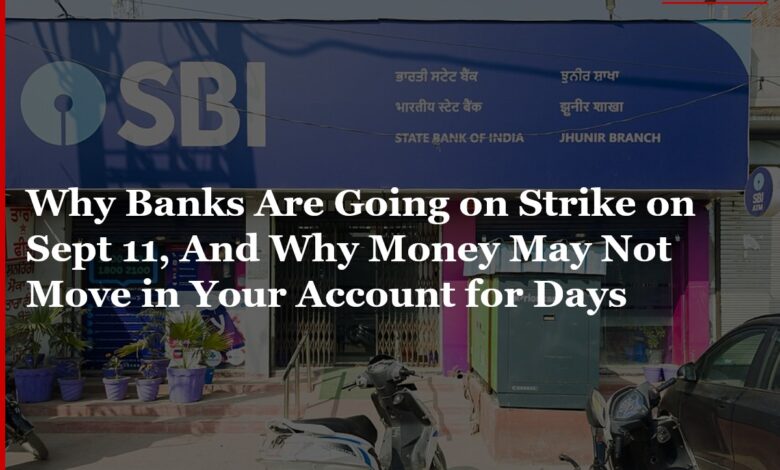
Bank Strike September 11: UFBU’s bank strike on September 11, 2026 could freeze banking in Chandigarh, Punjab and Haryana for up to five days. Here’s why banks are striking and what it means for you.
North Desk Correspondent
Chandigarh, September 10
Banks across India, including branches in Chandigarh, Punjab and Haryana, will be shut on Friday, September 11, as employees and officers observe a nationwide strike call given by the United Forum of Bank Unions (UFBU). For customers, the timing is unforgiving: the strike lands right before a weekend, and Monday, September 14, is a holiday on account of Ganesh Chaturthi in several states. Put together, banking operations in the region could effectively freeze for four to five consecutive days.
The scene at the counter
Bank Strike September 11: At a Punjab National Bank branch in Sector 34, Chandigarh, the disruption is already showing up in everyday transactions. A bank officer, speaking on condition of anonymity, confirmed to North Desk that the branch has been informing customers about the coming closures.
In one instance witnessed by this reporter, a customer depositing a cheque was told it would only go for clearing on Monday, (and where it’s shut on Monday — on Tuesday) meaning the cheque would not actually be processed until Tuesday at the earliest. It’s a small, ordinary moment, but it captures the scale of the problem better than any strike notice: money that people expect to move within a day or two may now sit untouched for the better part of a week.
Bank Strike September 11: Why are banks striking?
Bank Strike September 11: The UFBU — an umbrella body of seven unions representing bank employees and officers (AIBEA, AIBOC, BEFI, NCBE, AIBOA, INBEF and INBOC) — has served a formal strike notice to the Indian Banks’ Association (IBA) and the Chief Labour Commissioner. The unions’ grievances are not new; they’ve been building for over a decade, and three issues sit at the core.
Five-day banking, still unimplemented
Bank Strike September 11: The demand to close banks on all Saturdays goes back to a settlement signed between unions and the IBA in May 2015, which committed to working toward declaring every Saturday a holiday. The issue resurfaced in a November 2020 settlement, and in December 2023 the IBA and unions signed a fresh Memorandum of Understanding in which the recommendation for five-day banking was formally sent to the government. In March 2024, the IBA itself agreed in principle to the proposal — under which employees would work Monday to Friday but with each working day extended by 40 minutes to compensate. More than a year and a half later, the government has still not issued the notification needed to make it official, and that delay is now a central strike demand.
A pay scheme unions call discriminatory
Bank Strike September 11: The second flashpoint is the revised Performance-Linked Incentive (PLI) scheme. Under the new structure, senior executives at Scale IV and above can earn PLI payouts of up to Rs 20 lakh a year, while officers up to Scale III are capped at roughly Rs 50,000. Unions argue this breaks from the earlier understanding with the IBA — that PLI days should be applied uniformly across employees and officers up to Scale VII, and tied to overall bank performance rather than skewed toward senior ranks. They also say the revised scheme was rolled out without proper consultation.
Pension-related demands
Bank Strike September 11: The third plank covers a set of long-pending pension issues that unions want addressed alongside the other two.
Despite an IBA meeting on September 4 and a conciliation meeting called by the Chief Labour Commissioner on September 7, AIBEA has told members these were routine steps that don’t warrant scaling back strike preparations. September 11 is not an isolated action either — UFBU has already announced a second, three-day strike from September 28 to 30, coinciding with the half-yearly closing of bank accounts, and has warned of an indefinite nationwide strike from October 26 if the government and bank managements don’t move on the demands by then.
What actually shuts down, and for how long
September 11 is a Friday. Saturday and Sunday follow as regular weekly bank holidays. Then comes Monday, September 14 — a Negotiable Instruments Act holiday for Ganesh Chaturthi in a number of states, under whose calendar Chandigarh’s own holiday list also marks the day as a regional holiday.
The stock exchanges — NSE and BSE — are shut nationwide on September 14 as well, meaning trade settlements and cash-market activity pause on top of the banking freeze. For a Chandigarh, Punjab or Haryana resident, that’s potentially five days — Friday through Tuesday — where cheque clearing, NEFT/RTGS processing through branch channels, and in-person banking are all unavailable, layered on top of whatever normal turnaround time those services already take.
What to do before Friday
- Deposit or encash any cheques that need clearing before Friday, not on the day itself
- Don’t count on salary or EMI-linked transactions processing on their usual date if that date falls in the Sept 11-14 window
- Digital channels — UPI, mobile banking, ATMs — are expected to keep functioning through the strike, though cash-heavy branches may see longer queues once banks reopen
- NRIs sending remittances home should account for the delay in crediting, especially if routed through cheque or branch-dependent transfers
ALSO: Explained: Apple Just Hiked Prices On Its Entire India iPhone Lineup
ALSO: Hanuman Ansh Crosses ₹150 Crore, Beats Dhurandhar Record, Kantara Next
ALSO: Chandigarh Airport International Flights: Why It Connects to Just One Country
Follow North Desk on WhatsApp for the latest from Punjab, Haryana and Himachal Pradesh: https://whatsapp.com/channel/0029Vb7ccdxJENy2H87DBG3E