How a Fake ₹10 Lakh "Gift" From Canada Cost Two Chandigarh Brothers Lakhs

Canada money transfer scam: A fraudster impersonating a real acquaintance promised two brothers ₹10 lakh from Canada — then used a fake visa crisis to extract ₹2.45 lakh. Here’s how the scam unfolded.
North Desk Correspondent
Chandigarh, July 20
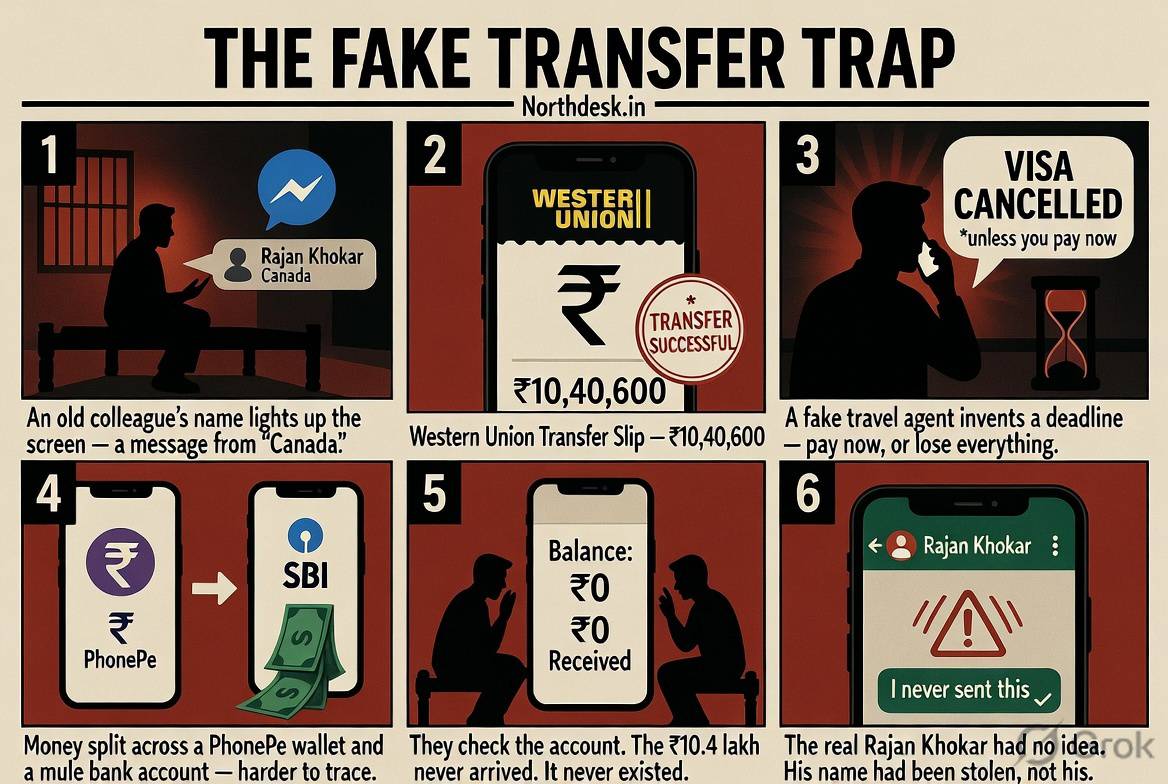
The Canada money transfer scam started the way good news usually does — with a familiar name lighting up a phone screen.
Sunil Kumar, 48, was sitting at home in Manimajra area in Chandigarh on the evening of May 6 with his younger brother Rameshwar, the two of them doing nothing more dramatic than passing an ordinary evening together, when Rameshwar’s phone buzzed with a Messenger notification. The name on it was Rajan Khokar — a man Rameshwar had actually worked with once, years back. Not a stranger’s number. Not a robotic customer-care voice reading from a script. A name with history attached to it, popping up like an old colleague reaching across time to say hello.
Except the man wasn’t Rajan Khokar. He was wearing him.
‘I am in Canada!’
Canada money transfer scam: The message that followed was the kind engineered to make a person’s pulse quicken with excitement rather than suspicion. “I’m in Canada now,” the impostor wrote. “I want to send you ₹10 lakh — you can just give it back to me whenever I come to India.” No catch mentioned. No urgency, not yet. Just an old friend, it seemed, offering an act of trust so casual it barely registered as strange. He asked for Rameshwar’s Aadhaar card — reasonable enough, surely, for a bank transfer of that size — and within a short while, a document arrived: a Western Union money transfer slip, official-looking, stamped with a figure that must have made both brothers’ hearts skip. ₹10,40,600. Ten lakh, forty thousand, six hundred rupees, apparently already in motion, already theirs.
…And then the trap
It is worth pausing on how quietly this trap was built. There was no threat in the opening act — only generosity, and the particular kind of generosity that disarms people precisely because it asks nothing of them. Nobody suspects a gift.
Canada money transfer scam: Then, as these things always do, the story tilted. A short while later, the man calling himself Rajan Khokar said something needed sorting before the money could land: ₹2,45,000 had to be withdrawn on his behalf and handed to a travel agent in Delhi, a man named Varinder Thakur, whose mobile number arrived along with the instruction as if it were the most ordinary administrative detail in the world.
Sunil called Thakur on WhatsApp. And this is where the fraud stopped being generous and became urgent, the way a con always eventually does — because urgency, not greed, is what stops a person from calling their bank, from asking a second question, from sleeping on it. Thakur told him plainly: Rajan Khokar’s visa was about to be cancelled. Unless ₹45,000 moved immediately to a PhonePe number belonging to someone called Vikas Kumar, the whole windfall — the visa, the visit, the ₹10 lakh gift — would collapse.
Sunil paid it. Anyone might have. When a friend’s future feels like it’s balanced on your next ten minutes, most people don’t stop to ask why a Canadian visa problem is being solved through a PhonePe transfer to a stranger named Vikas.
It didn’t stop there. Thakur came back with a bank account number — an SBI account in Mumbai, held in a name that belonged to no one either brother had ever heard of: Afzal. Sunil transferred ₹2 lakh from his own SBI account into it, moving money he’d earned to rescue money that had never existed, to protect a friendship that, unbeknownst to him, wasn’t even in the room.
Canada money transfer scam: The suspicion
Canada money transfer scam: When Thakur asked for still more, something in Sunil finally resisted. He said no. And in the silence that followed — the silence of a scam that has taken what it can and gone quiet — the brothers did what they should have done at the very first message: they checked Rameshwar’s bank account. The ₹10,40,600 had never arrived. It never would.
Then came the moment that turns this from a story about lost money into a story about a stolen name. Rameshwar reached out to the real Rajan Khokar — not through the Messenger thread the fraud had used, but through Khokar’s actual WhatsApp number, the one that had always belonged to him. Khokar had no idea what any of it meant. He had sent no message. He was not in Canada, promising anyone a fortune. Somewhere between the two of them, a stranger had put on his name like a coat and walked into a family’s trust wearing it.
Canada money transfer scam: By the time the brothers filed their complaint the same day, they had lost ₹2,45,000 — chasing money that was never real, to save a friendship that had been hijacked without either side knowing it.
The mechanics of the Canada money transfer scam or fraud once you strip away the emotion, are almost elegantly cruel: a real relationship used as the entry point, since a genuine name defeats suspicion in a way no stranger ever could; a forged transfer document to make an imaginary sum feel tangible; a manufactured crisis — a visa, a deadline — to compress the brothers’ decision-making into minutes instead of days; and money split across two different channels, a personal PhonePe wallet and a mule bank account under a name with no connection to anyone in the story, making the trail harder to pull on the moment someone tries.
A case was registered at a Chandigarh Police Station, more than two months after the incident, under Bharatiya Nyaya Sanhita sections covering cheating, forgery, and criminal conspiracy, against persons unknown. The police are investigating to trace a PhonePe number, a mule account in Mumbai bearing a stranger’s name, and a Messenger identity that borrowed a real man’s face to sell a family a fortune that was never coming.
What the FIR in the Canada money transfer scam can’t quite capture is the quieter loss underneath the financial one: somewhere in Manimajra, a name that used to mean “an old friend, a former colleague” now arrives on a phone with a flicker of doubt attached to it. That, as much as the ₹2.45 lakh, is what the fraud actually took.
Follow North Desk on WhatsApp for the latest from Punjab, Haryana and Himachal Pradesh: https://whatsapp.com/channel/0029Vb7ccdxJENy2H87DBG3E
Read also: ASI Amarjit Singh: From Life Term For Killing KHALRA To Acquittal
READ ALSO: Three Of Khalra’s Convicted Killers Are Out On Bail Right Now — Here’s Why





2 Comments