CBSE ICSE Result 2026: Class 10 Date, Class 12 Timeline, How to Check and DigiLocker — Complete Guide
Update — CBSE Class 10 result has been declared. Link results.cbse.nic.in
North Desk Bureau
Chandigarh, April 14
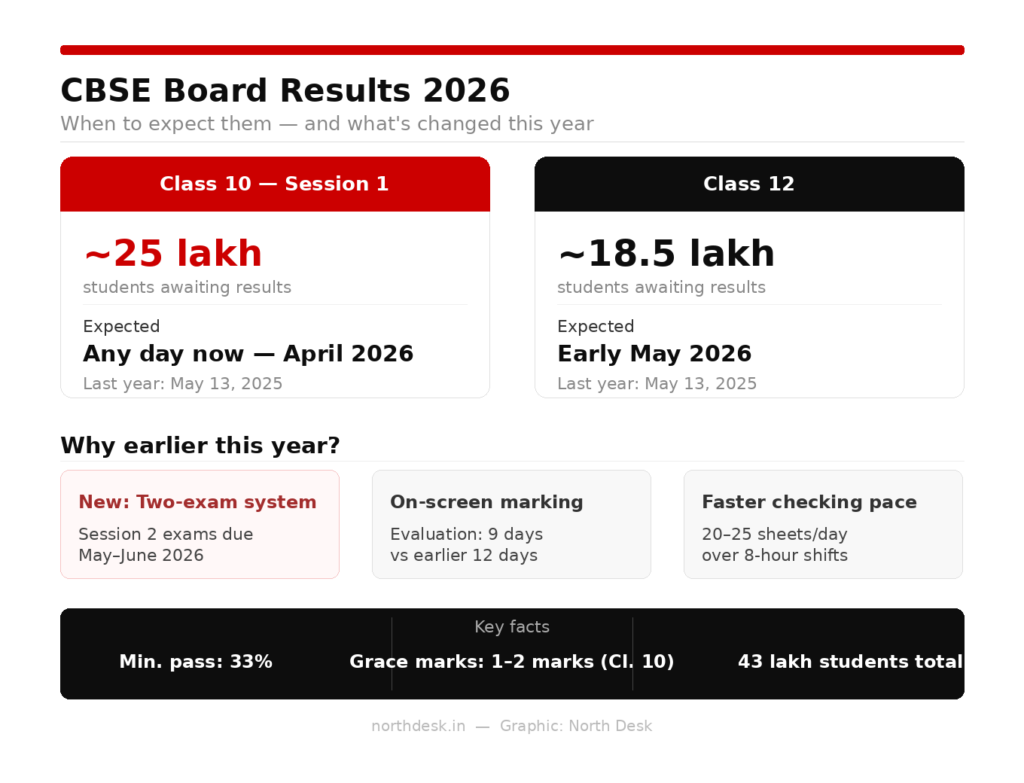
Nearly 43 lakh students — including around 25 lakh from Class 10 and 18.5 lakh from Class 12 — are waiting for the Central Board of Secondary Education (CBSE) to declare their 2026 board results. The good news: the wait is likely to be shorter than in previous years. Here is everything you need to know.
When will the CBSE Class 10 result 2026 be declared?
CBSE has not announced an official date, but all indications point to the Class 10 result being declared before the last week of April 2026 — significantly earlier than last year, when it came on May 13.
Some reports suggest the announcement could come as early as mid-April. Either way, this is the earliest timeline in recent years for Class 10 results.
When will the CBSE Class 12 result 2026 come out?
The Class 12 result is expected before the second week of May 2026, also ahead of last year’s May 13 declaration. The Class 12 board exams concluded on April 10, leaving a tighter evaluation window.
What about ICSE and ISC results — when are they coming?
Students who appeared for the Council for the Indian School Certificate Examinations (CISCE) board exams are on a slightly different timeline.
Around 2.53 lakh students appeared for the ICSE Class 10 exam in 2025, and approximately 2.6 lakh students took the ICSE exams this year, with 1.5 lakh appearing for ISC.
The ICSE exams concluded on March 30 and ISC on April 6, 2026. One consistent pattern is that CISCE releases both ICSE and ISC results on the same day — last year that was April 30. Based on that trend, the ICSE Class 10 result may be declared in the last week of April–around April 28, 2026.
To check results, students need their Unique ID, Index number, and Captcha code. Official websites are cisce.org and results.cisce.org.
SMS option: Type ICSE<space><7-digit Unique ID> and send to 9248082883 for Class 10. For ISC Class 12, replace ICSE with ISC.
The minimum passing mark for ICSE and ISC is 33 per cent overall, with 35 per cent required subject-wise. Students must pass in English and any four of the remaining subjects to receive the pass certificate
Why are results coming earlier in 2026?
This is the big shift — and it has a clear reason.
CBSE has introduced a two-examination system for the first time from the 2025-26 academic session. Students can now appear for a second round of board exams (Session 2) between May and June 2026 to improve their scores in up to three subjects. To make room for Session 2, the board has had to accelerate the declaration of Session 1 results.
Two other factors are helping speed things up:
On-screen marking (OSM): CBSE has moved to digital evaluation this year. Examiners assess answer sheets on screen rather than physically. This has cut the evaluation time to approximately nine days, compared to 12 days earlier for Class 12.
Faster checking pace: Examiners are evaluating 20 answer sheets per day for major subjects and 25 for other subjects, over eight-hour shifts.
What is the grace marks policy for Class 10?
Students who fall short by one or two marks in Class 10 may be eligible for grace marks. However, these are not mentioned on the final marksheet. The minimum passing mark is 33 per cent overall.
What is the Local Angle: Chandigarh, Punjab, Haryana
For students in the tricity and across Punjab and Haryana, results from CBSE-affiliated schools are among the most eagerly awaited each year. Chandigarh, which falls under the CBSE’s Panchkula regional office, recorded a pass percentage of 93.71 per cent in the 2025 Class 10 results, while Panchkula recorded 92.77 per cent. The 2026 figures will be watched closely against these benchmarks.
Prominent CBSE schools with strong results in this region include DAV, Kendriya Vidyalaya, Bhavan Vidyalaya, and Army Public Schools. Parents and students from across Punjab, Haryana, and Himachal Pradesh should keep login credentials ready before the official announcement drops.
Where to check CBSE result 2026
Students will need their roll number, school number, admit card ID, and date of birth to access results. The following official platforms will carry the results:
- results.cbse.nic.in
- cbse.gov.in
- results.nic.in
- results.digilocker.gov.in (for digital marksheet)
- umang.gov.in (mobile app)
- cbse.nic.in
Pro tip: CBSE result portals see extremely heavy traffic immediately after declaration. If the site does not load, try DigiLocker or the UMANG app — both provide official, verified digital marksheets.
SMS option: Type CBSE10 <Roll Number> and send to 7738299899 for Class 10. For Class 12, type CBSE12 <Roll Number> to the same number.
What is DigiLocker and how do students use it to get their CBSE result?
DigiLocker is a government-run digital document platform — think of it as a secure online locker where official documents issued by government bodies are stored against your Aadhaar number. For CBSE students, it is particularly useful because the board uploads marksheets and passing certificates directly to DigiLocker shortly after results are declared. These documents carry the same legal validity as physical originals.
How to access your CBSE result on DigiLocker:
Go to digilocker.gov.in or open the DigiLocker app on your phone. Sign in using your mobile number linked to your Aadhaar — you will receive an OTP to verify. Once logged in, look for the CBSE section under “Issued Documents.” Your Class 10 or Class 12 marksheet will appear there once CBSE pushes the results. You can download it as a PDF, share it digitally, or present it at institutions — it is accepted as an official document without needing an attested photocopy.
Why use DigiLocker over the CBSE result website?
On result day, the official CBSE portals — results.cbse.nic.in and cbse.gov.in — are flooded with traffic from millions of students checking simultaneously. Servers slow down or throw errors for hours. DigiLocker handles this better because it is a separate platform and does not face the same surge. For students who want their marksheet quickly without fighting a crashing website, DigiLocker is the smarter first stop.
One thing to note: DigiLocker requires your mobile number to be linked to Aadhaar. Students who have not done this should do so before result day to avoid last-minute hassle. The UMANG app also provides access to CBSE results and works on the same principle
What’s new in CBSE 2026 that students should know?
Beyond the two-exam system, CBSE has introduced several changes this year:
- APAAR ID mandatory: Students must now have their Aadhaar-linked APAAR (Academic Bank of Credits) ID linked to their school records.
- Minimum 75% attendance: Class 10 and 12 students required 75 per cent attendance to be eligible for board exams.
- Digital marksheets: Available on DigiLocker shortly after result declaration — no need to wait for physical documents.
What happens after results — compartment and Session 2
Students who do not clear one or more subjects in Session 1 will have two options: appear for the compartment exam, or use Session 2 (May–June 2026) to attempt up to three subjects for score improvement. This is a significant safety net that did not exist in previous years.
North Desk will update this page the moment CBSE declares results. Bookmark this page or follow @NorthDeskIn on X for live alerts.





One Comment