Punjab Pilgrim Bus Safety Row: The NHRC vs AAP Showdown Explained
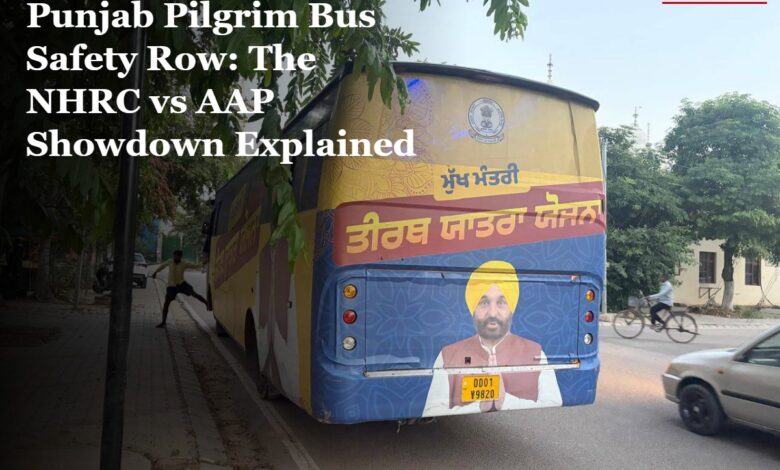
Punjab Pilgrim Bus Safety Row: Why has the NHRC issued a notice over Punjab’s Mukh Mantri Tirath Yatra buses? Here’s our detailed Q&A explainer on the safety violations, CIRT rules, and AAP-NHRC showdown.
North Desk Correspondent
Chandigarh, October 26
A major political and administrative dispute has broken out between the National Human Rights Commission (NHRC) and the Aam Aadmi Party (AAP)-led Punjab Government over the private AC sleeper coaches chartered for the state’s flagship Mukh Mantri Tirath Yatra Scheme.
The friction began after an NHRC bench issued a strict notice to the Punjab Chief Secretary and the Union Ministry of Road Transport and Highways (MoRTH), flagging severe fire-safety violations and illegal coach modifications. The intervention sparked an immediate political exchange between AAP National Convener Arvind Kejriwal and NHRC member Priyank Kanoongo.
Here is a comprehensive question-and-answer breakdown of the controversy, the safety regulations at stake, and the political arguments.
What is the Mukh Mantri Tirath Yatra Scheme?
The Mukh Mantri Tirath Yatra Scheme is a flagship welfare program launched by the Punjab government to provide free pilgrimage tours for senior citizens and economically disadvantaged families.
- The Operation: The state government bears all expenses—including travel, AC sleeper bus transport, meals, and accommodations. By mid-October 2026, approximately seven lakh elderly citizens had used the service.
- The Key Routes: The scheme operates across five primary spiritual circuits:
- Punjab: Amritsar (Golden Temple) and Sri Anandpur Sahib–Naina Devi.
- Interstate: Salasar & Khatu Shyam Ji (Rajasthan), Haridwar & Rishikesh (Uttarakhand), and Mathura & Vrindavan (Uttar Pradesh).
Why did the NHRC issue a notice to Punjab Govt?
Punjab Pilgrim Bus Safety Row: The NHRC acted on formal complaints alleging that the chartered AC sleeper buses do not comply with mandatory safety codes prescribed under the Central Motor Vehicles Rules (CMVR) and the Automotive Industry Standards (AIS-052/AIS-119).
Because the vast majority of passengers are elderly pilgrims who have limited physical mobility during an emergency, the human rights panel intervened, ordering the Punjab Chief Secretary to inspect the fleet and submit a comprehensive action-taken report within seven days.
What specific safety violations were flagged in the buses?
According to NHRC member Priyank Kanoongo, technical evaluations and complaints identified several critical structural hazards:
- Unauthorised Cabin Partitions: Partitions were erected between the driver’s cockpit and the passenger saloon. The Central Institute of Road Transport (CIRT), Pune, has repeatedly warned that physical partitions prevent drivers from noticing electrical sparks or rear fires before smoke engulfs the coach.
- Obstructed Emergency Exits: Additional sleeper berths and plywood dividers were allegedly installed directly in front of mandatory emergency doors and escape windows, leaving passengers trapped in the event of a rollover.
- Chassis Overhang Extensions: The bodies of several chartered buses were reportedly built past the legal chassis rear-overhang limits, destabilizing high-speed highway handling.
- Fire System Deficiencies: Multiple vehicles lacked certified Fire Detection and Suppression Systems (FDSS), fire-retardant interior upholstery, or functional glass-breaking emergency hammers.
How did Arvind Kejriwal and the AAP react?
Punjab Pilgrim Bus Safety Row: AAP National Convener Arvind Kejriwal strongly dismissed the inspection, framing it as politically motivated interference by the BJP-led Central Government to derail a successful welfare scheme.
Posting on X, Kejriwal asked:
- The “First Time in History” Argument: Kejriwal questioned why a national human rights body was conducting motor vehicle fitness inspections, claiming the commission had never conducted roadside bus checks in its institutional history.
- Selective Scrutiny Claims: He alleged that while state-run transport fleets like Uttar Pradesh Roadways operate older buses across North India, the NHRC singled out only Punjab’s “super deluxe” pilgrimage buses.
- Attacking the Centre: Kejriwal directly questioned Prime Minister Narendra Modi, asking why central bodies were targeting elderly citizens traveling for religious pilgrimages.
How did the NHRC respond to AAP’s allegations?
Punjab Pilgrim Bus Safety Row: NHRC member Priyank Kanoongo rejected claims of political bias, asserting that human life and passenger safety supersede political considerations.
- The 1,000-Bus Nationwide Drive: Kanoongo countered that the commission’s action is not unique to Punjab. Over the past year, the NHRC has been probing sleeper bus infernos across Maharashtra, Andhra Pradesh, and Rajasthan, leading to restrictions or deregistrations of over 1,000 non-compliant buses nationwide.
- The Punjab Registration Anomaly: Kanoongo revealed that the Punjab Transport Department had earlier informed the commission in January 2026 that no private sleeper coach buses were legally registered within the state, raising questions about how these out-of-state fleets obtained transport contracts.
- Corruption Charges: The debate turned personal when Kanoongo posted on X: “Don’t be afraid, Arvind! We haven’t yet launched an investigation into the commissions you’re getting from running these buses,” warning that officials and contractors endangering lives could face criminal prosecution.
What are the safety benchmarks for sleeper buses in India?
Punjab Pilgrim Bus Safety Row: Interstate sleeper buses have come under increased judicial and administrative scrutiny following fatal highway fires where passengers could not locate emergency exits in dense smoke. Standard safety norms mandated by MoRTH and CIRT require:
| Safety Parameter | Regulatory Mandate (AIS-119 / CMVR) | Alleged Violation in Hired Fleet |
| Driver-Passenger Partition | Strict visual and audio contact must be maintained; no solid barriers allowed. | Complete physical partitions installed between driver and passenger saloon. |
| Emergency Exits | Clear, unobstructed paths to rear emergency doors and roof hatches. | Obstructed by modified berths and wooden fixtures. |
| Fire Suppression (FDSS) | Automated water-mist or aerosol suppression in engine bays and passenger cabins. | Inadequate detection sensors and non-functional extinguishers. |
| Chassis Dimensions | Coach body must strictly match manufacturer-approved chassis wheelbases. | Bodies extended past chassis boundaries to fit additional berths. |
Punjab Pilgrim Bus Safety Row: A report next
Punjab Pilgrim Bus Safety Row: The Punjab Chief Secretary must submit a formal inspection and compliance report to the NHRC addressing each safety parameter.
If the state confirms that the chartered fleet failed to meet CMVR standards, the government will have to either ground the non-compliant private operators and re-tender compliant fleets or risk judicial action and central vehicle impoundments across interstate routes.
ALSO: Who Is Bhim Singh? Meet the Ex-Serviceman Father Shaking Punjab Over Jhota’s Murder
ALSO: Who Was Parvinder Singh Jhota? Anti-Drug Crusader Shot Dead on Camera
Follow North Desk on WhatsApp for the latest from Punjab, Haryana and Himachal Pradesh: https://whatsapp.com/channel/0029Vb7ccdxJENy2H87DBG3E