Why Sonam Wangchuk Ended His 26-Day Fast: The Four Assurances That Ended the Standoff
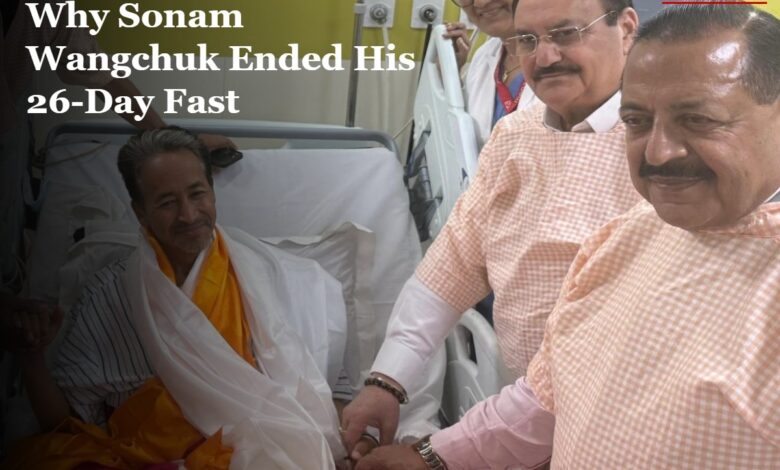
Sonam Wangchuk ends fast: Sonam Wangchuk broke his hunger strike after 26 days following government assurances on protester safety, NEET victim compensation and Pradhan’s position. CJP says its protest continues.
North Desk Correspondent
New Delhi, July 24
Sonam Wangchuk’s 26-day hunger strike ended shortly after midnight on Thursday — not because his demands were fully met, but because the government finally moved on four fronts he had spent the previous 48 hours spelling out in a public letter. The Cockroach Janta Party, whose Jantar Mantar agitation Wangchuk had joined on June 28, immediately made clear the protest itself is not over.
Background: How the movement got here
Sonam Wangchuk ends fast: The CJP-led agitation began on June 20, built around allegations of irregularities and paper leaks in the NEET-UG competitive examination. Its demands were threefold: accountability for the exam “irregularities,” reforms to the education system, and the resignation of Union Education Minister Dharmendra Pradhan. Wangchuk — the Ladakh-based education reformist and climate activist better known nationally as the inspiration for a Bollywood character, and a veteran of multiple hunger strikes over Ladakh’s statehood demand — joined the protest at Jantar Mantar on June 28 and began an indefinite fast the same day.
The movement escalated on July 18, when Delhi Police forcibly shifted Wangchuk from the Jantar Mantar site to Safdarjung Hospital on High Court orders, acting on medical advice after 20 days without food. He was later moved to Medanta Hospital in Gurugram, where he remained through the fast’s end.
Two days later, on July 20, the CJP’s “Sansad Chalo” march toward Parliament was stopped by Delhi Police using tear gas and baton charges, with protesters also alleging pellet guns and tasers. In its aftermath, CJP accused authorities of trying to paint the student-led movement as violent; police rejected the charge. Wangchuk’s wife, Gitanjali Angmo, publicly defended the protesters’ conduct, and Wangchuk himself repeatedly urged supporters to respond to any provocation “only with flowers.”
It’s against this backdrop — a worsening health situation, a violent crackdown, and no movement from the government for nearly a month — that the events of Wednesday and Thursday need to be read.
The four reasons he broke the fast
1. An unequivocal assurance on no punitive action against protesters
This was Wangchuk’s non-negotiable condition, laid out in writing to Union Ministers JP Nadda and Jitendra Singh on Wednesday, Day 25 of the fast. He asked for a clear government commitment that no protester who took part in the CJP movement would face “punitive or retaliatory legal action” for what he called their only “offence” — raising their voice for a fair examination system.
The demand carried weight because Delhi Police has already filed roughly ten FIRs tied to the protests, and the Delhi High Court is hearing three separate petitions over alleged excessive police force during the July 20 march.
2. Assurance on compensation for NEET-leak suicide victims
Nadda and Singh, who first visited him at Medanta Hospital on Tuesday night, told Wangchuk the government would “positively consider” compensating the families of students who died by suicide following the NEET-UG paper leak — one of the founding grievances of the movement.
3. A promise of parliamentary accountability, including Pradhan’s position
The ministers also assured him of a “meaningful discussion in Parliament” on accountability for the exam irregularities — with the resignation of Education Minister Dharmendra Pradhan explicitly on the table for consideration, though not confirmed. This is the demand CJP says remains unresolved, which is why the party has vowed to keep protesting.
4. Mounting political pressure and Modi’s late-night address
By Wangchuk’s own count, 65 MPs across party lines had either visited him or signed letters urging him to end the fast, including a joint appeal from Opposition MPs asking him to let Parliament carry the debate forward instead. Separately, Prime Minister Narendra Modi used a late-night video address on Thursday to announce the Cabinet would discuss tougher anti-paper-leak measures on Friday and that a new Bill would be introduced in Parliament next week.
Sonam Wangchuk ends fast, and what CJP is saying now
Sonam Wangchuk ends fast: Wangchuk formally broke his fast just after midnight Thursday in the presence of Nadda, Singh, and senior Leh Apex Body leaders, with his wife by his side. Modi later posted urging him to “regain his old weight” under doctors’ supervision.
CJP, however, used the same news cycle to reiterate that the protest at Jantar Mantar continues: the resignation demand and full accountability process are, in its view, still just assurances, not outcomes.
Follow North Desk on WhatsApp for the latest from Punjab, Haryana and Himachal Pradesh: https://whatsapp.com/channel/0029Vb7ccdxJENy2H87DBG3E


5 Comments