Mann Backs Delhi's Protesting Students. Punjab's Own Paper-Leak Record Is Now the Question.
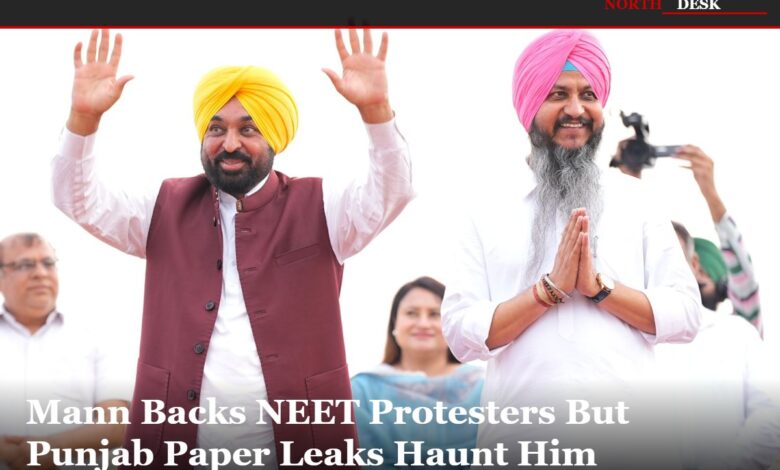
Punjab paper leaks : As Delhi shuts down 16 Metro stations amid the CJP protest, Bhagwant Mann’s solidarity with NEET students is being turned against him — Punjab’s own unresolved paper leaks are now the story.
North Desk Correspondent
Chandigarh, July 23
As Delhi Police shut down sixteen Metro stations across the capital on Thursday morning — Rajiv Chowk, Central Secretariat, Khan Market, ITO and Mandi House among them — the crowd at Jantar Mantar continued to swell for what organisers are calling Day 34 of the Cockroach Janta Party’s protest against the 2026 NEET-UG paper leak and CBSE’s on-screen marking irregularities. What began in early June as a satirical youth outfit’s campaign has, over seven weeks, turned into the least controllable street movement the Modi government has faced in years — one now drawing in opposition leaders, Bollywood, Punjabi cinema, and, closer home, a direct political boomerang aimed at Punjab’s own Chief Minister.
What’s happening in Delhi, and why
The protest traces back to CJP founder Abhijeet Dipke’s campaign demanding Union Education Minister Dharmendra Pradhan’s resignation over the NEET-UG leak and compensation for the families of aspirants who died by suicide after the scandal broke. It stayed a marginal story until Ladakhi environmentalist Sonam Wangchuk joined in early July with an indefinite hunger strike alongside six students of the All India Students Association — a fast now past its third week, with Wangchuk hospitalised and a Delhi High Court order this week directing his shift to Medanta Hospital.
The turning point came on July 20, when police used tear gas and baton charges to stop a march of more than 10,000 protesters attempting to reach Parliament. The images from that crackdown are what pulled in the rest of the country: opposition MPs staged a black-clothes solidarity protest outside Parliament the next day; Rahul Gandhi, Priyanka Gandhi Vadra and Akhilesh Yadav were themselves detained this week during a sit-in outside the Prime Minister’s residence; NCP(SP) chief Sharad Pawar and MP Supriya Sule made a solidarity visit to the protest site.
Ordinary citizens across Delhi, Hyderabad and other cities have been sending food to the protesters through delivery apps, a detail that’s turned into its own small viral thread on “humanity versus democracy.”
Political commentary has increasingly framed this as a movement that has slipped its own leash — what one analysis called an organic, leaderless youth upsurge that CJP itself can no longer fully steer, whatever its original backers intended.
What the parties are saying
The government’s defence, delivered by Union Health Minister J.P. Nadda, has been to widen the frame rather than answer on NEET specifically: he read out a state-by-state list of paper-leak scandals under opposition governments — Jammu & Kashmir, Himachal Pradesh, Jharkhand, Telangana, Tamil Nadu, West Bengal, Kerala, Karnataka, and Punjab — and asked why Rahul Gandhi’s criticism was selective, accusing the opposition of exploiting students for political mileage rather than caring about their welfare.
Rahul Gandhi’s rebuttal has centred on the argument that the protest reflects deeper failures — a “rigged” education system, rising costs, unemployment — rather than being reducible to one leak.
Samajwadi Party chief Akhilesh Yadav mocked a government press conference on the issue as tone-deaf, and Congress and Left MPs have jointly demanded Home Minister Amit Shah’s and Pradhan’s resignations over the police action.
What students are saying
Punjab paper leaks: Wangchuk’s own framing throughout has been that the fast is a matter of conscience over students’ futures, and he has repeatedly signalled willingness to end it if the government agrees to protect the protesting students rather than prosecute them. CJP’s core demands remain Pradhan’s resignation, Wangchuk’s unconditional release from any restriction, and compensation for families of NEET aspirants who died by suicide.
Political scientist Yogendra Yadav, visiting the site, described the scale of youth turnout on education and jobs as the movement’s most significant achievement regardless of what happens to any single demand.
AAP’s role — and the contradiction now facing it
Nationally, AAP has positioned itself as the students’ most visible institutional defender. Founder Arvind Kejriwal wrote to Delhi Police demanding public disclosure of FIRs and detainee lists after Monday’s crackdown, visited Mandir Marg and Parliament Street police stations in person, and secured the release of dozens of detained protesters — a AAP Punjab social media post this week cast this as the mark of a genuine “people’s leader,” with Kejriwal declaring he wouldn’t leave the police station until every detained student was freed.
Punjab paper leak record
Punjab paper leaks: That posture is exactly what Punjab’s opposition is now using against Bhagwant Mann. SAD chief Sukhbir Singh Badal accused Mann of “fake solidarity” at Jantar Mantar while Punjab’s own recruitment exams remain compromised — citing both the Pharmacy Officer exam cheating racket and unresolved irregularities in the Punjab Subordinate Services Selection Board’s (PSSSB) Group-B recruitment exam.
Punjab paper leaks: That Group-B case, involving roughly one lakh candidates across 408 posts including Naib Tehsildar and Treasury Officer, was referred to the Vigilance Bureau in January after aspirants alleged irregularities — and six months later, the investigation, led by Muktsar DSP Amandeep Singh, remains open with no findings made public.
Congress has pressed harder still. PPCC president Amarinder Singh Raja Warring has demanded both Mann’s and Education Minister Harjot Singh Bains’s resignations, listing four separate scandals under this government — the Group-B leak, the Class 12 English paper, the PSTET exam, and the Pharmacist recruitment exam — and invoking AAP leader Manish Sisodia’s own earlier position that a minister should resign if a paper leak occurs on his watch.
Punjab paper leaks: Warring has also pointed out that when Punjab students protested the Pharmacy Officer leak locally, they were, in his telling, met with force rather than solidarity — the opposite of the treatment Kejriwal is now publicly claiming credit for extending to Delhi’s protesters.
The Punjab government’s own defence, laid out in response to the Pharmacy Officer case, is that it wasn’t a conventional leak at all but a technologically sophisticated cheating attempt that investigators detected and stopped before it compromised the exam — a materially different claim than “leak,” though one the opposition has largely declined to accept at face value.
The open question
Punjab paper leak: What Nadda’s list did, intentionally or not, was hand Punjab’s opposition parties a live comparison: a Chief Minister demanding accountability from Delhi over exam integrity, while his own state’s Vigilance Bureau sits on an unresolved case involving a lakh candidates.
Neither PSSSB nor the Punjab government has yet responded on record to Badal’s or Warring’s specific charges of Punjab paper leaks this week. Whether that silence holds through the news cycle, or whether Mann is forced to answer for Punjab’s own record the way he has asked Delhi to answer for NEET’s, is the thread worth watching from here.
READ ALSO: ASI Amarjit Singh: From Life Term For Killing KHALRA To Acquittal
READ ALSO: Cops Disposed Of Jaswant Singh Khalra’s Body. Then They Had Whisky, Dinner
Follow North Desk on WhatsApp for the latest from Punjab, Haryana and Himachal Pradesh: https://whatsapp.com/channel/0029Vb7ccdxJENy2H87DBG3E

4 Comments