The Ex-Spy Chief on the Exam Panel: What Is Tapan Deka Doing Here?
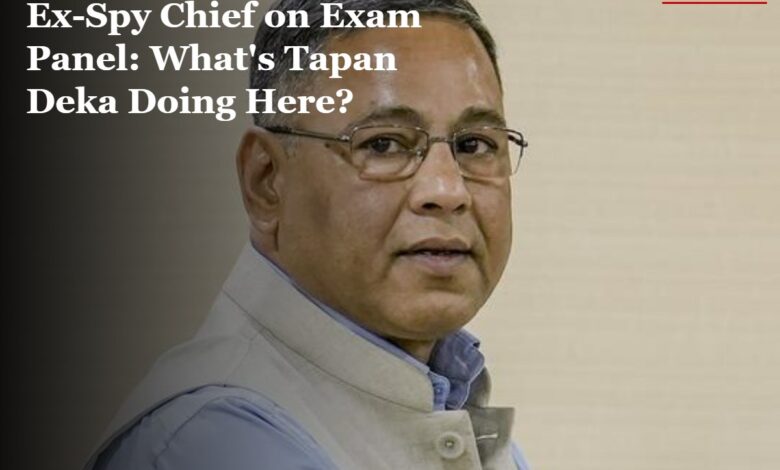
Tapan Deka Task Force:Tapan Deka, former IB Director and Himachal Pradesh-cadre IPS officer, is on Nandan Nilekani’s exam reforms task force. North Desk evaluates what Tapan Deka is doing on the exam panel.
North Desk Correspondent
Chandigarh, July 27
When Prime Minister Narendra Modi announced a six-member task force under Nandan Nilekani on Sunday to overhaul India’s examination system, most of the coverage went where the government wanted it to go — technology, transparency, the Aadhaar architect brought in to fix a broken process. Buried in the same list of names is someone whose career has nothing to do with exams, question papers, or educational technology at all: Tapan Kumar Deka, who stepped down as Director of the Intelligence Bureau exactly 26 days before this appointment.
The task force itself was Delhi’s answer to a problem it could no longer contain through denial. A NEET-UG 2026 paper leak and irregularities in CBSE’s on-screen marking process had triggered a 36-day sit-in at Jantar Mantar led by the Cockroach Janta Party, which widened after activist Sonam Wangchuk’s health deteriorated during a fast and police lathi-charged a protest march to Parliament on July 20. The agitation ended Saturday only after the government agreed to all of CJP’s demands, including the resignation of Education Minister Dharmendra Pradhan.
Nilekani’s panel — alongside former ISRO chairman S. Somanath, IIT Madras director V. Kamakoti, former education secretary Anita Karwal, and logistics expert Amrit Lal Meena — is the government’s attempt to show it is fixing the underlying system, not just absorbing one resignation and moving on.
Every other name on that list maps cleanly onto the task force’s stated job. Somanath brings large-system engineering. Kamakoti brings computing and hardware security expertise from one of India’s top technical institutes. Karwal has run the education bureaucracy from the inside. Meena’s logistics background speaks to the sheer scale of administering exams for tens of millions of candidates. Deka doesn’t fit that pattern.
Who is Tapan Deka?
Tapan Deka Task Force: He is a 1988-batch IPS officer allotted to the Himachal Pradesh cadre. His early career postings were in state policing operations in Punjab, before he moved into the Intelligence Bureau in 1998.
From there his record reads almost entirely as counter-terrorism: he ran counter-terror operations in Kashmir, led the crackdown on the Indian Mujahideen network between 2008 and 2015, oversaw investigations into the Pathankot air base attack and the Pulwama attack, and was involved in tracking down IM founder Yasin Bhatkal after his arrest in Nepal.
Closeness to Doval
Tapan Deka Task Force: He is widely described as a close aide of National Security Adviser Ajit Doval, and colleagues have called him a “crisis manager” for his role handling sensitive internal-security situations. He became IB Director in July 2022 and, across two tenure extensions, held the post for four years — the longest run for an IB chief in more than three decades — before retiring on June 30, 2026.
In fact, he would have retired in 2024 but got two extensions of one year each.
One more entry in his file is worth sitting with given the circumstances of this particular appointment: during the CAA protests in Assam, Deka played a role under Union Home Minister Amit Shah’s direction in managing the unrest and “restoring normalcy.”
In other words, the closest precedent for what Deka has actually done professionally isn’t fixing an examination system. It’s managing a protest movement.
READ ALSO: Dharmendra Pradhan Resignation Headlines: How India’s Papers Covered It
None of this means the government’s stated rationale — technology-led reform, transparency, a leak-proof exam architecture — is false. Somanath, Kamakoti, Karwal and Meena are all genuinely credentialed for exactly that job, and Nilekani’s Aadhaar-era experience with de-duplication at national scale is a defensible fit even if its record is contested.
Tapan Deka: Task Force brief
Tapan Deka Task Force: Read against what CBI investigators have actually found, though, Deka’s inclusion looks less like an odd fit and more like a functional one. The 2026 leak wasn’t a single breach — it was allegedly fed by an NTA-appointed examiner with authorized access, moved through intermediaries across four states, financed through payments running into lakhs of rupees, and circulated over Telegram.
CBI has also found evidence that the same network compromised the 2025 paper too, meaning this has operated across multiple exam cycles, not one lapse. That profile — insider recruitment, interstate logistics, sustained operation, digital tradecraft — sits much closer to the kind of networks Deka spent three decades dismantling than to a software bug or a proctoring gap. The new Public Examinations (Prevention of Unfair Means) Amendment Bill, being introduced in the Parliament, backs that reading up: it proposes fast-track courts and jail terms of up to ten years, with steeper penalties specifically for organized rackets.
Whether that’s the actual brief Deka has been handed isn’t public yet — the task force’s terms of reference haven’t been released. But it’s a more grounded explanation than the alternative, and one North Desk will be watching for once those terms are published.
ALSO READ: Why Sonam Wangchuk Ended His 26-Day Fast: The Four Assurances That Ended the Standoff
Follow North Desk on WhatsApp for the latest from Punjab, Haryana and Himachal Pradesh: https://whatsapp.com/channel/0029Vb7ccdxJENy2H87DBG3E

2 Comments