Hanuman Ansh Miracles: 5 Scenes Behind the ₹100 Crore Sleeper Hit–North Desk SUNDAY SPECIAL
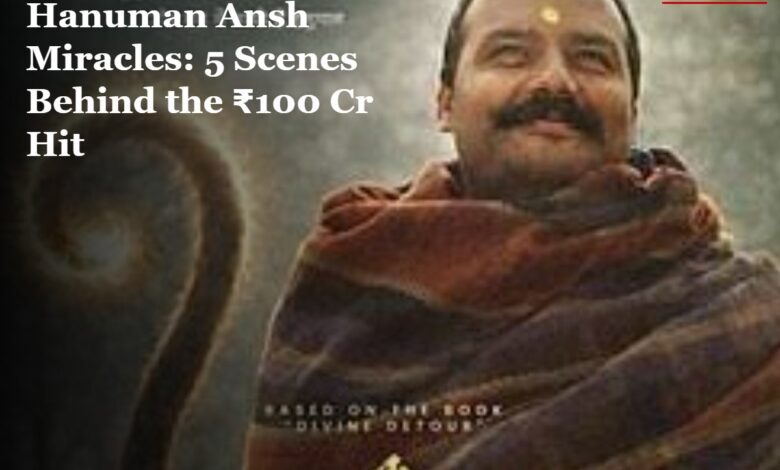
Hanuman Ansh miracles turned Rs 10 lakh into nearly Rs 100 crore in about a month on word of mouth alone. Here are the 5 miracle scenes from the film — and what’s fact, what’s film.
North Desk Correspondent
Chandigarh, September 5
Hanuman Ansh opened on August 7 to a Rs 10 lakh single day — the kind of number that usually buries a film without a trace. Twenty-nine days later, it had crossed Rs 82 crore net in India (and now nearing Rs 95-100 crore), made almost entirely on a Rs 2 crore budget, with no big-name cast and no studio marketing push behind it.
READ ALSO: Neem Karoli Baba Steve Jobs Story: How a Guru Shaped Apple and Facebook
Hanuman Ansh Miracles: Trade watchers now count it, alongside the 1975 devotional Jai Santoshi Maa, as one of the highest theatrical return-on-investment stories in Hindi cinema. On September 3, Hombale Films picked up international distribution rights; the film opens overseas on September 11 — the 53rd anniversary of Neem Karoli Baba’s mahasamadhi.
ALSO: Kainchi Dham Explained: What It Is, Why It Matters, and How to Get There
Written, directed and produced by Dr Vishal Chaturvedi under his own banner, the film draws on his book Divine Detour: That Changed My Life, tracing the journey of Lakshman Narayan Sharma — the Uttar Pradesh Brahmin boy who became Neem Karoli Baba, the “Miracle Baba” of Kainchi Dham, whose devotees would go on to include Steve Jobs, Mark Zuckerberg, and a long line of Silicon Valley seekers. The film doesn’t market itself on spectacle — its stated theme is seva, selfless service — but what’s pulling audiences back for repeat viewings, by most trade accounts, is precisely the string of miracle scenes threaded through it. Here are five of many the film puts on screen.
READ ALSO: The Harvard Professor Fired Over LSD Who Introduced America to Neem Karoli Baba
Hanuman Ansh Miracles
1. The train that wouldn’t move
The oldest and most widely told story in the Neem Karoli Baba canon. Travelling ticketless near Farrukhabad, the young sadhu is forced off a train by a British-era conductor. The train won’t restart — not for the crew, not for repeated mechanical checks. Only when officials beg him to reboard does the engine move again. The film uses this as the naming moment: the station, and eventually Baba, comes to be associated with the village of Neem Karoli.
2. A lockup in Fatehgarh
In the film’s telling, an SHO named Nasir Ali detains Baba under Section 109 at a Fatehgarh police station. Overnight, constables report Baba going in and out of the locked cell ten or twelve times. By morning, Nasir himself can’t get the lock open — until Baba tells him, “don’t get angry, Nasir, come in,” and the door gives way on its own. Nasir apologises, having concluded he was holding no ordinary man.
3. The snakes.
A quieter, stranger scene. An assistant sees snakes wrapped around Baba’s body and says the baba is Lord Shiva. The film doesn’t dwell on it or explain it — the baba plays it down and tells a stunned assistant: you just see what you want to, you saw it since you are a Lord Shiva devotee.
ALSO: Kainchi Dham Explained: What It Is, Why It Matters, and How to Get There
4. The barber’s son.
The most emotionally worked scene of the five. Baba’s wife tells him he looks better clean-shaven than bearded, so he visits a barber — who Baba notices is distracted and upset. The barber explains: his son left home six months ago after being scolded, and hasn’t been seen since. He pledges to offer Ladoos to God if he gets his son back. Baba tells him to give 75 annas as an offering, then — mid-shave — says he’ll be back, and returns two minutes later, telling the barber not to scold the boy again. The next morning, the son walks in from roughly 100 miles away, describing a half-shaven man who found him, told him to go home, and paid for his ticket with 75 annas.
5. The kadhi-chawal that didn’t run out.
The bhandara miracle — food stretching to feed everyone present — appears a few times in the film. The clearest version: Baba arrives at a village home with a few companions in tow, asking for kadhi-chawal. The woman of the house, seeing how little is left in the pot, is certain she’ll come up short. When she serves everyone, there’s enough — with some to spare. It’s the closest the film comes to stating its own theme outright: abundance follows service, not the other way round.
Hanuman Ansh has been positioned as the first of a planned trilogy, with its ending pointing toward more of Baba’s story still to come.
READ ALSO: Neem Karoli Baba Steve Jobs Story: How a Guru Shaped Apple and Facebook
READ ALSO: The Harvard Professor Fired Over LSD Who Introduced America to Neem Karoli Baba
ALSO: Kainchi Dham Explained: What It Is, Why It Matters, and How to Get There
ALSO: Neem Karoli Baba Larry Brilliant story: The Guru Behind Google.org’s Founder
Follow North Desk on WhatsApp for the latest from Punjab, Haryana and Himachal Pradesh: https://whatsapp.com/channel/0029Vb7ccdxJENy2H87DBG3E





6 Comments