AC Blast Fires: Why Air Conditioners Catch Fire And What To Do
AC Blast fires are surging from Haryana IAS Dhanendra Kumar’s death to Indirapuram and Shahdara. Here’s why it happens and what you can do to stay safe this summer.
North Desk Correspondent
Chandigarh, May 29
Dhanendra Kumar, 80, had served as Principal Secretary to the Haryana Chief Minister, represented India at the World Bank, and spent two years building the Competition Commission of India from scratch. On May 28, it was a blast in the indoor unit of an air conditioner at his Hauz Khas home in Delhi that killed him.
Kumar’s death is the most high-profile casualty in a summer that has turned the appliance most Indians rely on for survival into an unexpected and invisible threat.
He is not alone. Earlier this month, nine people died in a fire at a residential complex in Vivek Vihar in east Delhi’s Shahdara, where investigators are examining a possible AC unit fault as the trigger. And just a few days ago, a blast in a split AC on one of the upper floors of a high-rise tower in Ghaziabad’s Gaur Green Avenue society in Indirapuram sent thick black smoke billowing across the Delhi-Meerut Expressway — twelve flats were gutted, residents fled in panic, molten glass fell to the ground below. Mercifully, there were no fatalities, but only because the building’s residents moved fast.
Three incidents. Four weeks. A pattern that should alarm every household in North India as the summer deepens.
A Heatwave That Is Also a Fire Emergency
Delhi’s fire services have been receiving nearly one emergency call every seven minutes this week. More than 7,800 fire-related incidents were reported across the capital in just the first four months of 2026 — a nearly 20 per cent jump from the same period last year — with 32 people already dead. Fire-related emergencies surged 73 per cent in April alone compared to March.
Electrical faults account for nearly three-quarters of summer fires in Delhi, according to fire service data. The Delhi government’s Department of Fire Services itself states that around 60 per cent of all fires in the city are of electrical origin — short circuits, overheating, overloading.
In Chandigarh, fire officials say they have been getting fire calls as they do every year this time. “So far there hasn’t been any incident because of fire because of AC. But summer has only began and there is already a spurt in number of fires because of increasing heatwave,” said a fire official. He added that last year there were incidents of fire or blasts because of AC. “That can always happen because often there is a wooden panel next to it. Only yesterday we got fire because of an electricity meter.”
The heat is not incidental to this. It is the cause.
With the region recording its warmest May nights in 14 years, and temperatures touching 44-45°C during the day, air conditioners are running harder and longer than they were designed to. That stress, compounded by ageing wiring, infrequent servicing, and voltage fluctuations endemic to smaller cities and towns, creates conditions in which machines fail — sometimes catastrophically.
Punjab, Haryana, Himachal Pradesh and Delhi NCR are in the same heat corridor. The risks are identical.
AC Blast fires: Why Air Conditioners Catch Fire
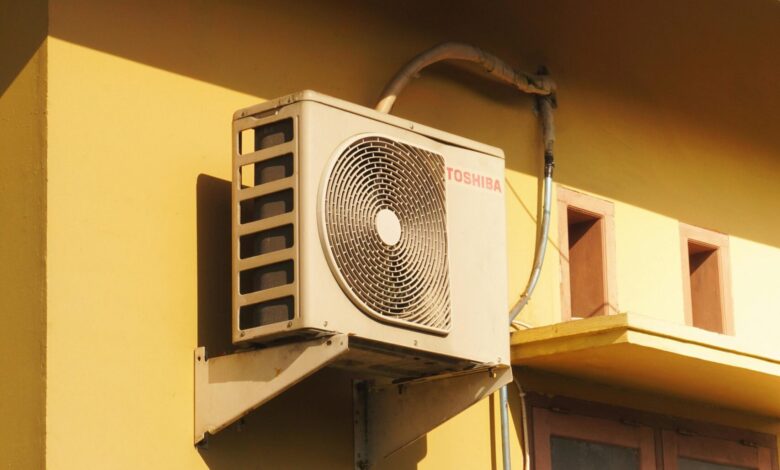
An AC does not simply cool air. It circulates a refrigerant gas through a compressor-driven cycle, expelling indoor heat outside. In a split AC, the indoor unit houses the evaporator, blower, and filter; the outdoor unit contains the compressor. Both are potential fire sources.
In extreme heat, with the AC running continuously, electrical components — particularly the compressor, capacitor, and wiring — can overheat. Non-inverter ACs are especially vulnerable: their compressors run at full speed, shut off completely, then restart at full speed again. That repeated cycle puts significant mechanical and electrical stress on the system.
Inverter ACs vary their compressor speed, which reduces strain — but they are not immune. Fires can still originate in their electronic circuit boards, from refrigerant leaks, faulty installation, or voltage fluctuations.
On AC Blast fires, There is a newer and less-understood danger: modern refrigerants. Older units used R22 gas, which is non-flammable. Most ACs manufactured and sold in India over the past several years use R32 or R290 — refrigerants that are more environmentally friendly, but flammable. If a refrigerant leak occurs near an electrical spark — from a failing capacitor, corroded wiring, or a faulty compressor — it can ignite. Most households are unaware their AC contains flammable gas.
Poor servicing compounds everything. When technicians use nitrogen for leak testing and fail to flush it out completely, residual pressure builds up inside the system. Improper vacuuming leaves moisture that gradually forms acid, corroding internal components from within. These are not freak occurrences — they are routine consequences of the unregulated, unverified AC servicing market that most Indian cities, including Chandigarh, Ludhiana, and Amritsar, rely on.
There is also the MCB problem. Miniature Circuit Breakers are installed to trip a circuit when overload is detected. When an MCB itself is faulty or of substandard quality, this safeguard fails silently — and the current continues to flow even as heat builds toward a breaking point.
Warning Signs You Should Not Ignore
AC Blast fires: According to safety guidance from major AC manufacturers, the following are signals that your unit may be developing a dangerous fault:
— Unusual noises from either the indoor or outdoor unit, particularly grinding, hissing, or crackling sounds — Frequent cycling: the unit switches on and off more often than usual — Inconsistent or deteriorating cooling despite the compressor running — A burning smell or visible smoke from the indoor unit — The circuit breaker tripping repeatedly when the AC is running
Any of these should be treated as an emergency. Do not reset the breaker and continue using the unit. Call an authorised service technician.
What You Can Do — and What You Must Stop Doing
AC Blast fires: The following precautions are drawn from manufacturer safety guidelines and fire service advisories:
Do: — Service your AC at the start of every summer, not just when it breaks down. Ask specifically for filter cleaning, refrigerant pressure check, and wiring inspection. — Check that your MCB and fuse are in good condition. If they are more than a few years old or have tripped before, have them replaced. — Set the temperature at 24–26°C. Running the AC at 18°C or lower does not cool the room faster — it strains the compressor continuously. — If your area experiences frequent voltage fluctuations, install a stabiliser for your non-inverter AC. — Ensure the outdoor unit has clear space around it. Accumulated leaves, debris, and dust restrict airflow and cause overheating. — Keep a fire extinguisher at home. The IMD has included this in its heatwave advisory this year.
Do not: — Run the AC continuously for extended periods without breaks, especially overnight and through the afternoon peak — Allow anyone other than an authorised or verified technician to refill refrigerant gas. DIY gas refills are one of the leading causes of AC-related fires, particularly when cheap or unverified refrigerant is used. — Place objects — furniture, curtains, stored material — in direct proximity to either the indoor or outdoor unit — Ignore an unusual noise or smell from your AC assuming it will resolve itself
The North India Dimension
AC Blast fire: Cities like Ludhiana, Jalandhar, Amritsar, Ambala, and Hisar experience the same summer extremes as Delhi, often with older building stock, less regulated electrical infrastructure, and an even more fragmented AC servicing market. The risks are, if anything, higher — and the awareness lower.
The Vivek Vihar AC Blast fire killed nine people in a residential building. The Hauz Khas fire killed a former Chief Secretary-level officer. The Indirapuram fire gutted twelve flats in a modern high-rise society. None of these buildings were slums. None were categorically unsafe in any obvious way.
The machine sitting in your bedroom wall, running through the night as temperatures refuse to drop, deserves more attention than most of us give it.
ALSO: Gurmeet Ram Rahim Singh Parole: 16th Release, 406 Days Outside Sunaria Prison
LIQUOR LANGAR!: Chandigarh’s Sector 9 Gets a ‘Liquor Langar’ — and a Rude Awakening
Follow North Desk on WhatsApp for the latest from Punjab, Haryana and Himachal Pradesh: https://whatsapp.com/channel/0029Vb7ccdxJENy2H87DBG3E