Why Lawyers Are Challenging Chandigarh's New Tenancy Law in High Court — North Desk
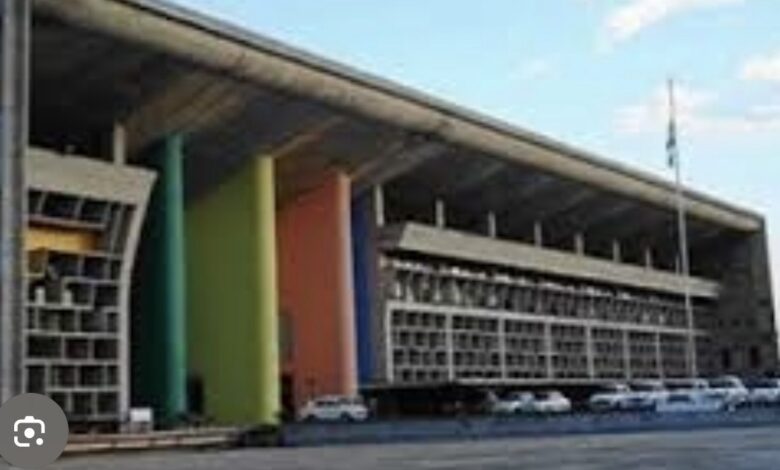
Chandigarh tenancy law in High Court : Barely eight days after the Centre extended the Assam Tenancy Act to Chandigarh, two of the city’s most powerful legal bodies have filed a writ petition challenging it. North Desk breaks down each argument, in plain language.
North Desk Bureau
Chandigarh, May 18
UPDATED ON MAY 18 EVENING: The hearing of both –the petition and the PIL–was taken up together. The PIL was withdrawn. The court ordered that the case will now go to the regular bench which hears such cases, and is likely to be taken up in one or two days.
Who has gone to court and why does it matter?
The Punjab and Haryana High Court Bar Association — the body representing advocates who practise before the High Court — and the District Bar Association, Chandigarh — which represents advocates in the district courts — have jointly filed a Civil Writ Petition before the Punjab and Haryana High Court at Chandigarh.
This is not a routine case filed by a private litigant. Two organised bodies of the legal profession, whose members deal with rent disputes every day in Chandigarh’s courts, are collectively saying the new law is legally unsustainable. That carries weight.
Additionally, a Chandigarh-based advocate has filed a public interest litigation in the Punjab & Haryana High Court challenging the Central Government notification. Both are likely to come up for hearing Monday before the bench headed by the chief justice, as per the cause list of the high court.
Chandigarh tenancy law in High Court : What exactly are they challenging?
The petition targets the Ministry of Home Affairs notification dated May 6, 2026, which extended the Assam Tenancy Act, 2021 to the Union Territory of Chandigarh, simultaneously repealing the East Punjab Urban Rent Restriction Act, 1949.
The lawyers are not challenging the idea of a new rent law in principle. Their objections are specific: the way this was done, the constitutional authority used to do it, and several particular provisions within the new Act that they say are harmful, arbitrary, and unconstitutional.
Ground 1: You can’t use a Punjab law to bring in an Assam law
Chandigarh tenancy law in High Court: This is the foundational legal argument and, if accepted by the court, could be enough to strike down the entire notification on its own.
Section 87 of the Punjab Reorganisation Act, 1966 gives the Central Government the power to extend to Chandigarh any law that is in force in the State of Punjab. The logic was straightforward: when Punjab was divided in 1966 and Chandigarh became a Union Territory, Parliament wanted a mechanism to keep Punjab laws applicable to Chandigarh so that the legal framework remained continuous.
The lawyers’ argument is this: Section 87 says “laws in force in Punjab.” The Assam Tenancy Act, 2021 is a law in force in Assam, not in Punjab. It has never applied to Punjab. Therefore, Section 87 cannot be the legal vehicle for bringing this Assam law to Chandigarh. The Centre simply did not have the authority, under this provision, to do what it did.
Judgments have been cited in favour of this argument.
Ground 2: Tehsildars and ADCs cannot decide what courts are supposed to decide
Chandigarh tenancy law in High Court: Under the new Assam Tenancy Act as extended to Chandigarh, the Rent Authority is the Tehsildar (Section 30) and the Rent Court — the appellate body — is the Additional Deputy Commissioner or ADC (Section 33). These are revenue and administrative officers, part of the executive arm of government.
Under the old East Punjab Urban Rent Restriction Act, 1949, the Rent Controller was a Subordinate Judge of the First Class — a judicial officer — and the appellate authority was the District Judge. Rent disputes were decided within the judicial hierarchy.
The lawyers argue that this transfer of adjudicatory power from judicial officers to executive officers violates the constitutional principle of separation of powers. When someone’s right to remain in their home or to recover their property is at stake — these are civil rights of the highest order — they must be decided by judges with judicial training, independence from the executive, and security of tenure. A Tehsildar has none of these.
The petition cites two landmark Supreme Court judgments on this principle both of which firmly established that judicial functions cannot be delegated to executive officers.
Ground 3: The new law guts the purpose of rent control altogether
The lawyers argue that Sections 21(2)(g) and 5 read with Section 23 of the new Act don’t just change the rent law — they destroy it from within.
Section 21(2)(g) allows a landlord to evict a tenant simply by giving a written notice, without having to demonstrate or prove any personal necessity. The entire edifice of tenant protection under rent law — built on the idea that a landlord must justify eviction — is removed.
Section 5 of the Act gives effect to notice-based termination of tenancy, and Section 23 imposes penal rent of twice the monthly amount for the first two months after termination, and four times the monthly amount thereafter, until the tenant vacates.
The petition argues that the combination of notice-based eviction and punishing penal rent renders any tenant protection “illusory.” A tenant facing a 4x rent bill every month has no real ability to contest an eviction even if they have a legitimate dispute. The law’s internal pressure makes litigation practically impossible for tenants of ordinary means. The lawyers say this defeats the very object and purpose of rent control legislation.
Stories like this one — explained clearly, without the clutter — land on our WhatsApp Channel every evening. Follow North Desk and stay a step ahead on everything that matters in North India.
Ground 4: The Assam law problem
Chandigarh tenancy law in High Court: This ground challenges the mechanical transplant of an Assam law onto a very different city.
The new Act’s definition of “premises” excludes from its coverage: hotels, lodging houses, dharamshalas, inns, industrial premises, and any premises used by a company or body corporate under Section 3. These categories are excluded from the Act’s protection entirely.
In Assam, these exclusions may make legislative sense within Assam’s broader legal framework. But in Chandigarh, these categories now exist in a legal vacuum — the 1949 Act has been repealed, and the new Act doesn’t cover them. Anyone renting a shop in an industrial area, running a lodging house, or operating a dharamshala in Chandigarh now has no rent law to turn to in a dispute. None.
The petition also argues that Chandigarh’s urban character was not considered at all when the Assam Act was transplanted here.
Ground 5: The objections were invited, then ignored
Chandigarh tenancy law in High Court: This is a procedural ground that adds a governance dimension to the legal challenge.
When the Centre first proposed bringing a new tenancy law to Chandigarh, it followed the procedure required under the General Clauses Act — it invited public objections. The bar associations filed detailed written objections.
The lawyers say they were given the impression that their objections were being considered. Then, on May 6, 2026 — without any further communication, without a hearing, and without addressing a single one of the objections filed — the notification was issued.
What are the lawyers asking the High Court to do?
Chandigarh tenancy law in High Court: The petition makes the following specific prayers:
One: Quash the MHA notification dated May 6, 2026 extending the Assam Tenancy Act to Chandigarh.
Two: Specifically quash Sections 30 and 33 (which give rent authority powers to Tehsildars and ADCs)
Three: Issue a mandamus — a court direction — to the respondent authorities to restore rent authority and appellate jurisdiction to judicial officers, as it was under the old framework.
Four: Stay the operation of the May 6 notification during the pendency of the writ petition.
The respondents in the petition are: the Chandigarh Administration through its Chief Secretary, the Chief Secretary directly, the Union of India through the Ministry of Home Affairs, the Ministry of Law and Justice, the Secretary Estates of the Chandigarh Administration, and the Deputy Commissioner (Estate Office).
North Desk will report further developments as they occur.




Very well articulated.