Manpreet Ayali Joins Akali Dal Waris Punjab De: Khalistan Remark, BJP Rejection and Punjab 2027 Signal
Manpreet Ayali: The Dakha MLA’s formal entry into Akali Dal (Waris Punjab De) gives the jailed MP’s party its first elected legislator — and could trigger a chain of defections. His Khalistan remark, BJP rejection and indictment of Badal-era SAD leadership reshape Punjab’s Panthic political landscape ahead of 2027.
Arvind Chhabra
Chandigarh, June 9
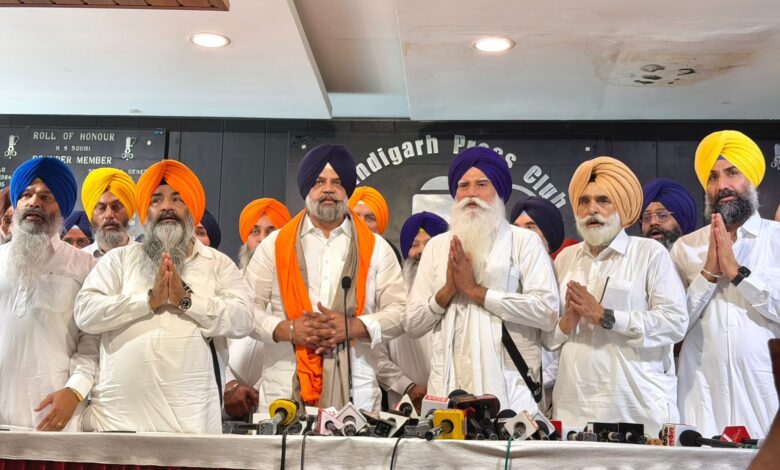
In a development that could reshape Punjab’s Panthic political landscape ahead of the 2027 Assembly elections, veteran legislator Manpreet Singh Ayali formally joined Akali Dal (Waris Punjab De) — the political party floated by jailed MP Amritpal Singh — at a ceremony in Chandigarh on Tuesday. Ayali was welcomed into the party by MP Sarabjeet Singh Khalsa and Tarsem Singh, father of Khadoor Sahib MP Amritpal, in the continued absence of the party chief who remains lodged in Dibrugarh Central Jail.
The development marks a qualitative leap for a party that, despite holding two Lok Sabha seats, has so far had no presence in the Punjab Vidhan Sabha.
Who is Manpreet Singh Ayali
Born on January 6, 1975, in Ayali Khurd village in Ludhiana district, Manpreet Singh Ayali, 51, is one of the most durable electoral forces in the Akali fold. He first won the Dakha Assembly seat in 2012, lost it narrowly to human rights lawyer and AAP leader H.S. Phoolka in 2017, reclaimed it in the 2019 by-election following Phoolka’s resignation, and then held it again in 2022 — making him a four-time contestant who has won three times from the same seat.
In the 2022 Punjab Assembly elections — a near-wipeout for the Shiromani Akali Dal — only three of its candidates survived the AAP wave: Ganieve Majithia (wife of Bikram Singh Majithia) from Majitha, Ayali from Dakha, and Dr Sukhwinder Sukhi from Banga. In a field of 117 seats, the SAD returned three. Ayali was the only one among them without the protection of either a dynasty name or an exceptional local sympathy factor — he won on his own political weight.
He subsequently became the Leader of the SAD Legislature Party in the Punjab Assembly, a largely symbolic but institutionally important role given the party’s decimated numbers. He also served as convener of a coordination committee between various Akali factions.
Beyond his electoral record, Ayali has been a long-standing internal critic of Sukhbir Singh Badal, repeatedly questioning the leadership’s style and accountability — a voice that found little space within the old guard.
The drift had been visible for a while
Today’s formal joining is not the beginning of the story — it is a confirmation of alignment that has been developing for months. Ayali had been working with Waris Punjab De for several months, and candidates backed by him in the zila parishad and panchayat elections had campaigned using Amritpal Singh’s photographs.
In April, Akali Dal (Waris Punjab De) and SAD (Punar Surjit) — a breakaway Akali faction led by Giani Harpreet Singh — had formally announced an alliance, with Ayali appointed as the convener of the Panthic Unity Coordination Committee formed to oversee the partnership.
Today’s formal party membership is therefore less a leap of faith and more the completion of a well-signalled political journey.
A blunt autopsy of the Badal era
What distinguished Tuesday’s joining from a routine political switch was the directness of Ayali’s public reasoning about why the SAD he served for decades has arrived at this point.
He said the Akali Dal founded in 1920 had served Punjab and the Panth with distinction for a long time, and the community had reposed trust in it through prolonged struggles and morchas. But then came the reckoning. “The problem is not with the Akali Dal,” he said. “The problem is with the leadership.”
He was precise. He invoked the Jhaunda Committee — the internal accountability mechanism the SAD constituted in the wake of the 2015 sacrilege and police firing controversies that devastated the party’s credibility. “When the Jhaunda Committee was formed, we made every effort to get the leadership to accept its report,” Ayali said. “If they had accepted it, the Akali Dal would have survived.” Mistakes were admitted, he said — and then the leadership went back on its word. That, in his telling, was the point of no return.
The vacuum that followed, Ayali argued, has been filled by Amritpal Singh. “Bhai Amritpal Singh has emerged as a leader and filled that vacuum — and a large number of youth are joining this direction.”
The agenda: From Bandi Singhs to Khalistan, democratically
Manpreet Ayali also laid out the issues WPD intends to fight on — and the list is a combination of long-standing Panthic demands and current Punjab grievances.
He named the release of Bandi Singhs — Sikh prisoners he described as having fought for Punjab’s rights without any personal agenda — as a central commitment. He directly raised Amritpal’s own continuing detention: despite the National Security Act having lapsed after over three years, he noted, Amritpal remains confined in Dibrugarh — a situation the party is committed to reversing.
On structural Punjab issues, Ayali went back to 1966 — the Punjab Reorganisation Act — arguing that Punjab has been denied its legitimate rights on river waters since that moment, through constitutional provisions he described as illegitimate. He raised the Bhakra Beas Management Board specifically, calling its current structure unconstitutional and noting that Punjab’s representation on it has been progressively reduced. He raised Chandigarh’s continued status as a Union Territory and the non-transfer of Punjabi-speaking areas. Unemployment, agrarian distress, and law and order also featured.
Crucially, Manpreet Ayali also ruled out any alliance with the BJP — a pointed signal to the Panthic constituency that WPD will not repeat the SAD’s trajectory of accommodation with the Bharatiya Janata Party.
And in the day’s most provocative formulation, he said the party would pursue all demands of Punjab — including Khalistan — through democratic and constitutional means. The qualification matters, but so does the statement: no mainstream elected legislator in Punjab has said this from a public platform in recent memory.
Amritpal: An MP in jail, a party from behind bars
To understand the significance of Manpreet Ayali’s entry, it is necessary to understand where Akali Dal (WPD) currently stands.
The party was formally founded on January 14, 2025, and currently holds two Lok Sabha seats — Amritpal Singh’s Khadoor Sahib and Sarabjeet Singh Khalsa’s Faridkot. It has no seats in the Punjab Legislative Assembly and remains unregistered with the Election Commission of India.
Amritpal, the party president, has been in jail since April 2023. After three years under the National Security Act in Dibrugarh Central Jail, his NSA detention expired in April 2026 — but Punjab Police immediately re-arrested him in connection with the Ajnala police station attack case of February 2023, and he was sent back to judicial custody in the same Dibrugarh jail. The Punjab and Haryana High Court, accepting the state government’s security arguments, directed that Amritpal continue to remain in custody at Dibrugarh even after the expiry of his NSA detention.
He attended Parliament just once — on July 5, 2024, when he was administered the oath of office after being granted four-day parole. Two subsequent applications seeking parole to attend Assembly sessions were rejected by the High Court, with the Punjab government consistently citing law and order concerns.
In short, the party’s president has been running political operations entirely from behind bars, and his father Tarsem Singh has been the visible face of party affairs.
Why Ayali’s joining matters
For a party with no legislative presence, an MLA — particularly one of Manpreet Ayali’s standing — is significant for several reasons.
First, it provides institutional legitimacy. A sitting elected member brings credibility that social media reach and street mobilisation alone cannot confer. It signals to fence-sitters within the Akali spectrum that joining WPD is not a fringe move.
Second, Manpreet Ayali’s base in Dakha, a constituency he has won three times, gives the party its first Assembly-level pocket of organised support in the Ludhiana-Malwa belt — a geography where it has been weaker than in the Majha region.
Third, and perhaps most significantly, Manpreet Ayali has framed his own joining as the trigger for a cascade. He stated that several political leaders and supporters were waiting for him to take the plunge before announcing their own decisions, adding that the next five to six months would see a series of high-profile inductions.
The name he specifically flagged in this context should make the AAP government sit up. On reports of AAP MLA Kunwar Vijay Pratap Singh being seen with WPD leaders, Manpreet Ayali said: “He is thinking about it, and there are very good chances that he may join the party.” Kunwar Vijay Pratap is a former IPS officer and the former head of the Special Investigation Team probing the 2015 sacrilege cases — a figure with a pan-Punjab public profile that crosses community lines.
The anti-defection question
There is also a procedural dimension with an unusual twist. Since Waris Punjab De is not a registered political party, Manpreet Ayali faces no disqualification under the anti-defection provisions of the Tenth Schedule. But his own statement adds a further wrinkle: he has said he does not intend to resign from the SAD for now. This means the SAD must decide whether to expel its only credible sitting MLA — absorbing the embarrassment of him simultaneously holding membership of both organisations — or let the situation stand, which carries its own humiliation.
2027 and the Panthic consolidation play
With the 2027 Punjab Assembly elections just months away, a pattern is emerging. The Badal-era SAD won three seats in 2022. It has since watched its leadership face public penance for sacrilege-era failures, its factions splinter, and now one of its three surviving MLAs walk out the door while simultaneously declining to formally resign.
The Panthic consolidation around Amritpal’s party is not yet a coalition — the Punar Surjit alliance talks collapsed not long ago. But the direct induction of Ayali suggests WPD is now attempting a different strategy: absorbing leaders individually rather than negotiating bloc-to-bloc mergers. Whether Amritpal will be free to campaign, whether the party achieves ECI registration before 2027, and whether the consolidation can translate into seats across a 117-constituency map — these remain the critical open questions..
ALSO READ: Mohali Office Murder: Dimple Stabbed to Death by Ex-Partner–Entire Attack on CCTV
ALSO READ: Bikram Majithia Row: Who Is Jobanpreet, and Why Bikram Majithia Was Named in FIR
Follow North Desk on WhatsApp for the latest from Punjab, Haryana and Himachal Pradesh: https://whatsapp.com/channel/0029Vb7ccdxJENy2H87DBG3E