Panchkula School Negligence: How Systemic Lapses Failed a Special Needs Child
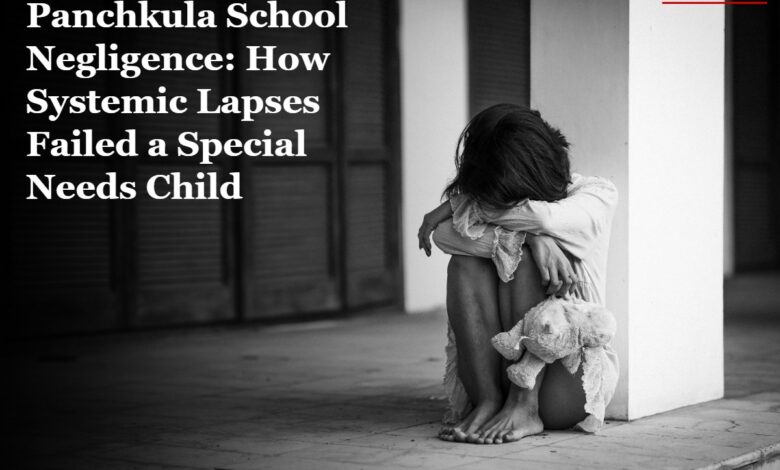
Panchkula School Negligence: A six-year-old child with special needs was brutally assaulted in a Panchkula government school. Here is how institutional lapses and absent supervision failed her.
North Desk Correspondent
Chandigarh, November 1
Panchkula School Negligence: The brutal assault of a six-year-old girl with special needs inside a government school classroom in Panchkula exposes the fatal distance between policy mandates and ground reality even though state and central education policies routinely champion inclusive schooling,
The incident, which left the Class 1 student battling severe injuries at the Postgraduate Institute of Medical Education and Research (PGIMER) in Chandigarh, has triggered a high-level administrative inquiry, an FIR against the school administration for gross negligence, and suo motu cognisance by the Haryana State Commission for Protection of Child Rights (HSCPCR).
Beyond the initial shock of an eight-year-old boy inflicting grievous harm on a younger classmate, the emerging details point squarely toward a total collapse of institutional custody, duty of care, and basic campus safety protocols.
Panchkula School Negligence: The Lapses in Supervision and Emergency Response
Panchkula School Negligence: Under the Ministry of Education’s Guidelines on School Safety and Security, primary sections require constant adult presence, active corridor monitoring, and designated attendants for children with special needs (CwSN).
In this instance, critical lapses occurred across three fronts:
- Unmonitored Classrooms: The two minors were left unattended inside a classroom without teacher presence or an assigned caretaker during school hours.
- Delayed Intervention: Family members alleged that access to the room was delayed and the child remained unassisted for an extended duration before medical help was arranged.
- CCTV Disconnect: While surveillance cameras reportedly captured the sequence of events, real-time human monitoring—a standard safety directive across state-run institutions—was entirely missing.
Inclusion Without Infrastructure: The Resource Gap
Panchkula School Negligence: India’s Rights of Persons with Disabilities (RPwD) Act, 2016 mandates that schools provide reasonable accommodation, individualized support, and trained resource personnel to ensure safe, inclusive learning environments.
Yet, government primary schools across the region continue to operate with severe deficits in dedicated special educators and trained non-teaching attendants. When children requiring higher degrees of supervision are enrolled without corresponding support staff, the responsibility defaults onto regular teachers who often juggle overcrowded classrooms and administrative duties.
The Panchkula incident illustrates the severe operational hazards of enrolling vulnerable children without fulfilling mandatory staffing protocols.
The FIR details
Panchkula School Negligence: The Panchkula police registered a First Information Report (FIR) focusing on institutional negligence under relevant provisions of the Bharatiya Nyaya Sanhita (BNS) and the Juvenile Justice (Care and Protection of Children) Act, fixing liability on the school staff for failure to safeguard a minor under their charge.
Simultaneously, statutory child protection bodies are navigating the legal parameters concerning the eight-year-old boy. Under the Juvenile Justice Act and established legal principles of childhood culpability (doli incapax), the focus for a child of this age remains strictly non-punitive. Interventions directed by the Child Welfare Committee (CWC) and the Juvenile Justice Board (JJB) center on comprehensive psychological assessments, home environment inquiries, and structured trauma counseling.
High-Level Inquiries Underway
Panchkula School Negligence: The Haryana government and district administration have constituted inquiry panels to scrutinize staff duty rosters, campus gate logs, and internal oversight mechanisms active on the day of the incident. HSCPCR has also demanded a comprehensive action-taken report detailing past safety audits of the premises.
As the six-year-old victim recovers under medical care, the broader question confronting the education department extends beyond individual suspensions: whether government schools possess the operational discipline, human resources, and vigilance required to guarantee the physical safety of the children entrusted to their custody.
ALSO: Chandigarh Sector 22 Murder: How an Instagram Reel Brawl Triggered Deadly Schoolkid Shooting
Follow North Desk on WhatsApp for the latest from Punjab, Haryana and Himachal Pradesh: https://whatsapp.com/channel/0029Vb7ccdxJENy2H87DBG3E