Punjab Stubble Burning Crisis: How Cash Promises Turned into Police FIRs
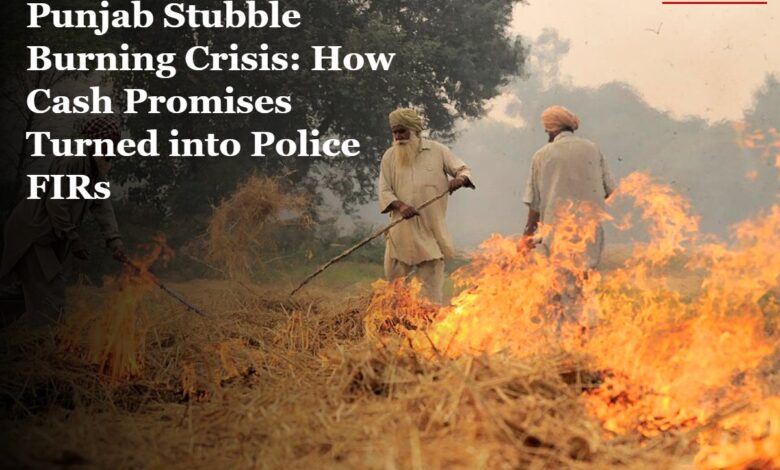
An in-depth investigation into Punjab stubble burning crisis: How 4,600 farm fires, vanished cash incentives, and punitive red entries left farmers stranded.
North Desk Correspondent
Chandigarh, November 10
Every November across the Malwa and Majha plains, the onset of winter brings an all-too-familiar haze, stinging eyes, and toxic air quality warnings across north India. Yet, beneath the smog choking the northern plains lies a deeper, systemic failure of state governance.
Four years after the Aam Aadmi Party (AAP) swept into power in Punjab on the promise of systemic agricultural overhaul and scientific farm management, the ground reality in 2026 presents a grim paradox. Instead of the promised ₹2,500 per acre financial compensation and universal bio-decomposer coverage, Punjab’s small and marginal farmers have received over 1,440 police FIRs, punitive “Red Entries” in their land revenue records, and empty machinery sheds.
The ongoing Punjab stubble burning crisis is no longer merely an ecological dilemma; it has become an administrative trap where farmers bear the criminal brunt of state-level inaction.
Punjab Stubble Burning Crisis:
The Broken Timeline: From “One Year Guarantee” to Endless Deflection
Punjab Stubble Burning Crisis: To understand the scale of the current impasse, one must examine the documented political record.
Back in October 2020, while serving as the Chief Minister of Delhi, Arvind Kejriwal routinely held Punjab responsible for Delhi’s hazardous air quality index, describing paddy residue burning as the principal culprit behind northern smog.
Following AAP’s landslide victory in Punjab in March 2022, the political calculation changed overnight. On November 4, 2022, Arvind Kejriwal shared a press briefing stage with Chief Minister Bhagwant Mann in New Delhi. On camera, Kejriwal acknowledged direct responsibility, famously stating:
“Now we have our government in Punjab; stubble burning is entirely our responsibility. Give us one year, and by next November it will be resolved.”
Four years down the road, with over 4,600 active farm fires recorded in the state this harvesting season alone, that guarantee has dissolved. Rather than providing an independently verifiable assessment of residue management infrastructure, state ministers have reverted to holding defensive press briefings targeting neighbouring states and central authorities.
Punitive Action Over Support: The “Red Entry” Nightmare
Punjab Stubble Burning Crisis: The most damaging consequence of this policy breakdown has fallen squarely on the farming community. Caught in a narrow 15-day window between paddy harvesting and wheat sowing, farmers without access to heavy residue machinery resort to matchsticks out of sheer economic compulsion.
Instead of deploying functional alternatives, the state administration has taken a punitive turn:
Over 1,440 FIRs: State authorities have registered hundreds of criminal cases against farmers under Section 223 of the Bharatiya Nyaya Sanhita (BNS) for defying residue burning bans.
Over 1,000 Red Entries in Jamabandis: District revenue officials have slapped “Red Entries” into land records across Ferozepur, Sangrur, Bathinda, and Tarn Taran.
Credit Freezes: A red entry acts as an administrative chokehold. Farmers marked with these entries are barred from obtaining fresh Kisan Credit Card (KCC) loans, mortgaging land, or securing official revenue clearances, pushing them directly into the hands of private moneylenders.
The irony has not been lost on farmer unions. The very leadership that declared in 2022 that “farmers are not criminals” is now maintaining official registries that penalize the agrarian backbone of the state.
Where Did the ₹2,056 Crore Go? The Machinery Deficit
Punjab Stubble Burning Crisis: Between the 2018–19 and 2025–26 financial years, the Central Government disbursed ₹2,056.50 crore to Punjab under the Crop Residue Management (CRM) Scheme. On paper, the Punjab Agriculture Department claims to have deployed over 94,450 subsidized residue management machines—including Super Seeders, Happy Seeders, Straw Management Systems (SMS), mulchers, and balers.
However, a survey of ground realities reveals three glaring operational gaps:
Custom Hiring Centres (CHCs) in Paralysis: A significant proportion of registered CHCs exist only on paper or lack functional tractors with adequate horsepower (55–65 HP) required to operate heavy Super Seeders.
Access Inequity: Marginal farmers holding fewer than five acres cannot afford the high rental rates (ranging from ₹2,000 to ₹2,800 per acre including diesel costs) charged by private operators during the peak rush.
The Bio-Decomposer Illusion: The much-touted Pusa Bio-Decomposer spray—promised by AAP leadership in 2021 as a cost-free solution to dissolve stubble in fields within 20 days—has disappeared from state agriculture distribution points without leaving any measurable trace on ground acreage.
The Inter-State Contrast: How Haryana Managed Industrial Off-Take
Punjab Stubble Burning Crisis: Punjab’s administrative inertia becomes even starker when contrasted with its immediate neighbour, Haryana.
| Metric / Parameter | Punjab Policy Execution | Haryana Policy Execution |
| Direct Cash Incentive | Proposed ₹2,500/acre; abandoned after tying it to external funds | Provided ₹1,000/acre direct DBT; enhanced up to ₹1,200/acre |
| Industrial Off-Take | Stalled biomass projects; limited local boiler integration | Operational Panipat 2G Ethanol Plant utilizing lakhs of metric tonnes of straw |
| Administrative Stance | High incidence of Red Entries and police cases | Focus on ex-situ aggregation, baler subsidies, and verified payouts |
| Reduction in Farm Fires | Elevated fire counts across key belt districts | Consistent 60% to 70% decline in farm fire incidents |
By treating crop residue as an industrial raw material rather than a criminal offense, Haryana created a functional market for paddy straw bales, relieving farmers of the clearance burden while putting direct cash into their bank accounts.
ALSO: Punjab AQI Turns Severe Amid Stubble Burning: 1,152 New Blazes Choke Malwa
Follow North Desk on WhatsApp for the latest from Punjab, Haryana and Himachal Pradesh: https://whatsapp.com/channel/0029Vb7ccdxJENy2H87DBG3E