Punjab AQI Turns Severe Amid Stubble Burning: 1,152 New Blazes Choke Malwa
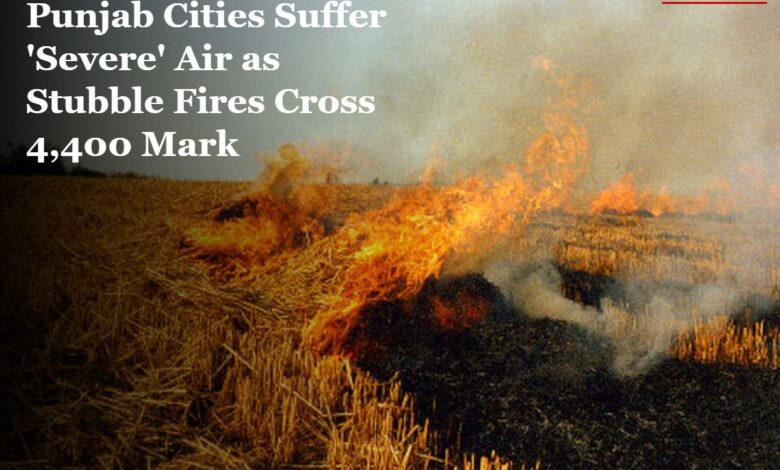
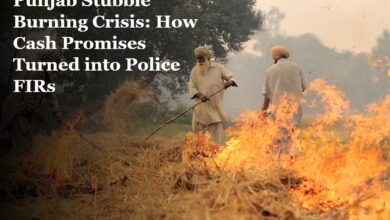
Punjab AQI Turns Severe Amid Stubble Burning: While national headlines focus on Delhi, Punjab’s own heartland is gasping for air. Single-day farm fires spiked to 1,152, pushing Mandi Gobindgarh AQI to 445 and choking Malwa.
North Desk Correspondent
Chandigarh, November 9
For years, the national air pollution discourse every November has been dominated by a singular narrative: Delhi gasping under a blanket of north-westerly smoke blamed on Punjab’s agricultural fires.
Yet on the ground across the Malwa and Majha plains, an acute environmental and public health crisis is playing out directly inside Punjab. In urban centres and rural hamlets across the state, residents are inhaling air that is frequently more toxic, stagnant, and dangerous than the capital city’s air, with regional monitors breaching hazardous thresholds.
The crisis intensified sharply as the state recorded 1,152 fresh stubble burning incidents in a single 24-hour cycle, pushing the cumulative seasonal farm fire count past 4,459 cases. Coupled with local festive emissions, the industrial hub of Mandi Gobindgarh touched an alarming AQI of 445 (‘Severe’), while cities like Bathinda, Jalandhar, and Ludhiana continue to reel under dense, persistent smog blankets.
The Malwa Chokehold: Punjab’s Worst-Hit Belts
Punjab AQI Turns Severe Amid Stubble Burning: While satellite maps track smoke plumes heading toward Delhi-NCR, the heaviest particulate concentration remains trapped directly over Punjab’s central and south-western farm belts due to seasonal temperature inversions and low wind velocity.
According to latest real-time monitoring and official agency disclosures:
The Single-Day Spike: The 1,152 single-day farm fire count marks a sharp 34.8% spike in active fire spots across the state, indicating that post-harvest clearing has entered its peak window.
Top Fire Hotspots: Tarn Taran leads the state with over 654 cumulative farm fires, closely followed by Ferozepur (592 fires, including 157 new cases), Sangrur (488 cases, with 194 fresh fires in a single day), and Bathinda (406 cases, adding 132 new blazes).
Industrial & Urban Smog Traps: In Mandi Gobindgarh, the Central Pollution Control Board (CPCB) air monitors recorded an index reading of 445, firmly placing it in the emergency ‘Severe’ bracket. Meanwhile, Ludhiana recorded an AQI of 281, Jalandhar 260, and Khanna 249, with Amritsar languishing in the ‘Very Poor’ category.
The Bathinda Extremes: Just days earlier, localized and private sensor networks in Bathinda recorded spikes breaching the 1,000–1,100 mark before standard 24-hour averages settled into toxic ranges, highlighting intense micro-climatic pollution pockets where stubble smoke sits trapped over residential neighbourhoods.
Punjab AQI Turns Severe Amid Stubble Burning: Ground Reality
Punjab AQI Turns Severe Amid Stubble Burning: While metropolitan cities have access to air purifiers and extensive air-monitoring coverage, rural Punjab faces this toxic exposure with virtually no protective buffer:
1. Surge in Acute Respiratory Cases: Outpatient departments (OPDs) in civil hospitals across Bathinda, Sangrur, Mansa, and Patiala are reporting a 35–45% surge in acute bronchitis, asthma aggravations, and burning eye infections, particularly among agricultural labourers and children.
2. The “Evening Inversion” Phenomenon: Over 90% of stubble-burning activity now occurs in the late afternoon (between 3:00 PM and 6:00 PM) to avoid daytime polar-satellite overpasses. As nighttime temperatures drop, the heavy particulate matter (PM2.5) cannot disperse into the upper atmosphere, settling at breathing level until midday sun clears the fog. 3. Traffic Hazards: Low-lying smog has drastically curtailed morning visibility on rural links and national highways (including the Amritsar–Bathinda NH-54 and Patiala–Sangrur stretches), causing vehicle pile-ups and halting.
The Administrative Breakdown: Subsidies vs ‘Red Entries’
Punjab AQI Turns Severe Amid Stubble Burning: The sharp escalation in fires exposes persistent structural friction between state enforcement and farming communities:
Resistance to Penal Actions: The state revenue and police departments have been issuing ‘red entries’ in land records (khasra girdawari) against farmers caught burning residue. However, nodal officers deployed in rural pockets frequently face resistance and gheraos by active BKU (Bharatiya Kisan Union) cadres who prevent challans from being served.
The Machinery Bottleneck: Farmers argue that the subsidized Crop Residue Management (CRM) machinery—such as Happy Seeders and Super Seeders—remains cost-prohibitive for small and marginal landholders holding under 5 acres, given diesel costs and tight time windows between paddy harvesting and wheat sowing.
Political High-Ground Vanishes: With the AAP governing Punjab, the party can no longer redirect accountability toward an opposition-ruled state machinery in Chandigarh, while opposition parties (BJP, Congress, SAD) cite the mounting fire count and ‘Severe’ air quality index readings as proof of administrative inaction.
ALSO: 1984 Massacre: ‘200 Murders in One FIR’: Ex Judge Dhingra on How Trials Were Rigged
Follow North Desk on WhatsApp for the latest from Punjab, Haryana and Himachal Pradesh: https://whatsapp.com/channel/0029Vb7ccdxJENy2H87DBG3E