Persistent Refusal of Sexual Relations Without Reason is Mental Cruelty: Supreme Court
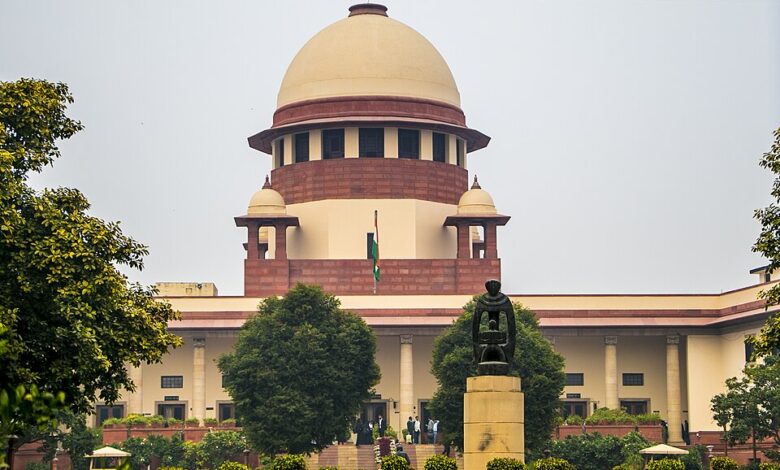
In a significant ruling that has implications for how Indian courts assess marital cruelty, the Supreme Court has held that denial of conjugal rights including persistent refusal of sexual relations without reasonable cause constitutes mental cruelty and is a valid ground for divorce under the Hindu Marriage Act.
North Desk Bureau
New Delhi, June 5
The Supreme Court of India has ruled that a spouse’s persistent refusal to engage in sexual relations without any reasonable cause constitutes mental cruelty under Section 13(1)(ia) of the Hindu Marriage Act, 1955, and is sufficient ground for a court to grant divorce.
The ruling, delivered this week by a bench of Justices Sanjay Karol and Augustine George Masih, came in a matrimonial dispute involving a doctor couple from Rajasthan and Gujarat who had been living separately for over 15 years after barely two to three months of cohabitation in an 18-year-old marriage.
The Case
The couple had married in December 2007 as per Hindu rites. Both were government doctors — the husband posted in Rajasthan, the wife employed as a gynaecologist in Gujarat. No child was born from the marriage.
Within months of the wedding, the parties began living separately. The husband filed for divorce in 2009 before the Family Court at Bharatpur, Rajasthan, alleging cruelty under Section 13(1)(ia) of the Hindu Marriage Act. The Family Court dismissed the petition in August 2019, holding that the husband had failed to prove cruelty on the wife’s part.
The husband appealed to the Rajasthan High Court, which reversed the Family Court’s finding in January 2025 and granted divorce. The wife then approached the Supreme Court, maintaining throughout — from the trial stage all the way to the apex court — that she had never wished to dissolve the marriage and was willing to resume matrimonial life.
The Supreme Court dismissed her appeal, upholding the divorce.
Refusal of sexual relations: The Locked Bedroom
A key factual finding that influenced the court’s reasoning was the wife’s conduct even during the brief period of cohabitation. The husband’s evidence, which the wife did not deny, was that she would retire early to her room, lock it from inside and not open the door despite knocking. The husband was left to sleep in a separate room.
The court found this conduct, taken together with the persistent refusal of sexual relations over the years, to constitute mental cruelty. It relied on the Supreme Court’s earlier landmark ruling in Samar Ghosh v. Jaya Ghosh (2007), which had laid down that a unilateral decision to refuse intercourse for a considerable period without physical incapacity or valid reason may amount to mental cruelty.
“The courts in India have repeatedly established that withholding sexual intimacy inflicts severe emotional distress and undermines the bedrock of marriage,” the bench observed.
Rights Cannot Be Claimed Without Duties
Refusal of sexual relations/conjugal rights: Beyond the specific facts, the judgment contains an important articulation of the court’s understanding of marriage as a legal institution. The bench held that conjugal rights and conjugal duties are inseparable — one cannot be demanded while the other is abandoned.
“Marriage, in its legal and constitutional dimension, can never be reduced to a mere contractual intersection of individual rights, nor can it be viewed strictly through the narrow lens of a petition for conjugal rights. It is a deeply personal and social partnership built on mutual respect, shared expectations and equal responsibility,” the bench said.
“Conjugal rights do not exist in a vacuum; they are the structural counterparts to conjugal duties. To demand the fulfilment of the former while wilfully abandoning the sanctity of the latter is to undermine the very essence of the institution. Matrimony, therefore, is not a one-sided right to be enforced, but a shared covenant of emotional support, fidelity, responsibility and care, where the rights of one are always tied to the duties they owe to the other.”
15 Years Apart: Separation Itself as Cruelty
The court went further, holding that prolonged separation — spanning over 15 years in this case — can itself constitute mental cruelty to both parties under Section 13(1)(ia) of the Hindu Marriage Act. This is a significant legal holding because it means an appellate court does not necessarily need to invoke Article 142 of the Constitution (the Supreme Court’s extraordinary power to do “complete justice”) to grant divorce on grounds of irretrievable breakdown. It can arrive at the same outcome through the statutory cruelty ground.
“Where parties have been living separately for several years and asking them to live together after a prolonged duration would amount to cruelty to both the parties, divorce can be granted on this ground as provided under Section 13(1)(ia) of the HMA,” the bench held.
The court also noted that an appellate court is entitled to take into account events and conduct during the pendency of litigation — not just at the time of filing — while assessing whether cruelty has been established.
‘Actions Speak More Than Dry Words’
Refusal of sexual relations: The wife’s consistent submission before every court — that she was willing to live with her husband — did not find favour with the Supreme Court. The court noted that despite this stated willingness, she continued to work in Gujarat and there was no evidence of any concrete step taken to join her husband in Rajasthan.
“There appears to be no intention on her part to join company of the husband as actions speak more than the dry words,” the bench observed pointedly.
The court also noted that granting divorce would not cause harm to any third party since there were no children from the marriage, and that both parties were financially independent government doctors.
ALSO READ: Mohali Office Murder: Dimple Stabbed to Death by Ex-Partner–Entire Attack on CCTV
The Broader Legal Significance
Refusal of sexual relations: The judgment clarifies and consolidates several strands of matrimonial law:
First, it reaffirms that denial of conjugal rights — specifically, persistent refusal of sexual intimacy without reasonable cause — is mental cruelty under Section 13(1)(ia) of the Hindu Marriage Act, not merely a ground for seeking restitution under Section 9 of the same Act.
Second, it holds that prolonged separation, taken together with absence of any genuine effort at reconciliation and complete emotional alienation, can amount to cruelty under the statute itself — without requiring the court to invoke its extraordinary constitutional powers under Article 142.
Third, it establishes that an appellate court can legitimately consider conduct and events during the entire period of litigation, including developments after the original petition was filed, while assessing whether the ground of cruelty has been made out.
Fourth, it reinforces that a spouse’s verbal or pleaded willingness to reconcile must be matched by actual conduct. Courts are entitled to test stated intentions against real-world actions. The bench was conscious of the weight of dissolving a marriage over one party’s objection. “This Court is conscious of the view that the approach of the Courts should be to preserve the sanctity of marriage and the Court should be reluctant to dissolve the marriage at the mere asking of one of the parties,” the judgment notes. However, it concluded that after 15 years of separation, “there is no sanctity left in the marriage.”
ALSO READ: Mohali Office Murder: Dimple Stabbed to Death by Ex-Partner–Entire Attack on CCTV
ALSO READ: Bikram Majithia Row: Who Is Jobanpreet, and Why Bikram Majithia Was Named in FIR
Follow North Desk on WhatsApp for the latest from Punjab, Haryana and Himachal Pradesh: https://whatsapp.com/channel/0029Vb7ccdxJENy2H87DBG3E




One Comment