The Hindu Apologises for Front-Page Dera Sacha Sauda Ad: Why This Is Different From a Correction
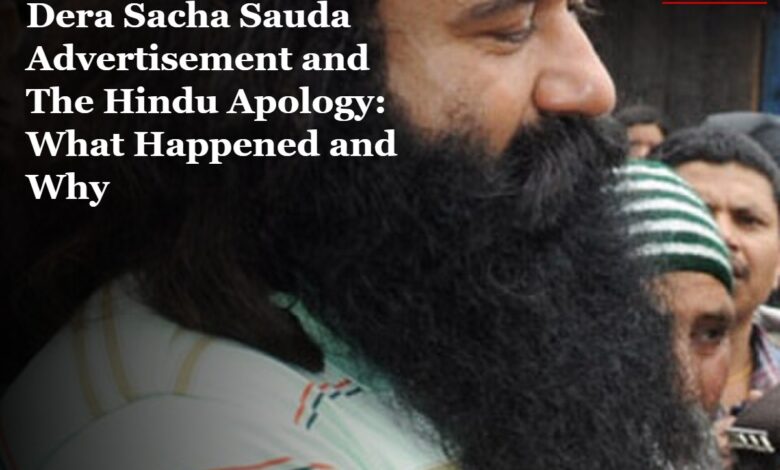
The Hindu apology Dera Sacha Sauda advertisement row explained — what the front-page ad claimed, why The Hindu apologised, and the unanswered question of who approved it.
North Desk Correspondent
Chandigarh, September 14
On September 12, readers of The Hindu’s Delhi, Mohali and North India editions opened their newspapers to a front page that looked, at first glance, like a news feature. A bold headline “What is Dera Sacha Sauda? (Facts vs Fiction)” sat above a Q&A layout, complete with subheads, court citations, and infographics. It was, in fact, a full-page paid advertisement defending Dera Sacha Sauda chief Gurmeet Ram Rahim Singh, who is serving a 20-year sentence for raping two women disciples. By the next morning, The Hindu had published an unconditional apology on its own front page. That sequence — a legacy newspaper publicly apologising for a paid advertisement, rather than for its own reporting — is rare and unusual.
The Hindu Apology Dera Sacha Sauda Ad: What the advertisement said
The Hindu Apology Dera Sacha Sauda Advertisement: The ad was structured to resemble editorial content rather than a typical display advertisement. It posed questions in a Q&A format and supplied the Dera’s own answers:
- “Was there a conspiracy against Guru Ji?” — “Yes, absolutely,” blaming a conspiracy by “drug mafias and forces opposed to the Dera.”
- “Do the parole and furlough granted to Sant Dr. Gurmeet Ram Rahim Singh amount to VIP treatment?” — “No, not at all,” followed by a section titled “What the courts said,” invoking the Punjab and Haryana High Court and the Supreme Court to lend judicial authority to the claim.
- A statistics block citing, without independent verification, that the Dera had freed 7.5 crore people from addiction, planted 35.4 crore trees, donated over 93 lakh units of blood, built 2,368 homes for the needy, and run cleanliness campaigns in 36 cities.
A small disclaimer at the bottom read that The Hindu had no editorial or journalistic involvement in the creative and would not be liable for its content. An identical Hindi version ran the same day in Dainik Bhaskar’s Delhi edition.
Why the backlash was immediate
The Hindu Apology Dera Sacha Sauda Advertisement: The ad’s framing of Ram Rahim — his case is well documented and un-appealable on the central rape conviction — clashed directly with The Hindu’s institutional identity as a paper built on editorial credibility. Criticism came fast and specifically: journalists and alumni of the Asian College of Journalism publicly questioned former editor-in-chief N Ram and Malini Parthasarathy, Director of The Hindu Group, over the decision to give such prominent space to an organisation headed by a convicted rapist. Social media amplified the anger, particularly over language in the ad that described Ram Rahim in terms critics called sanitising.
What the apology said
The Hindu Apology Dera Sacha Sauda Advertisement: On September 13, The Hindu ran a front-page apology:
“The Hindu deeply regrets the publication in its Delhi, Mohali, and North India editions of an offensive front-page advertisement titled ‘What is Dera Sacha Sauda? (Facts vs Fiction)’ and alleging, among other things, that there was a conspiracy against the convicted rapist, Gurmeet Ram Rahim Singh, head of the Dera Sacha Sauda, by ‘drug mafias and forces opposed to the Dera.’ The Hindu tenders its unconditional apology to its readers for publishing this deeply offensive advertisement.”
N Ram confirmed on X that the apology ran on the front page of all editions. Visually, the correction was a fraction of the size and visual weight of the original ad — a single formal column of text against a full-bleed, graphic-heavy page.
Why this is unusual
The Hindu Apology Dera Sacha Sauda Advertisement: Newspapers routinely publish corrections for factual errors in their own reporting — a wrong name, a misattributed quote, a misstated figure. They almost never apologise for paid advertisements, and there is a structural reason for that: the disclaimer. By law and convention, once a publication discloses that content is a paid advertisement and disclaims editorial involvement, liability for that content’s accuracy shifts to the advertiser, not the publisher. The Hindu had that disclaimer in place and chose to apologise anyway — voluntarily, with no court order compelling it.
The nearest comparable precedent is instructive precisely because it is different in kind. When Patanjali Ayurved’s Baba Ramdev and Acharya Balkrishna apologised in newspapers over misleading advertisements, they did so because the Supreme Court held them in contempt and ordered the apology published, in specified size, across dozens of papers.
That was the advertiser apologising under judicial compulsion. Here, the publisher apologised for someone else’s paid content, under no such order — an inversion that has no easy parallel in recent Indian newspaper history.
The unanswered question: who approved this?
The Hindu Apology Dera Sacha Sauda Advertisement: The Hindu’s apology does not explain how the advertisement was accepted in the first place, or whether any editorial figure reviewed it before it ran on the front page — the most valuable placement in the paper. The ad’s format compounds the concern: rather than reading as conventional advertising copy, it borrowed the visual grammar of an editorial explainer — headline, subheads, a “what the courts said” section citing judicial bodies — making it easy to mistake for reporting on first glance.
That raises a distinct question from the apology itself: was this simply a commercial acceptance lapse, or did the ad’s news-like design specifically get it past editorial scrutiny that a conventional display ad would have triggered? The Hindu has not addressed this.
The legal cloud the ad ignored
The advertisement’s framing of Ram Rahim’s cases as closed or vindicated by courts sits uneasily against the actual state of litigation. He was convicted by a CBI court in 2017 for the rape of two disciples — the sentence he is currently serving. He was also convicted in 2019 of the 2002 murder of journalist Ram Chandra Chhatrapati, who had published an anonymous letter accusing him of rape and was shot dead outside his home; the Punjab and Haryana High Court later overturned that conviction, and an appeal against that acquittal remains pending before the Supreme Court.
A separate conspiracy-to-murder case involving former Dera manager Ranjit Singh also has an appeal pending before the Supreme Court. He is additionally facing trial in a case involving allegations of forced castration of Dera followers. Legal experts have noted that running a full-page defence casting doubt on these proceedings while they remain sub judice could itself invite scrutiny for contempt.
The regional context: parole and “Bandi Singh” comparison
For Punjab and Haryana, this episode lands on top of an already running controversy. Ram Rahim has been released on parole or furlough repeatedly — SGPC functionaries have put the count at 17 times — most recently a 21-day furlough in August 2026. Each release has drawn condemnation from the Akal Takht and the SGPC, who have consistently framed it as “double standards”:
They say that Sikh prisoners who have completed their sentences, including those held for decades, remain in custody, while a rape and murder convict is released “as if on a picnic,” in the words of Akal Takht Jathedar Kuldeep Singh Gargaj.
ALSO: Gurmeet Ram Rahim Furlough: 17th Release; Here’s How Much Time He Has Spent Outside Prison
ALSO: Hawara Parole U-Turn: Punjab Police Opposed It Months Ago, Now Mann Meets Governor
Follow North Desk on WhatsApp for the latest from Punjab, Haryana and Himachal Pradesh: https://whatsapp.com/channel/0029Vb7ccdxJENy2H87DBG3E




One Comment