SIR Punjab Explainer: What Is the Special Intensive Revision of Voter Rolls — And What Does It Mean for You
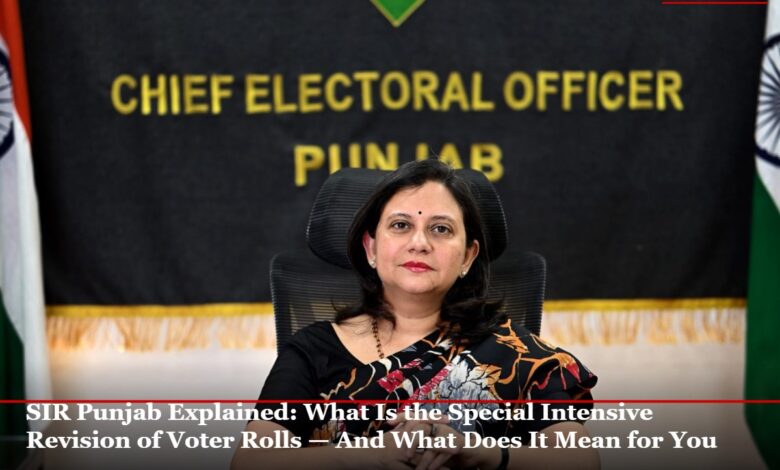
SIR Punjab: BLOs will visit every home in Punjab from June 25 under the Election Commission’s Special Intensive Revision. Here is what the form is, what happens if you don’t submit it, and what NRIs and new voters need to know.
North Desk Correspondent
Chandigarh, June 25
SIR Punjab: What exactly is happening?
Starting June 25, government officials called Booth Level Officers (BLOs) will begin knocking on doors across every constituency in Punjab. Their job: verify that your name is on the voter list, hand you a pre-printed form with your existing details, and collect it back once filled.
This is the Special Intensive Revision (SIR) of electoral rolls — a massive, nationwide exercise ordered by the Election Commission of India (ECI) to clean up and update India’s voter lists. Punjab is part of SIR Phase III, which covers 16 states and 3 Union Territories announced by the ECI on May 14, 2026.
The exercise will run till July 24. Draft voter rolls will be published on August 3, and the final rolls on October 1, 2026.
ALSO READ: 66,000 Chandigarh Voters Risk Deletion as Punjab, Haryana Extend Deadlines
Why is this happening now? Isn’t the voter list updated regularly?
The ECI updates voter rolls every year, but a Special Intensive Revision is a different — and far more thorough — exercise. It involves door-to-door enumeration of every household, not just processing applications. The last SIR in Punjab was conducted around 2002-03. This is effectively a once-in-two-decades ground-up verification.
The ECI says four problems have built up over the years: voters who have migrated and are registered in more than one place; names of deceased voters not removed; foreign nationals whose names have crept into rolls; and people who have shifted constituencies but remain on old rolls.
The Supreme Court of India, on May 27, 2026, upheld SIR’s legal validity, ruling it consistent with the Representation of the People Act and within the ECI’s constitutional mandate.
Who will come to my door — and when?
SIR Punjab: A Booth Level Officer (BLO) assigned to your polling booth. In Punjab, 24,453 BLOs have been deployed to cover the state’s 2,14,61,043 registered electors.
The BLO will: — Distribute a pre-printed Enumeration Form with your existing voter details — Help you fill it if needed — Return to collect the completed form
If the BLO does not find you at home, they will make up to three visits and leave a sticker at your door recording the date of each visit.
The enumeration period runs from June 25 to July 24, 2026.
What is this Enumeration Form — and what do I have to do with it?
SIR Punjab: The Enumeration Form is a dedicated SIR document issued by the ECI. It will arrive pre-filled with your name, voter ID number (EPIC), and other existing details drawn from the current voter roll.
You must:
- Check that all details are correct
- Fill in any fields the BLO points out
- Hand it back to the BLO
This is not optional. If your filled form is not returned to the BLO, your name will not appear in the draft electoral roll published on August 3. The Punjab CEO has been explicit: submission of the enumeration form is compulsory for inclusion.
You can also fill the form online at voters.eci.gov.in — log in with your EPIC number, verify your pre-filled details, and submit.
Will my name be deleted if I don’t respond?
SIR Punjab: Punjab Chief Electoral Officer Anindita Mitra has categorically stated: “No eligible voter’s name will be deleted during this process.”
Here is how it works in practice: if a household does not return the form, the BLO will make three attempts to collect it. If still not received, the BLO will record a reason — absent, shifted, deceased, or duplicate — based on inquiries from neighbours.
If your form is not received and your name does not appear in the draft roll published August 3, you will receive a formal notice during the claims and objections period (August 3 to September 2). You will then get an opportunity to appear before the Electoral Registration Officer (ERO) with documents to establish your eligibility, and have your name included before the final roll is published on October 1.
The bottom line: non-submission creates paperwork and inconvenience, not automatic deletion. But it is far easier to hand the form to the BLO when they visit.
What if my name or my parents’ name was on the 2003 voter list?
This is the key document link the ECI uses to establish your voter eligibility. If your name — or your parents’ name — appears in the electoral roll of the last Special Intensive Revision (around 2002-03), you do not need to submit any additional documents. The pre-filled Enumeration Form is sufficient.
You can search the old rolls at voters.eci.gov.in to check whether this link exists for you.
If neither your name nor your parents’ name appears in the 2003 rolls, you may be issued a notice during the notice phase (August 5 to October 3). In that case, you will need to submit one of 12 documents prescribed by the ECI to prove your eligibility.
What documents might I need if called for a hearing?
If you are issued a notice, you will need any one of the following categories of documents:
— Birth certificate from a competent authority — School leaving certificate or mark sheet showing date of birth — Aadhaar card (accepted as proof of identity only — not proof of citizenship or date of birth) — Passport — Government service records or LIC/PSU documents issued before July 1, 1987 — Any other document from the ECI’s approved list of 12
Note: Aadhaar alone is not sufficient to establish citizenship. The Supreme Court has specifically clarified this.
I am a new voter. How do I get added?
If you are 18 years or older and not yet registered, the SIR is an opportunity to enrol. You need to fill Form 6 — not the Enumeration Form — and submit it to the BLO, or apply online at voters.eci.gov.in. A Declaration form will also be required alongside Form 6 during this period.
I am an NRI. Does this affect my voter registration?
The SIR is primarily a resident-voter exercise. If you are already registered as an overseas elector, your registration is governed separately. NRIs register using Form 6A, which is available at voters.eci.gov.in.
However, SIR is a good moment to verify that your Form 6A details — passport number, Indian address, overseas address — are current and accurate. Errors in existing overseas elector records can be corrected now before the final rolls are published in October.
OCI (Overseas Citizen of India) cardholders are not eligible to vote in Indian elections.
Can I be punished for being on two voter rolls simultaneously?
Yes. The Punjab CEO has specifically flagged this. Being enrolled as a voter in more than one constituency is a punishable offence under law, carrying a prison term of up to one year. If you have shifted and are registered at both your old and new address, you should proactively seek deletion from one roll using Form 7 at voters.eci.gov.in.
What is the full timeline I should keep in mind?
June 25 – July 24: House-to-house enumeration by BLOs across Punjab July 24: Rationalisation of polling stations completed August 3: Draft electoral rolls published August 3 – September 2: Claims and objections window — you can apply for corrections, additions, or deletions August 3 – September 28: EROs dispose of claims and objections; hearings held October 1: Final electoral rolls published
Where can I get help?
— ECI portal: voters.eci.gov.in — State CEO Punjab website: ceopunjab.nic.in — Helpdesks set up at district and assembly constituency levels across Punjab — Your BLO: name and contact number will be printed on your Enumeration Form
Follow North Desk on WhatsApp for the latest from Punjab, Haryana and Himachal Pradesh: https://whatsapp.com/channel/0029Vb7ccdxJENy2H87DBG3E
ALSO: Bhagwant Mann Forensic Row Explained: Who Is Jaspreet Singh, What Happened and Why It Matters


6 Comments