What Op Safed Sagar Doesn’t Show: At 15,000 Feet, IAF Pilots Fought in Ludhiana Woollens
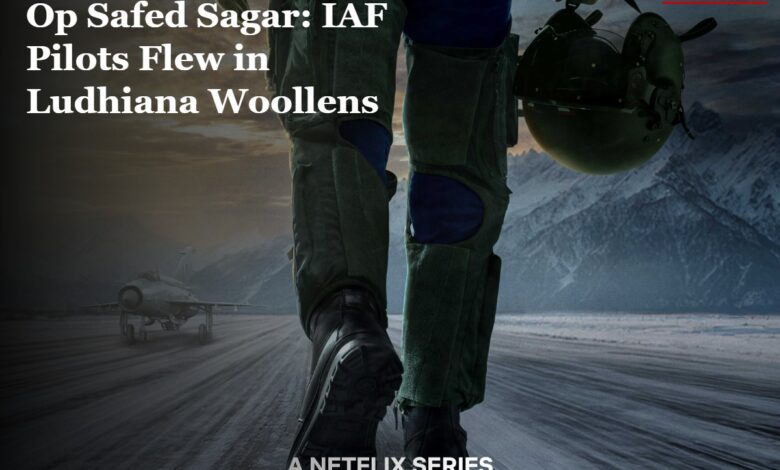
Operation Safed Sagar: IAF’s Golden Arrows squadron flew Kargil War sorties at 15,000 ft in Ludhiana-made woollens, lacking cold-weather gear even as Netflix’s Operation Safed Sagar revives the story.
North Desk Correspondent
Chandigarh, August 19
Twenty-seven years after Operation Safed Sagar, a detail from the Kargil War’s air campaign is surfacing that even the standard military histories and the web series have largely missed: the Indian Air Force’s fighter pilots, flying combat sorties at altitudes above 14,000 feet, did so without proper extreme-cold-weather flying gear. Instead, they wore ordinary woollen inners manufactured in Ludhiana, tucked under their regular flying overalls.
Operation Safed Sagar :The account comes from Air Chief Marshal (retd) B.S. Dhanoa, who commanded No. 17 Squadron — the “Golden Arrows” — during the 1999 conflict, and whose own trajectory from MiG-21 squadron leader to IAF chief is now being retold to a new audience via Netflix’s six-episode war drama Operation Safed Sagar, in which Jimmy Shergill plays him on screen.
Operation Safed Sagar: A Punjab squadron, forward-deployed
Operation Safed Sagar: The Golden Arrows were not new to the region. The squadron’s home base was Bhisiana Air Force Station, near Bathinda, and it was from there that the unit was forward-located to Srinagar as the scale of the Pakistani intrusion across the Line of Control became clear in May 1999.
Then-Wing Commander Dhanoa moved the bulk of his squadron and aircraft north within days, though a handful of pilots — among them Flying Officer C.H. Bal Reddy, who has separately written about the period — were initially retained at Bathinda to man the Operational Readiness Platform before joining the rest of the unit in Srinagar.
It’s against this backdrop that Dhanoa’s account of the equipment gap lands with particular weight for Punjab: a squadron based in Bathinda, fighting a war at Himalayan altitudes it was never designed or clothed for.
Why the clothing mattered
Operation Safed Sagar: The altitude gap was severe. Srinagar sits at roughly 5,000-5,500 feet; the targets the squadron was hitting in the Kargil sector were at 14,000-15,000 feet. Without specialised extreme-cold-weather flying suits, pilots went up in what amounted to civilian winter wear — Ludhiana-made woollen inners under their standard flying overalls.
That detail became more than incidental on 27 May 1999, the day Squadron Leader Ajay Ahuja’s MiG-21 was hit. According to Dhanoa’s account, Ahuja’s aircraft suffered a flame-out — not a direct missile strike — after his engine ingested exhaust gas from his own cannon fire while manoeuvring for a second strafing pass, a known hazard at altitudes where thin air already limits the oxygen available for combustion. With his engine dead, Ahuja chose to glide the aircraft rather than eject immediately, a decision Dhanoa says was deliberate: at 15,000 feet, without the right cold-weather gear or time to acclimatise, an ejection risked death by exposure even if the landing itself was survived. The squadron had, in effect, decided in advance that pilots hit at that altitude would try to stay with the aircraft and glide toward lower ground rather than eject into terrain that could kill them anyway.
Ahuja glided his crippled MiG-21 toward the Indus river, buying himself options — a sharp turn back toward India, or a shallower turn into a valley. He was hit while orbiting near the search area for a separately downed pilot, Flight Lieutenant K. Nachiketa, drifting into the engagement envelope of a shoulder-fired missile while trying to help pinpoint Nachiketa’s location for a rescue. Ahuja ejected, came down across the Line of Control in Pakistan-occupied Kashmir, and was killed after capture. He was awarded the Vir Chakra posthumously.
The bigger picture
Operation Safed Sagar: Kargil is well documented as a war the IAF fought with equipment not built for its terrain — ageing MiG-21s pressed into mountain strike roles, a political ban on crossing the LoC, and tactics improvised in real time. The absence of proper high-altitude flying gear fits that pattern, though it’s a detail that has had far less airtime than the aircraft and tactics themselves.
Despite the odds, a victory
Operation Safed Sagar: What stands out, set against this account of make-do gear and razor-thin margins for error, is that the Golden Arrows and the wider IAF still delivered. Flying ageing MiG-21s never designed for high-altitude strike missions, without the specialised cold-weather equipment the terrain demanded, and under the political constraint of not crossing the Line of Control, the squadron kept flying sortie after sortie through the war’s most dangerous weeks.
By mid-July 1999, sustained IAF strikes had helped force Pakistani troops off the Kargil heights, and No. 17 Squadron emerged from the conflict as one of its most decorated units. Ahuja’s death and Nachiketa’s capture were the war’s heaviest personal costs for the Golden Arrows — but the squadron’s sorties, flown in conditions this account suggests were tougher than official histories usually credit, were part of what turned the tide
Dhanoa has spoken about the Ahuja episode before, including at the 2019 “Missing Man” formation flypast he led at Bhisiana to mark twenty years since Ahuja’s death — attended by Ahuja’s wife Alka and son Ankur. But the specific detail of Ludhiana-made woollens as the pilots’ only defence against Himalayan cold, at the exact moment they were flying some of the most consequential sorties of the war, adds a distinctly Punjab thread to a story that is, at its core, about a squadron that trained and lived in this region before it flew into a war it was under-equipped for.
ALSO: Satyendar Jain Arrest: Punjab Elections Timing Under Scrutiny
ALSO: Hawara Parole U-Turn: Punjab Police Opposed It Months Ago, Now Mann Meets Governor
Follow North Desk on WhatsApp for the latest from Punjab, Haryana and Himachal Pradesh: https://whatsapp.com/channel/0029Vb7ccdxJENy2H87DBG3E