Satyendar Jain Arrest: Punjab Elections Timing Under Scrutiny
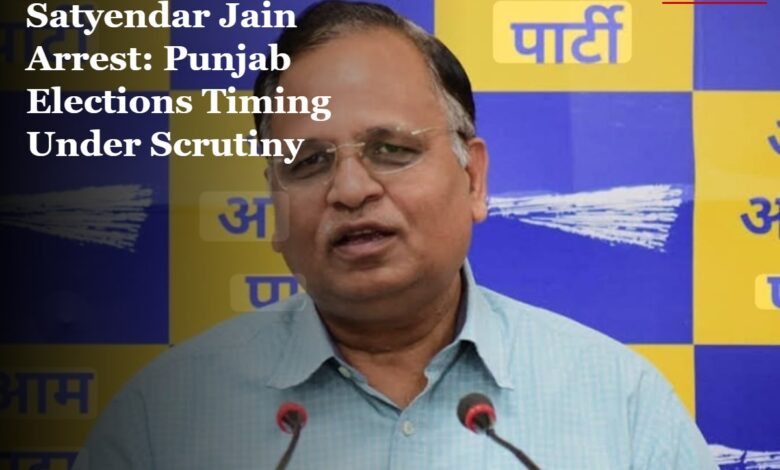
Satyendar Jain arrest comes as AAP’s Punjab co-in-charge faces a DJB tender case with an ED prosecution complaint already on record — ahead of Punjab elections.
North Desk Bureau
Chandigarh, August 19
Satyendar Jain, the Aam Aadmi Party’s co-in-charge for Punjab, was arrested by the Delhi Anti-Corruption Branch (ACB) on the evening of August 18, 2026, along with five others, in a corruption case linked to Delhi Jal Board (DJB) sewage treatment plant tenders — roughly six months out from Assembly elections in the state Jain has been tasked with steering for AAP.
Satyendar Jain Arrest: It is at least the third time in four years that an agency action against Jain has landed in the run-up to a state election where he held an AAP organisational charge. In 2022, he was arrested by the Enforcement Directorate a day ahead of PM Narendra Modi’s visit to Himachal Pradesh, where Jain was AAP’s election in-charge. This time, the FIR predates the arrest by over two years — but the timing, coming as Punjab heads to the polls, has again put the case at the centre of a familiar political argument between AAP and the BJP.
Satyendar Jain Arrest: what ACB and ED allege
Satyendar Jain Arrest: The FIR at the heart of the arrest was registered on May 11, 2024, on a complaint by the Directorate of Vigilance, Government of NCT of Delhi, alleging large-scale irregularities in DJB’s tendering process for augmentation and upgradation of ten sewage treatment plants (STPs) — at Pappankalan, Nilothi, Najafgarh, Keshopur, Coronation Pillar, Narela, Rohini and Kondli — originally estimated at around ₹1,546 crore.
According to the ACB, the investigation found that technical specifications in the tenders were made restrictive — mandating a specific treatment technology — in a way that favoured Hyderabad-based Euroteck Environment Pvt Ltd, limiting the field to three joint ventures across four tenders. Investigators also allege a proposed pilot study was skipped, and that corrigenda were exchanged between private parties and officials before being folded into the tender documents.
The ACB says its financial trail shows funds moving from entities linked to the technology provider to a firm owned by one of the arrested accused, and from there to former DJB CEO Udit Prakash Rai (IAS) and his relatives — around ₹1.52 crore, allegedly later used to buy property.
Jain was Delhi’s Water Minister and DJB chairman when the tenders were floated and awarded. The other five arrested are Rai; Ankit Srivastava, a former contractual consultant with DJB who had earlier advised Jain during his tenure as minister; and three private contractors — Nagendra Yadav, Raja Kumar Kurra and Pankaj Verma.
Notably, this is not a case starting from scratch. The Enforcement Directorate, which is separately probing the same tender allegations under the Prevention of Money Laundering Act, had already filed a prosecution complaint against 14 people, including Jain, in December 2025, estimating proceeds of crime in the case at around ₹17.7 crore. That distinguishes this arrest from Jain’s 2022 case, where AAP’s “fake case, eight years old” framing had more traction because the underlying FIR long predated any formal charge.
AAP’s response: a scripted defence, with a Punjab twist
Satyendar Jain Arrest: AAP’s reaction followed the pattern established over Jain’s, Kejriwal’s and Manish Sisodia’s earlier arrests: the case is “fake,” the BJP is running a “dictatorship,” and “the cup of sins is full.” National convenor Arvind Kejriwal, Manish Sisodia, Sanjay Singh, Saurabh Bharadwaj, Atishi and Anurag Dhanda all issued statements within hours, most invoking Jain’s prior 2022–2024 incarceration as proof this arrest, too, would eventually be “exposed as false.”
What is specific to this arrest, though, is the Punjab framing. Sisodia explicitly tied it to the Assembly election: “Punjab co-in-charge Satyendar Jain has been arrested… cornered on multiple fronts [Gen Z movement, Ram Temple donation allegations, E20], the BJP has once again fallen back on its old electoral tactics of using the ED, ACB and CBI.” Sanjay Singh made the same point more bluntly, linking it to the recent arrest of Sanjeev Arora and “indiscriminate raids” in Punjab, framing the sequence as pressure ahead of the state vote.
Dhanda’s specific factual claim — that the tender was issued in October 2022, after Jain was already jailed in May 2022 in the earlier PMLA case, and that he therefore “could not be responsible” — is worth flagging as a claim under active dispute rather than settled fact: the ACB’s case centres on the tendering process and conditions, and investigators have not (as of this arrest) detailed which specific decisions they attribute to Jain or when.
Satyendar Jain Arrest: Stakes for Punjab
Three things:
Jain runs AAP’s Punjab operation. His removal from the campaign trail — even temporarily — affects organisational bandwidth for a party defending its only state government, sacrilege-related political pressure, and reported unease within its own ranks in Punjab.
The Arora precedent. Sisodia and Singh’s statements both link this arrest to the earlier arrest of Sanjeev Arora, suggesting AAP sees — or wants to project — a pattern of Punjab-linked functionaries being targeted.
The 2022 Himachal parallel. Readers with a memory of the Himachal Pradesh campaign will recall the near-identical playbook — an ED arrest timed just ahead of a Modi visit, when Jain was that state’s AAP in-charge. Whether this is coincidence, pattern, or something ACB/ED would dispute is a question being talked about.
ALSO: 14-Year-Old Girl Strangled by Father, Grandfather Over ‘Suspicion’ She Met a Boy
ALSO: Hawara Parole U-Turn: Punjab Police Opposed It Months Ago, Now Mann Meets Governor
Follow North Desk on WhatsApp for the latest from Punjab, Haryana and Himachal Pradesh: https://whatsapp.com/channel/0029Vb7ccdxJENy2H87DBG3E





One Comment