Fact Check: Punjab Govt's DA Defence Is What It Already Told the Court -- And Lost
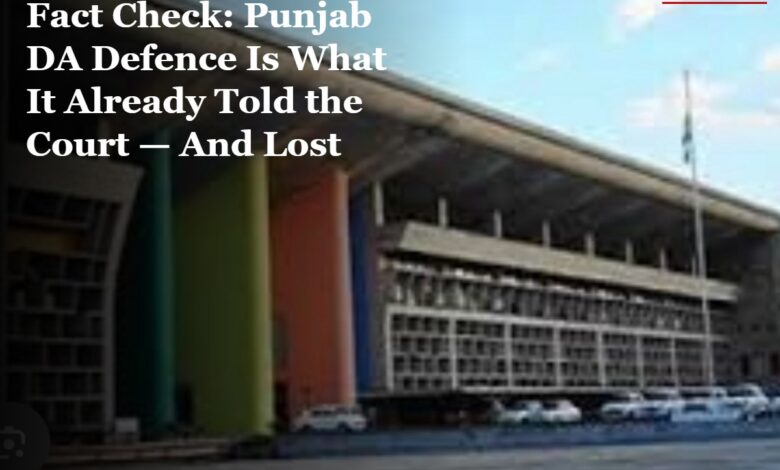
A Punjab DA fact check by North Desk: The govt’s Aug 3 statement on employee salaries repeats arguments it made in court — and the High Court rejected every one.
Arvind Chhabra
Chandigarh, August 4
The Punjab govenment’s August 3 press statement repeats, almost word for word, the arguments its own lawyers made in the Punjab and Haryana High Court. The court’s 76-page judgment, delivered the same day, rejected each one. Here’s a North Desk Fact Check and claim-by-claim comparison.
Punjab DA Fact Check: Hours after the Punjab and Haryana High Court ordered the state to pay all pending Dearness Allowance (DA) arrears within 15 days, the Punjab Government put out a statement defending its position — that its employees already earn more than their Central counterparts, that DA rates can’t simply be matched to the Centre, and that fixing DA is the government’s own sovereign call.
What the statement doesn’t mention is that this is almost exactly the case the state’s own senior lawyers argued in court — and that the Division Bench of Acting Chief Justice Ashwani Kumar Mishra and Justice Rohit Kapoor dealt with each of these points directly in its judgment. We checked each claim against the court record.
ALSO READ: AAP Slams Centre Over Paper Leaks While Congress Demands Bains’ Resignation
Punjab DA Fact Check by NORTH DESK
CLAIM 1: “Punjab employees already receive salaries 30% to 70% higher than the Centre, so a lower DA percentage doesn’t mean less money in hand.”
Did Punjab argue this in court? Yes.
Punjab DA Fact Check: This was one of the central planks of the state’s defence, argued by senior advocate D.S. Patwalia on behalf of the government:
“…the comparison sought to be made by the respondents on the basis of the percentage rate of Dearness Allowance (DA) alone is wholly misconceived… Consequently, even where the percentage rate of DA under Government of Punjab may presently be lower than the rate admissible under Government of India, the actual salary drawn in absolute monetary terms continues to remain comparatively higher in several categories.”
PSPCL’s senior counsel Chanchal K. Singla repeated the same point in near-identical language:
“…salaries of PSPCL employees and State of Punjab are much more than the Centre Government employees, so the comparison in percentage terms is irrational.”
What did the employees say?
Punjab DA Fact Check: The employees’ senior counsel, Sanjay Kaushal, called this a selective, cherry-picked comparison:
“…such a selective factual assertion is wholly misconceived, as the same is based upon the comparison of only four-five posts, which does not reflect the position across the majority of the spectrum of employees, which is proven from the fact that the report of the 6th PPC does not record any such findings, after analysing the entire data, across the board.”
Notably, today’s government statement lists exactly five posts — Clerk, Driver, Stenographer, ETT Teacher and Constable — which is the same “four-five posts” pattern the employees’ side told the court not to rely on.
What did the court rule?
Rejected. The Bench held that basic pay and DA are simply not comparable in the way the government was framing it:
“The plea regarding employees of State of Punjab getting higher aggregate salary in the few representative categories demonstrated through comparative charts, proceeds on a comparison, which the controversy does not invite… Basic pay and DA are answers to different questions. The first fixes the value of the post, the second protects that value against inflation, and a surplus in the first is no justification for confiscating the second.”
The court added that the same Pay Commission that gave Punjab employees their higher basic pay also recommended the Central DA pattern — and the state can’t accept one part and reject the other:
“The Pay Commission which recommended the pay matrix is the same Commission which recommended continuation of the Central DA pattern. The State accepted both limbs together, and cannot retain the limb it finds convenient while discarding the other.”
Verdict: Already argued, already rejected.
CLAIM 2: “The higher Central DA rate cannot be applied on top of Punjab’s already higher pay scales — the two pay structures cannot be combined.”
Punjab DA Fact Check: Did Punjab argue this in court? Yes, in substance.
This is essentially the same “absolute salary vs percentage DA” argument as Claim 1, made through comparative pay charts placed before the court.
The state’s position was that once its higher basic pay is factored in, adding full Central DA rates on top would make Punjab employees earn even more than Central employees — creating a fresh disparity in the other direction.
What did the employees say?
Their claim, as recorded by the court, was never about matching total salaries — only about the DA component:
“The writ petitioners never claimed parity of total emoluments with Central or Haryana Government employees. Their claim is that the State must release DA computed on the standard the State itself adopted, upon the pay structure, the State itself framed.”
What did the court rule?
Rejected, for the same reason as Claim 1 — basic pay and DA serve different purposes and can’t be offset against each other. The court also pointed out that the state’s own charts, meant to prove its case, actually proved the opposite:
“…the appellants’ own composite chart, tracing every Punjab DA revision to the corresponding rung of the Central 7th CPC series, is perhaps the best documentary proof of the adoption of the pattern which the appellants simultaneously deny.”
Verdict: Already argued, already rejected.
CLAIM 3: “Fixation of Dearness Allowance is a sovereign policy decision of the State Government.”
Did Punjab argue this in court? Yes.
The state’s counsel devoted a full section of arguments to the “limited scope of judicial review in fiscal policy,” relying on Supreme Court rulings including BALCO Employees’ Union and Narmada Bachao Andolan:
“Much emphasis has been laid on the limited scope of Judicial Review in matters of Fiscal Policy. It is argued that in the absence of any rules for granting same rate of DA, without any time lag, at par with the Central rate, amounts to directly exposing fiscal policy of the State to judicial review…”
What did the employees say?
Their response was that this was never a case about the court setting policy — only about enforcing a policy the state had already chosen and repeatedly acted on for five years:
“…once the rates of DA/DR were adopted, it partakes the character of an enforceable right and the same cannot be denied on the plea of financial crisis.”
What did the court rule?
Rejected — the Bench drew a clear line between “making policy” and “enforcing policy already made”:
“…the impugned judgment does not formulate fiscal policy. It does not fix a rate of DA of the Court’s choosing… To the contrary, it enforces the standard which the State itself chose in 2021 and has applied ever since…”
“…when there is a valid law requiring the Government to act in a particular manner, the Court ought not to permit deviation from it, for the Government, too, is not above the law.”
The court also directly addressed the idea that non-payment can be justified by calling it a policy choice:
“The deference doctrine protects the making of choices; it does not protect the indefinite non-performance of choices already made.”
Verdict: Already argued, already rejected.
CLAIM 4: “Punjab already bears the highest salary and pension burden among major states; paying this will squeeze funds for development.”
Did Punjab argue this in court? Yes, with the same figures.
PSPCL’s senior counsel placed before the court the exact numbers now being cited in the press statement:
“…the annual salary and pension outgo of the State is approximately Rs. 58,064.05 crores during the FY 2025-2026 (Revised Estimates)… the State of Punjab is already bearing a disproportionately high fiscal burden towards employee compensation.”
What did the employees say?
They pointed to the state’s own spending choices as undercutting this argument:
“…when it is explicit that the State is squandering funds by distributing freebies and huge amounts are being wasted on large-scale advertisement campaigns, while withholding the legitimate dues of the employees, then the Constitutional Courts will have to take cognizance of the same…”
What did the court rule?
Rejected. The Bench held that a large bill is not the same as an impossible one, and that financial hardship cannot be used to withhold money already legally owed:
“The figures placed before us, i.e., an annual salary and pension outgo of approximately Rs. 58,064.05 crore, and an arrear liability of Rs. 14,191 crore, establish the magnitude of the obligation, not the impossibility of performing it… Financial constraint may be a relevant consideration in structuring a scheme prospectively, but it is no answer to the enforcement of benefits which have accrued under an adopted standard.”
The court went a step further, specifically calling out the state’s spending on advertising and freebies while pleading poverty on employee dues:
“…large scale advertising campaigns in print or social media and other unproductive expenses cannot justify denial of dues admissible to the State employees.”
Verdict: Already argued, already rejected — and specifically countered by the court’s own advertising-spend order.
The bottom line
Every major argument in the Punjab Government’s August 3 statement — the higher-basic-pay defence, the “can’t combine two pay structures” logic, the “sovereign policy” claim, and the fiscal-burden argument — was placed before the Punjab and Haryana High Court by the state’s own senior counsel and PSPCL’s counsel during the hearings. The court considered each one at length across a 76-page judgment and rejected all of them, upholding the single judge’s order directing payment of DA arrears within a fixed timeline, with 6% interest for any delay.
The statement does not mention that these arguments were already tested — and did not succeed — in court.
OUR RELATED STORIES:
Read ALSO: Govt Fixes Retirees’ Gratuity, Core Arrears Order Still Pending
ALSO: Punjab Opposes DA To Its Staff, Tells HC: The 2021 Promise Was Just An ‘Endeavour’
Punjab High Court Rejects its ‘No Money’ Plea, Orders Full DA Payment by June 30
Follow North Desk on WhatsApp for the latest from Punjab, Haryana and Himachal Pradesh: https://whatsapp.com/channel/0029Vb7ccdxJENy2H87DBG3E

3 Comments