PM Modi Flags Off India’s First, World’s ‘Most Powerful’ Hydrogen Train
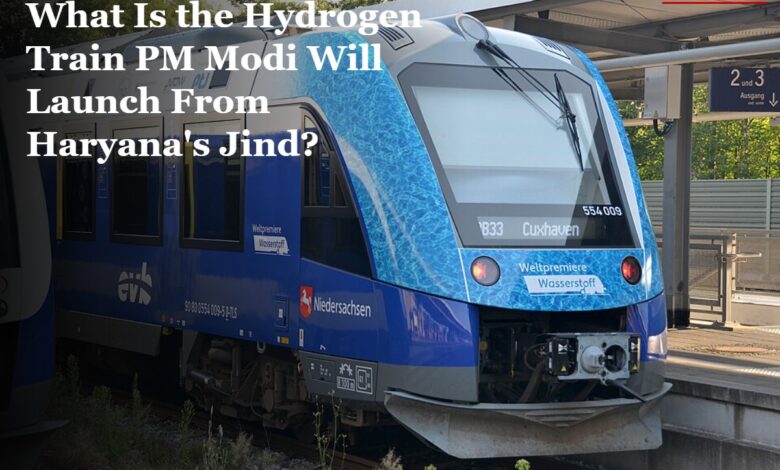
Hydrogen Train: PM Modi flagged off India’s first hydrogen-powered train from Jind on Friday. How it works, cost, route, fuel cell tech, and the localisation questions — a full Q&A explainer. (Story Filed on July 10, updated on July 15 and then on July 17)
North Desk Correspondent
Jind, July 17
The hydrogen train running between Jind and Sonipat is the most powerful hydrogen train in the world, said Prime Minister Narendra Modi as he flagged off India’s first hydrogen train from Jind on Friday. “This hydrogen train has 3,200 horsepower. Not only the most powerful, India’s hydrogen train is also the longest. In other countries, hydrogen trains run with three or four coaches. But India, in its very first attempt, has run a 10-coach hydrogen train, planting its flag in the world.”
Modi said, “India’s hydrogen train is not only smoke-free, it is also a shining example of Make in India. This hydrogen train has been designed by Indian engineers and built by an Indian company.”
Q: What did Prime Minister Modi launch on July 17?
Prime Minister Narendra Modi on Friday, July 17, flagged off India’s first hydrogen-powered train connecting Jind to Sonipat in Haryana.
With this, India has joined a select group of countries that have operational hydrogen-powered trains and marks an important step towards the adoption of clean and sustainable mobility in the railway sector.
The 89-km distance between Jind and Sonipat will be covered in two hours, with the train halting at 12 intermediate stations Hydrogen Train.
Q: How does a hydrogen train actually work?
Instead of diesel, the train generates electricity through a chemical reaction between hydrogen and oxygen, producing only steam and heat as by-products — no smoke, no carbon emissions. This electricity powers the train’s traction motors, essentially the same way an electric train runs, except the electricity is generated onboard rather than drawn from overhead wires.
Q: What’s the power and capacity of this train?
It runs on a 1,200-kilowatt hydrogen fuel cell propulsion system and has two driving power cars and eight passenger coaches, giving it 682 seats and total passenger capacity of 2,600. It has undergone trials at speeds ranging from 75 kmph to 120 kmph over the past two-and-a-half months between Sonipat, Jind and New Delhi.
Q: How fast will it run, and how far on one fill?
The train is designed to safely reach a maximum speed of 110 kmph, though its operational speed on the Jind-Sonipat route will be 75 kmph. On a full hydrogen fill, it can travel approximately 250 km.
Q: How much hydrogen does it consume, and where does the fuel come from?
Hydrogen Train: At maximum passenger load and operating conditions, it will consume about 300 kg of hydrogen per day. A 3,000-kg hydrogen storage and fuelling facility is being set up at Jind to supply the train. The fuel itself will come from a green hydrogen plant being built at Jind.
Q: Is it safe?
Around 27 hydrogen cylinders have been installed on the train, along with hydrogen leakage detectors, fire detectors and modern control systems that will be regularly inspected.
Q: Who built it, and where?
The hydrogen train was designed by the Lucknow-based Research Designs and Standards Organisation (RDSO) and manufactured at the Integral Coach Factory (ICF) in Chennai. The project, undertaken by Northern Railway, involved converting two conventional diesel power cars into hydrogen fuel cell-powered traction systems.
Q: Is the technology fully Indian-made?
Not entirely. While the railcar and coaches are built at ICF, the fuel cell (the actual engine that combines hydrogen with oxygen to generate electricity) is where the indigenous story thins out. An earlier pilot retrofit programme awarded to Medha Servo Drives ran on modules from Canada’s Ballard Power Systems, built on proton-exchange membrane stack technology India doesn’t manufacture domestically. The Jind trainset has reportedly used fuel cell systems from Tata Advanced Systems, though that sourcing isn’t officially confirmed, and even Tata’s fuel-cell work has historically relied on imported stacks. Efforts toward genuine localisation — an Adani-Ballard MOU to explore PEM manufacturing in India, a Hyundai HTWO research centre coming up at IIT Madras, and a BHEL tie-up with Singapore’s Horizon Fuel Cell Group — remain at the stage of memoranda and research centres rather than actual production.
Q: Where else in the world do hydrogen trains run?
Not nearly as popular as the “India joins Germany, Japan, China” framing suggests. The reality is more of a cautionary tale than a bandwagon:
Germany pioneered commercial hydrogen rail — the world’s first entered service in Lower Saxony in September 2018, and by August 2022 an entire line at Bremervörde ran exclusively on hydrogen trains. But the story has since turned: Lower Saxony pulled most of its 14 Coradia iLint units out of service in late 2024, and German regional operators have signalled future orders will favour battery-electric trains instead. Because the economics haven’t held up against batteries on most routes.
Japan began fare-paying tests of its FV-E991 hydrogen train on the Tsurumi Line back in 2022 but hasn’t scaled the programme since.
China, via manufacturer CRRC, has been running test operations on a hydrogen passenger train but hasn’t moved into volume production.
France has moved slower than initially planned on hydrogen train.
South Korea has a supply contract for 38 hydrogen fuel-cell trams for Daejeon Metro Line 2, but that line isn’t expected to enter service until 2028.
The United States got its first hydrogen train running (the Arrow service between San Bernardino and Redlands, California) in September 2025.
Italy is now preparing its own hydrogen line on the Brescia: Iseo–Edolo railway in Lombardy, a €367 million project combining trains with production and refuelling infrastructure.
So the honest picture: this is a small, struggling club, not a proven mainstream technology. Hydrogen rail works (the physics isn’t in question) but the operating economics have been tough against battery-electric alternatives on most routes, and the supplier base is genuinely wobbling. Cummins, whose fuel-cell stacks powered Germany’s original iLint trains, has since sold off its fuel-cell business after heavy losses, with the rail piece going to Alstom.
Q: What did this project cost?
Haryana Chief Minister Nayab Singh Saini puts the trainset cost at approximately Rs 141 crore, with a power output of around 2,400 kilowatts. The power figure likely reflects the combined output of both driving power cars rather than a single unit.
Q: What will tickets cost?
Fares will range from Rs 5 to Rs 25, priced in line with the existing DMU service it’s replacing on this route.
Q: Why does this matter politically?
This marks Modi’s first visit to Jind in nearly 12 years; he last visited here October 2014, when he addressed an election rally after Jat leader Birender Singh joined the BJP. The Jat-dominated district has long been seen as a political bellwether in Haryana, and observers view this visit as significant ahead of Punjab’s assembly elections next year.
CM Saini: Safety Clearance Secured”
Writing in The Tribune ahead of the July 17 launch, Chief Minister Nayab Singh Saini said the train has completed its trial run and received formal approval from the Chief Commissioner of Railway Safety (CCRS) — the regulatory clearance required before any new train type can carry passengers. Saini’s column frames the project as proof of “Atmanirbhar Bharat” and indigenous engineering capability, and describes the train as among the world’s longest hydrogen-powered trains running on broad-gauge track, and among the most powerful in Indian Railways’ fleet.
Follow North Desk on WhatsApp for the latest from Punjab, Haryana and Himachal Pradesh: https://whatsapp.com/channel/0029Vb7ccdxJENy2H87DBG3E
READ ALSO: PM’s Punjab, Haryana Visit Under Shadow of Khalistan Threat




4 Comments