Jaswant Singh Khalra case: HC Enhanced Jail Term From 7 Years To Life; CBI hadn’t Even Appealed
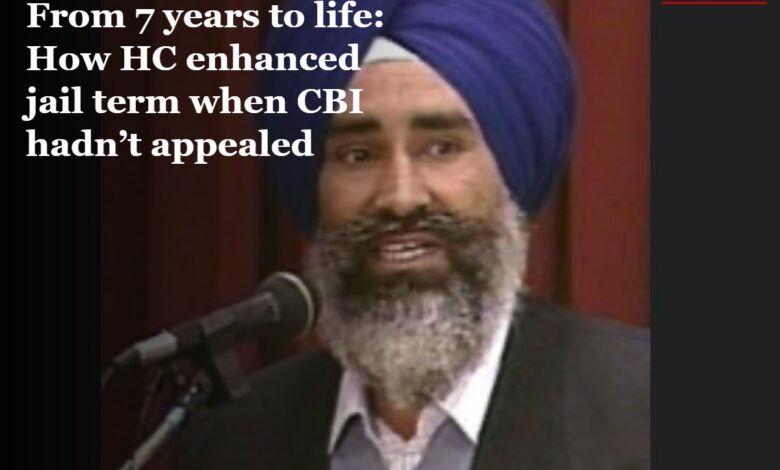
Jaswant Singh Khalra case: Punjab and Haryana High Court used a rare suo motu power to enhance four Khalra case convictions from 7 years to life, and the Supreme Court upheld it. Full story.
North Desk Correspondent
Chandigarh, July 9
Satluj, Diljit Dosanjh’s film on human rights activist Jaswant Singh Khalra, was pulled from ZEE5 within 48 hours of its release earlier this month, with no explanation given. As North Desk continues working through the original court records behind the case, one moment stands out that neither the film nor the news coverage of its removal has told: a High Court using a rare legal power to overrule its own instinct toward leniency, over the direct objection of the defence — and a Supreme Court, years later, refusing to undo it.
Who Khalra was, briefly
Jaswant Singh Khalra was a bank employee and human rights activist who, in the mid-1990s, began investigating the illegal cremation of thousands of unidentified bodies by Punjab Police during the state’s militancy years. He was abducted from outside his Amritsar home on September 6, 1995, held illegally, tortured, and killed. His body was never recovered — thrown, according to witness testimony, into a canal near Harike. The Supreme Court eventually confirmed that CBI investigators had documented 2,097 unlawful cremations in Tarn Taran district alone, corroborating what Khalra himself had already found and publicised before his death.
How the Jaswant Singh Khalra case reached sentencing
Jaswant Singh Khalra case: The CBI chargesheeted nine police officers in 1996, with SSP Ajit Singh Sandhu named as the principal accused. Sandhu died in 1997, in a death recorded as suicide, before he could be formally charged. Of the remaining accused, some died during the long trial, one was discharged for lack of evidence, and the case eventually proceeded against a group that included DSP Jaspal Singh and officers Satnam Singh, Surinderpal Singh, Jasbir Singh, Prithipal Singh, and Amarjit Singh.
In November 2005, the Additional Sessions Judge in Patiala convicted the accused. Jaspal Singh, DSP, and Amarjit Singh, ASI, were convicted under Section 302 (murder) and sentenced to life imprisonment. But four other officers — Satnam Singh, Surinderpal Singh, Jasbir Singh, and Prithipal Singh — were convicted only under Section 364 IPC, abduction with intent to murder, and given seven years’ rigorous imprisonment each. Given that these men had helped abduct, detain, and were present through Khalra’s torture and killing, seven years struck Khalra’s widow, Paramjit Kaur, as grossly inadequate to what the court itself had found they’d done.
Paramjit Kaur takes on the sentence herself
Jaswant Singh Khalra case: Paramjit Kaur filed Criminal Revision petition in 2006 before the Punjab and Haryana High Court, asking the court to enhance the sentences of these four officers. This was not a small ask, legally speaking — and the defence fought it on exactly that ground.
Senior defence counsel argued the revision wasn’t even maintainable. Their argument: under Section 377(2) of the Code of Criminal Procedure, the power to appeal for a harsher sentence in a case investigated by a central agency belongs solely to that agency (in this case, the CBI) not to a private complainant like Paramjit Kaur.
Since the CBI itself had not sought enhancement, the defence argued, no court should be entertaining her request to increase the punishment at all. They further argued that the revision had been admitted in 2006 without proper notice to the accused, making the entire proceeding, in their words, “a nullity.”
READ ALSO: Jailed in Same Cell Who Saw Everything–The Story of Khalra Witness Kulwant Singh
How the High Court got past the objection
Jaswant Singh Khalra case: The Bench of Justices Mehtab S. Gill and A.N. Jindal didn’t dispute the narrow reading of Section 377(2). Instead, they pointed to a different provision entirely: Section 386(e) of the Cr.P.C., which gives a High Court an independent power to enhance a sentence on its own initiative, regardless of who filed the appeal, or whether anyone specifically sought it under Section 377. The Court stated this directly in its order: “Learned counsel are overlooking this fact that it is not only under Section 377 Cr.P.C. where an appeal can be filed by the State Government against the sentence, but under Section 386(e) of the Cr.P.C., the Court has the suo motu power to enhance the sentence.”
In effect, the Court treated Paramjit Kaur’s revision as the occasion that brought the case back before it — but once the case was before it, the Court held it had its own separate authority to revisit the sentence, independent of any procedural defect in how the enhancement request had arrived.
Why the Court decided seven years wasn’t enough
Jaswant Singh Khalra case: The Court’s reasoning on the merits was direct rather than technical. It found that the evidence — Khalra’s abduction, his illegal detention at Jhabal police station, the torture, and his eventual killing — established something more serious than a routine abduction: “Intention of the appellants/respondents was clear. Deceased was abducted so that his life is extinguished.”
Given that finding, the Court held that the seven-year sentence handed down for abduction alone did not reflect the actual gravity of what these four men had done, since abduction was in every practical sense the beginning of a killing, not a standalone act.
In October 2007, the High Court enhanced the sentences of Satnam Singh, Surinderpal Singh, Jasbir Singh, and Prithipal Singh from seven years’ rigorous imprisonment to imprisonment for life. Their fines were left unchanged.
The Supreme Court had the chance to undo it — and didn’t
The convicted officers appealed the enhancement to the Supreme Court. In its 2011 judgment in Prithipal Singh & Ors. vs. State of Punjab, a two-judge Bench comprising Justices P. Sathasivam and Dr. B.S. Chauhan reviewed the entire case — the original convictions, the acquittal of Amarjit Singh on appeal, and the High Court’s enhancement — and found no reason to interfere with any of it. The Supreme Court’s judgment states plainly: “We do not find any reason to interfere with the well reasoned judgment and order of the High Court. The facts of the case do not warrant review of the findings recorded by the courts below.” The appeals were dismissed. The life sentences stood.
Rare moment in court
Jaswant Singh Khalra case: Sentence enhancement on a court’s own initiative, especially over a direct defence argument that the process used to get there was procedurally improper, is not something Indian appellate courts do often. It reflects two levels of the judiciary independently concluding that the punishment on record understated what the evidence showed: officers who didn’t simply grab a man off the street, but who abducted, detained, tortured, and ultimately killed a human rights activist for exposing what the state itself would later confirm as a mass, illegal disposal of thousands of bodies. For a case that already took sixteen years to reach its final word from the Supreme Court, the enhancement stands as one of the few moments in the entire record where the courts moved further, and more decisively, than the law technically obligated them to.
Follow North Desk on WhatsApp for the latest from Punjab, Haryana and Himachal Pradesh: https://whatsapp.com/channel/0029Vb7ccdxJENy2H87DBG3E
KHALRA FILES on North DESK:
READ ALSO: Jaswant Singh Khalra Had Named His ‘Killer’ To An Ex-Judge Before Abduction
READ ALSO: Cops Disposed Of Jaswant Singh Khalra’s Body. Then They Had Whisky, Dinner
READ ALSO: The Cop Who Fed Khalra His Last Meals…And Whose Words Convicted His Killers
READ ALSO: Jailed in Same Cell Who Saw Everything–The Story of Khalra Witness Kulwant Singh





One Comment