Gurcharan Singh Tohra On Khalra: Tohra’s Telegram That Reached The Supreme Court–North Desk SPECIAL
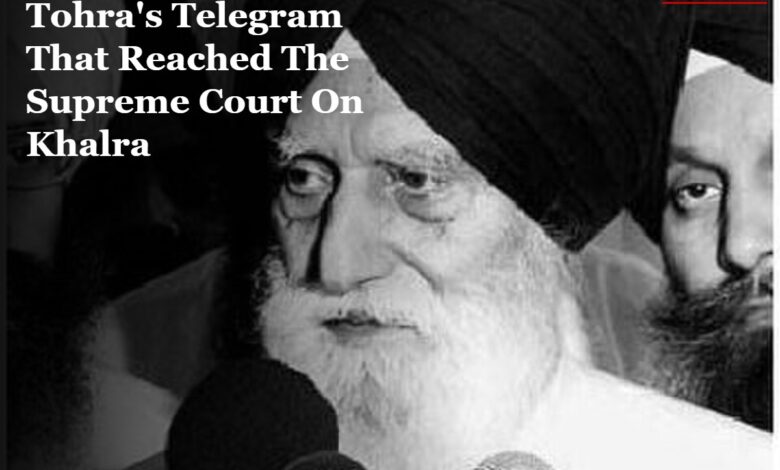
Gurcharan Singh Tohra On Khalra: Days after Jaswant Singh Khalra vanished in 1995, a telegram from SGPC president Gurcharan Singh Tohra reached the Supreme Court, and was treated as a habeas corpus petition.
Arvind Chhabra
Chandigarh, July 16
Within five days of disappearance of human rights activist Jaswant Singh Khalra, the Court had already opened a case file on it, triggered not by his wife’s petition, but by a telegram from then Shiromani Gurdwara Parbandhak Committee (SGPC) president Gurcharan Singh Tohra.
About Khalra and the issue
If you’re coming to this fresh: Jaswant Singh Khalra was a bank manager and General Secretary of the Human Rights Wing of the Shiromani Akali Dal who, in the early 1990s, exposed something Punjab Police did not want exposed. Using the cremation grounds’ own firewood-issue registers, he documented that thousands of young men picked up during the insurgency years (branded “unidentified militants”) had been secretly killed and cremated without any legal process, their bodies never claimed, their deaths never recorded. He went public with the findings. On September 6, 1995, he was dragged out of his house in Amritsar by men in police uniform. He was never seen alive again.
That case is back in the news in 2026 because of Satluj, a film based on Khalra’s life that was released on ZEE5 and then pulled amid political controversy — a takedown that has renewed public attention on the case and on where the men convicted of killing him are today.
North Desk’s Khalra Files series has covered several threads of it: the DSP convicted of the murder who can no longer be found at his own registered address, the witness whose testimony helped convict the killers, the killers currently out on bail. This is a thread that hasn’t been told yet: about a man who was never an accused, and never a witness in the courtroom sense, but who put his own name behind Khalra’s disappearance at the very top of the Indian judicial system, within days of it happening.
Who was Gurcharan Singh Tohra
Gurcharan Singh Tohra On Khalra: For close to three decades, Gurcharan Singh Tohra was president of the SGPC, the elected body that runs Sikh gurdwaras across Punjab and, with that, controls enormous religious, political and financial influence in the state. He was, alongside Parkash Singh Badal, one of the two or three most powerful figures in Akali politics through the turbulent 1980s and 90s, and remained SGPC president almost without interruption until his death in 2004. Khalra was a party colleague of sorts (General Secretary of the Akali Dal’s own Human Rights Wing) which is presumably why, when Khalra started getting threatened for his cremation-ground findings, he raised his fears not just with a retired judge but with Tohra directly.
READ ALSO: ASI Amarjit Singh: From Life Term For Killing KHALRA To Acquittal
Gurcharan Singh Tohra On Khalra: The telegram
Gurcharan Singh Tohra On Khalra: The records quote an actual Court order, passed in September, 1995— five days after Khalra’s abduction — by a bench that included Justice Kuldip Singh. It records that a telegram had been received “at the residence office of one of us,” sent by Gurcharan Singh Tohra, stating that Jaswant Singh Khalra, General Secretary of the Human Rights Wing of the Akali Dal, had been kidnapped by the police.
The bench’s response was unusually direct: it treated the telegram itself as a habeas corpus petition, and issued notice to the Director General of Police, Punjab, and the Senior Superintendent of Police, Amritsar, returnable within a week — with instructions that they be served not just by the ordinary court process but by telex and telephone too, given the urgency.
Gurcharan Singh Tohra On Khalra: The order also records that Khalra’s wife, Paramjit Kaur, had a petition of her own before the same bench around the same time — the petition that got the CBI handed the investigation after the Court found Punjab Police had failed to make any headway. Tohra’s telegram was later formally annexed to her habeas corpus petition as supporting material.
What this shows, essentially, is how fast and how high the alarm went. This wasn’t a case that took months to register as suspicious — within less than a week of Khalra vanishing, the country’s apex court had a file open on it, prompted in part by one of the most powerful men in Sikh institutional politics putting his name on a telegram saying, in as many words, that the police had done this. And yet it would take the CBI’s investigation, a decade-long trial, a High Court appeal and finally a 2011 Supreme Court verdict before anyone was actually held to account.
Follow North Desk on WhatsApp for the latest from Punjab, Haryana and Himachal Pradesh: https://whatsapp.com/channel/0029Vb7ccdxJENy2H87DBG3E
KHALRA FILES on North DESK:
READ ALSO: The DSP Convicted For Killing Khalra Cannot Be Found At His Address
READ ALSO: Jaswant Singh Khalra Had Named His ‘Killer’ To An Ex-Judge Before Abduction
READ ALSO: Cops Disposed Of Jaswant Singh Khalra’s Body. Then They Had Whisky, Dinner
READ ALSO: The Cop Who Fed Khalra His Last Meals…And Whose Words Convicted His Killers
READ ALSO: Three Of Khalra’s Convicted Killers Are Out On Bail Right Now — Here’s Why
READ ALSO: Jailed in Same Cell Who Saw Everything–The Story of Khalra Witness Kulwant Singh
READ ALSO: Punjab Truth Commission Explained: What It Is, Who Wants It, Why Now
READ ALSO: ASI Amarjit Singh: From Life Term For Killing KHALRA To Acquittal